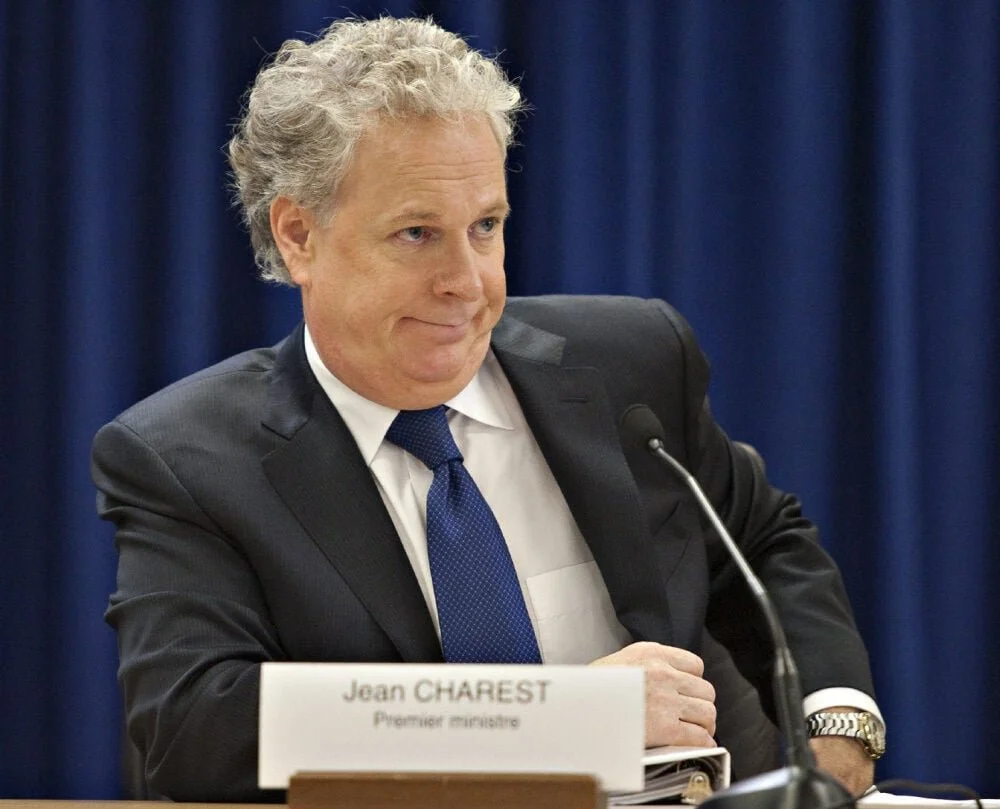
The corruption of the Jean Charest years in Quebec has not ceased to exist.
No political leader has been convicted following the Commission of Judge France Charbonneau of the Superior Court of Quebec, police investigations that costed taxpayers a lot of money and led essentially nowhere, and close associates of Jean Charest continue to perpetrate the same fraudulent behaviours described during the Charbonneau Commission.
Broadly speaking, the same modus operandi has been reproduced by managers of the Faculty of Law at the University of Sherbrooke, Marie-Pierre Robert, Louis Marquis, and Sébastien Lebel-Grenier, in the granting of teaching contracts to lecturers, practices that have been denounced since 2022.
Impunity, nepotism, favouritism, judicial protectionism offered to those denounced, and false judicial and quasi-judicial decisions rendered by judges and arbitrators in conflicts of interests still infect the "justice" system of the province of Quebec in 2026.
Let us recall what the Premier of Quebec, Paul St-Pierre Plamondon, stated in June 2020 about corruption :
"Lack of accountability in matters of corruption is the worst thing that we can do in our society.
Me, I’ve been a lawyer in Bolivia in corruption and human rights. Then, I’ve been involved, in fact, I’ve contributed in a way to start the Charbonneau Commission. We planted broomsticks in front of the National Assembly so that the corruption of the (Jean Charest’s) liberals stops. And then, I participated in follow up Committee on the recommendations made by the Charbonneau Commission, saying "This costed $44 millions of dollars. We will have results, and then change things after an overwhelming evidence of the level of corruption we have lived during the Charest years."
And then, we've just learnt yesterday that Marc Bibeau, the Liberal Party's big money man, who collected millions of dollars and who was instrumental in the granting of contracts, he organised cocktail parties at his house, where engineering firms obtained contracts in exchange of their donations, he also had Jean Charest's ear, he was involved in the staff nomination, nominations of ministers. Marc Bibeau, after 7 years of police investigation by the Permanent Unity Against Corruption (UPAC), that was going nowhere, will not be subjected to criminal prosecutions.
$44 millions of dollars for the Charbonneau Commission, and other millions of dollars for the UPAC.
And in the end, who is responsible? Who will pay the price? What is the message for the future?
What is the message for the future politicians when we realise that in fact, they can cheat and steal, and that, in the end, there are no consequences?
Because it is not true that we invested millions of dollars, poured in so much energy and came this close to get rid of the corruption, so that they continue on with the corruption and willful ignorance.
I am telling you, after having been involved for so many years in cases of corruption, one of my priorities will be the fight against corruption and the fight against lies in general.
I think we need to put an end to lying in Quebec. A first step is to put our foot down in terms of fight against corruption.
As what we are seeing at the moment, the fact that no one is held accountable after the Charbonneau Commission and all the UPAC’s work, is unacceptable.
We have to ask the government for results, a change of direction.
I think it is essential.”
For the younger ones who did not live through the “Charest years” or for those who do not remember them, let us recall the journal article published by Professor Gilbert Larochelle from the University of Quebec in Chicoutimi in 2013 in Presses universitaires de France, titled “Quebec Under the Grip of Corruption”, which summarises the minimum necessary to begin understanding the modus operandi of what happens in the shadows in Quebec :
“The use of bakchich (bribery) undoubtedly represents one of the greatest threats to democracy today. The word itself, originally from Persian, then adopted in Arabic and Turkish, has its equivalent in all cultures. In Italy, it is called a bustarella, in Mexico a mordida, in Spain it is soborno, and the mafia also uses the term pizzo. The French language abounds with euphemisms that revolve around the notion of a "bribe". As for the reality that these various expressions refer to, it is now the most widely shared thing in the world. A true plague on a global scale, corruption is no longer the domain of some obscure and poorly dressed potentate in distant lands. It wreaks havoc and erodes public institutions to the core in all Western countries. Quebec is not exempt from it. Indeed, for the past few years, a poisonous atmosphere has reigned there, marked by the revelation of dubious practices, the uncovering of embezzlements, and even a subversion of democracy and its rules. The weekly magazine Maclean's headlined its October 4, 2010 issue on Quebec : “The most corrupt province in Canada,” echoing the exact words of historian Samuel P. Huntington's observation in his 1968 comparison of Australia, Great Britain, the United States, and Canada. Indignations erupted from all sides, to denounce this as a prejudice, or even as a recurrence of the eternal dispute between Anglophones and Francophones. However, the formula now seems less far-fetched in light of the troubling revelations of the Charbonneau Commission, established in 2011 to investigate corruption in the “Beautiful Province”.
A brief history of corruption incidents before Jean Charest
“The phenomenon is not new. Quebec entered modernity in the late 1960s through the struggle of intellectuals against the corruption of Maurice Duplessis’s regime (1936-1939; 1944-1959). Strengthened by a rationalisation of political institutions and the establishment of a public administration founded not on influence peddling but on impartial rules and the depersonalisation of state services, the Quiet Revolution was supposed to equip Quebec with a bureaucracy immune, in principle, to abuses, extortion, and shady dealings. The same period of the 1960s and 1970s was also one of intensive development of infrastructure in Quebec. The construction sector experienced unprecedented growth, especially with the ambitious program of major projects such as the 1976 Olympic Games, the Montreal Metro, the Mirabel Airport, the Trans-Canada Highway, not to mention the monumental works in Northern Quebec to bring to life the James Bay hydroelectric dams. The most tangible signs of corruption appeared again, but this time in the fierce competition between Quebec's three main labour federations – the Quebec Federation of Labour (the “Fédération des travaillerus du Québec” - FTQ), the Confederation of National Trade Unions (the “Confédération des syndicats nationaux” - CSN), and the Confederation of Democratic Trade Unions (the “Centrale des syndicats démocratiques” - CSD) – first to gain the allegiance of workers, and then to exert, through the workforce, a certain control over the construction sector. The intensive marauding quickly degenerated into widespread corruption, with the use of intimidation, blackmail, threats, and violence, culminating in this pivotal event : the sacking of the James Bay Dam on March 21, 1974, where angry workers, infiltrated by organised crime, destroyed equipment. The damage amounted to 30 million Canadian dollars. In response to these acts of subversion, the Government of Quebec established the Cliche Commission the same year, with a mandate to clean up the construction sector, purge corrupt practices among unions, employers, contractors, and public servants. Judge Cliche was supported by two brilliant young lawyers : Brian Mulroney, future Prime Minister of Canada (1984-1993), and Lucien Bouchard, future Premier of Quebec (1996-2001). The journalist Gisèle Tremblay described the hearings as "a parade of Fellini-esque characters caught in the act in the most diverse roles at the call of a seasoned director". Among the Commission's conclusions, it was proposed that Quebec establish a recurring mechanism to investigate, every ten or fifteen years, in order to thwart the inevitable resurgence of scandals and schemes of all kinds.”
Corruption under Jean Charest (2003-2012)
“The recommendation, of course, went unheeded. But the political pathology of corruption did not cease to thrive, with symptoms accumulating until the late 2000s when the media took an interest in it, beginning to unravel the threads of the tangled web one by one. What they revealed defies the wildest imagination : corruption of public officials, rigged bids in public contracts to favour unscrupulous contractors, false invoicing, the establishment of a system based on collusion or complicity to evade the exercise of free competition, illicit financing of political parties through the subterfuge of rebates deducted from the cost of financing construction projects, organisation of so-called “turnkey” municipal elections by engineering consulting firms, suspicious ties between union leaders and construction magnates, partisan appointment of judges, and, above all, control by the mafia of major infrastructure projects. And we must not forget the classic and inherent lures of the genre itself : dubious accounting, sumptuous meals, trips abroad, etc.
Three remarks are necessary, at first glance, regarding the method employed, the full extent of which would be revealed gradually starting 2008. On one hand, the tentacular logic of corruption is astonishing due to the multiplicity of schemes put in place to siphon off public funds. We would discover that these were not individual, isolated, and sporadic acts, but rather a genuine system with a network of collaborations extending in both the business world and the state administration. On the other hand, one must observe the extraordinary effectiveness of this same system in neutralising whistleblowers who could have thwarted the schemers' operations, denouncing the circulation of "under-the-table" dealings, and attempting to enforce the requirements of normalcy. Finally, the mafia's grip — especially the Sicilian Rizutto clan — shows that its influence now extends well beyond the marginalised spheres where it is mistakenly believed to be confined : prostitution, drugs, gambling, illegal betting, and so on. On the contrary, its reconversion and even its infiltration into the heart of the Quebec economy now attest to its ability to influence the levers of power to make political decisions that conform to its interests. And the government is the primary provider of work in the construction sector, a $50 billion annual industry.
A Radio-Canada journalist, Alain Gravel, was the one who fired the first shot. His show titled Enquête questioned in 2008 the high expense accounts of the general director of the FTQ Construction union, Jocelyn Dupuis. He then discovered, on restaurant receipts, the name of Raynald Desjardins, former right-hand man of mafia godfather Vito Rizzuto. A first link was established between a union and the mafia. Then came another rather strange discovery : the president of the same union, Michel Arseneault, had stayed in the Bahamas on the luxurious yacht of the wealthy construction entrepreneur Tony Accurso.”
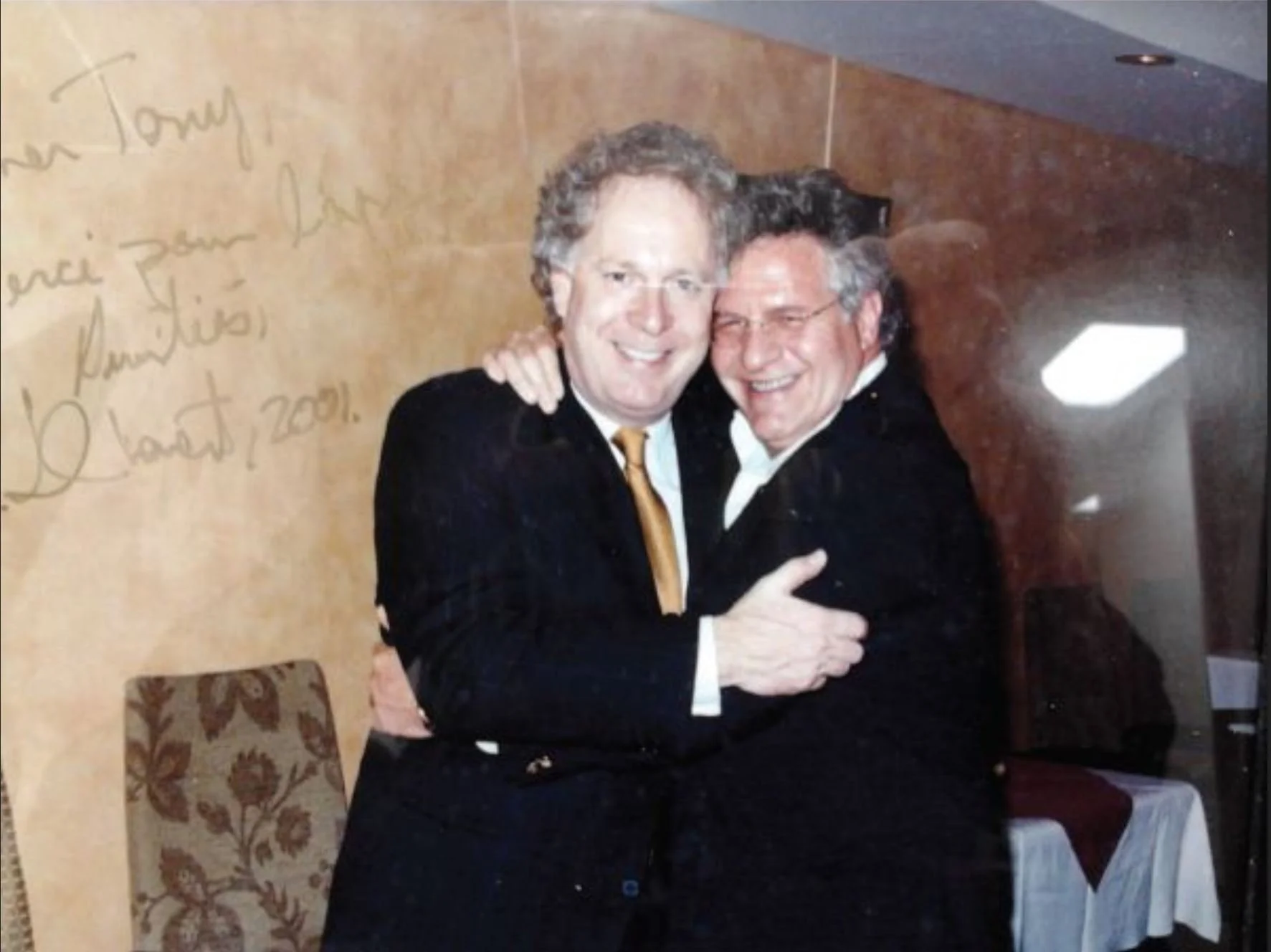
Jean Charest and Tony Accurso, 2001
“It should also be noted that this union has a capitalisation fund of $8.5 billion dollars called the “FTQ Solidarity Fund,” acquired with Quebecers’ tax credits and used to finance various companies in all sectors of the economy. And Accurso was one of the beneficiaries of this money to build his empire. A second dubious relationship was thus established between a union and the big business elite. In April 2009, information emerged that left all observers of the political scene speechless. It was revealed that the chairman of the City of Montreal’s executive committee, Frank Zampino, the second most important in the municipal hierarchy after Mayor Gérald Tremblay, had also been invited onto Tony Accurso’s yacht at the time when one of Accurso’s companies was bidding on a lucrative contract. Another link was added to the chain of events, this time between the political class and the collusion of the construction barons. These disclosures, seemingly anecdotal, nevertheless contained the matrix of everything that would come out later. And Accurso's yacht became, in the collective imagination, the symbol of the complicity of the actors involved in the tragedy.
The nervousness was palpable in the highest political circles of the Government of Quebec. As early as spring 2009, the opposition parties united to demand an inquiry commission in the construction industry. Over the following months, other voices rose up to demand that the truth be revealed and that the scent of scandal be dissipated : officers from the Sûreté du Québec and those of the City of Montreal, the Order of Engineers of Québec, the Association of Crown Prosecutors, and even the union federations suspected of involvement in corruption. We all remember the devastating effect the Gomery Commission (2004-2005) had on the Liberal Party of Canada, and whose work brought to light embezzlements amounting to $332 million dollars. Keeping in mind the lesson from this experience known as the "sponsorship scandal," Jean Charest's administration preferred to multiply palliative measures to cope with the ever-increasing pressure from public opinion and various intermediary bodies. The "Hammer" (“Marteau”) squad was established in 2009 so that the police could identify fraudulent practices in the construction industry. In February 2010, while 74% of Quebecers were calling for a public inquiry, the Government of Quebec announced the creation of an "Anti-Collusion Unit" whose mandate would be "to ensure close surveillance of markets, to prevent fraud, collusion, embezzlement, and to establish mechanisms for detecting collusion. Far from calming things down, the situation worsened when, in 2010 and 2011, two ministers, Tony Tomassi and David Whissel, were accused of favouritism and were forced to resign.
However, the ultimate safeguards of democracy have not ceased to operate and counterbalance the prevailing cynicism. Indeed, civic engagement on the streets has been relentlessly strenghtened, the parade of highly publicised arrests of construction magnates and their vassals had legthened, so much so that the noose tightened around the entire industry. It was estimated that infrastructure project prices in Montreal had fallen by 30% since the launch of the "Hammer" squad, as if the octopus, alerted by the ongoing purges, knew it was being watched from all sides. The year 2011 lifted the last obstacles to the implementation of measures to clean up the construction sector; first, with the creation, in February, of the "Permanent Anti-Corruption Unit" (UPAC), and then, in a dramatic turn of events, with the creation of the Charbonneau Commission, 927 days after the opposition parties first demanded it in the National Assembly of Quebec. The hearings began in September 2012 and they offer Quebecers a reality show like no other, where tragedy rivals comedy, crime rivals celebrity, the false innocent rivals the self-proclaimed guilty. The first witness, Lino Zampito, a disgraced businessman and repentant corruptor, set the stage with disarming candor, by revealing that the mafia takes 2.5% of all infrastructure contracts in Montreal and that another 3% goes, through obscure channels, to the mayor's political party. Those who followed him are no exception : they all convey the image of a trivialisation of corruption, of the normalisation of duplicity in the use of public funds.”
“What to think of the narrative of horrors unfolding before our eyes, like the plot of a bad movie? First, in the short term, it undoubtedly fuels the rise of cynicism and distrust towards political elites, inducing in citizens a feeling of powerlessness, which is so contrary to the very principle of democracy. It contributes to portraying Quebec as a society that fails to live up to its modernity, incapable of establishing institutions to ensure the morality of the public sphere.”
- Prof. Gilbert Larochelle, University of Quebec in Chicoutimi
In 2025, Judge France Charbonneau, who chaired the commission on corruption in the granting of public contracts by the Government of Quebec under Prime Minister Jean Charest, stated that :

"It was worse than anyone thought. Everyone was stunned. First, by what we managed to prove and by what was actually happening." "No one saw any problems with the bribes and everything that was being given, everything that was being exchanged. No one saw any problem with that." "They didn't see the Codes of Ethics, what they should and shouldn't do, and what placed them in conflicts of interests."
"Witnesses had told us that after receiving a certain amount of contracts, someone from the Party would come to them and say, 'Well, now you have to pay up’."
Judge France Charbonneau also essentially expressed her disappointment that organised crime and corruption are here to stay in Quebec, describing the 2020s as "hard times for justice" :