Claudiu Popa
All publications in this series :
-
-
-
-
-
-
Coming soon
-
Coming soon
-
-
-
English version coming soon.
French version available here : https://www.claudiu-popa.com/publications-juridiques/decoder-la-fraude
(if you open the link with Google Chrome browser, it automatically translates the article in English)
How do people in positions of authority act when they do not want their reprehensible actions to be discussed?
They create a diversion.
They employ a ruse.
They divert attention away from the sensitive issue by generating another topic of discussion, hoping that the rest will be forgotten. Diverting attention from the real problem in order to talk about something else of lesser importance or gravity for them; this is essentially what the two managers of the Faculty of Law of the University of Sherbrooke, Dean Louis Marquis and Dean Marie-Pierre Robert, did (directly and indirectly, notably through subordinates) once they were caught with fraudulent schemes in the granting of teaching contracts.

From left to right : Louis Marquis (Dean from January 2020 to December 2023) and Marie-Pierre Robert (Vice-Dean from 2015 to 2019 and Dean from January 2024 to present) of the Faculty of Law of the University of Sherbrooke. (Sources : Centre de recherches juridiques de Franche-Comté and University of Sherbrooke).
In the first article of this series (available here : https://www.claudiu-popa.com/about-the-university-environment/fraudulent-schemes-teaching-contracts-faculty-of-law-university-of-sherbrooke-1-marie-pierre-robert-louis-marquis-sebastien-lebel-grenier), three main schemes were mentioned. The first article focused primarily on the third scheme (the violation of the rule of 5 years of professional and/or teaching experience, the minimum requirement for a candidate to be hired as a lecturer).
This second article addresses the other two fraudulent schemes (the violation of the seniority rules and the false representations regarding the internal hiring procedure of the Faculty of Law), as well as the ruse employed by the managers of the Faculty of Law to divert the discussion as far as possible from these schemes.
Understanding the schemes that have been used to violate institutional seniority rules
To understand how the seniority rules have been violated, one must first understand what the rules are, as set out in the Lecturers’ Collective Agreement [1].
The collective agreement for lecturers at the University of Sherbrooke stipulates that from the moment lecturers receive and execute their first teaching contract, they accumulate seniority points (1 seniority point is equivalent to 45 hours of teaching, which is the usual duration of a course at the Faculty of Law of the University of Sherbrooke, spread over a 4-month term) :
Section 13.01 : From their first engagement, the lecturer accumulates seniority for the purposes of course assignment, in accordance with the procedure outlined in Chapter 14 [including sections 14.09 b) and 14.09 c)]. […]
At University of Sherbrooke, a lecturer accumulates two types of seniority : specific seniority (on a particular course) and overall seniority (which is the sum of all specific seniorities).
The management of the Faculty of Law of the University of Sherbrooke is contractually obligated, by the Lecturers’ Collective Agreement, to grant teaching contracts to lecturers in accordance with the seniority rules :
Section 14.09 b) : if one or more lecturers have seniority on the course, the course is assigned to the candidate with the most seniority on the course. […] In all cases where the candidates have equal seniority on the course, the course is assigned to the candidate with the most overall seniority;
Section 14.09 c) : if no lecturer has seniority on the course, the course is assigned to the candidate with the most overall seniority;
The rules are quite simple.
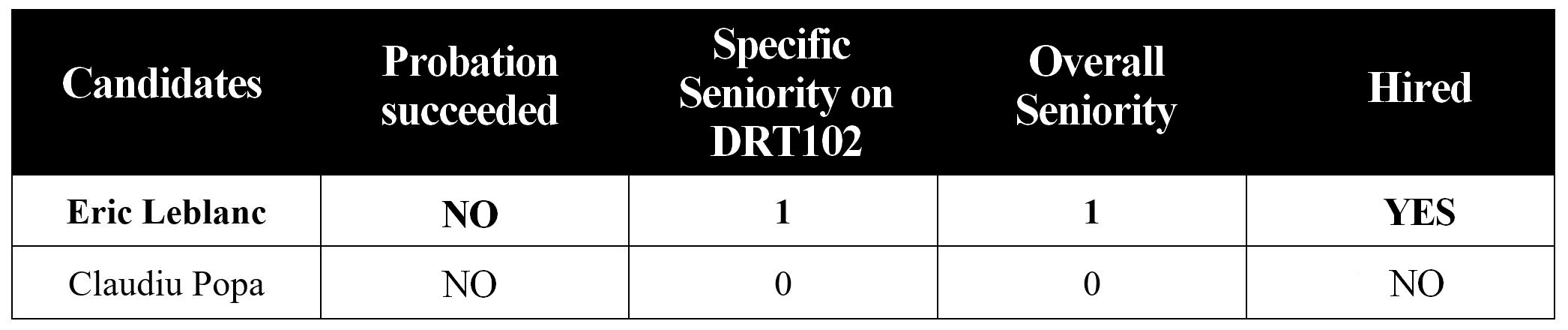
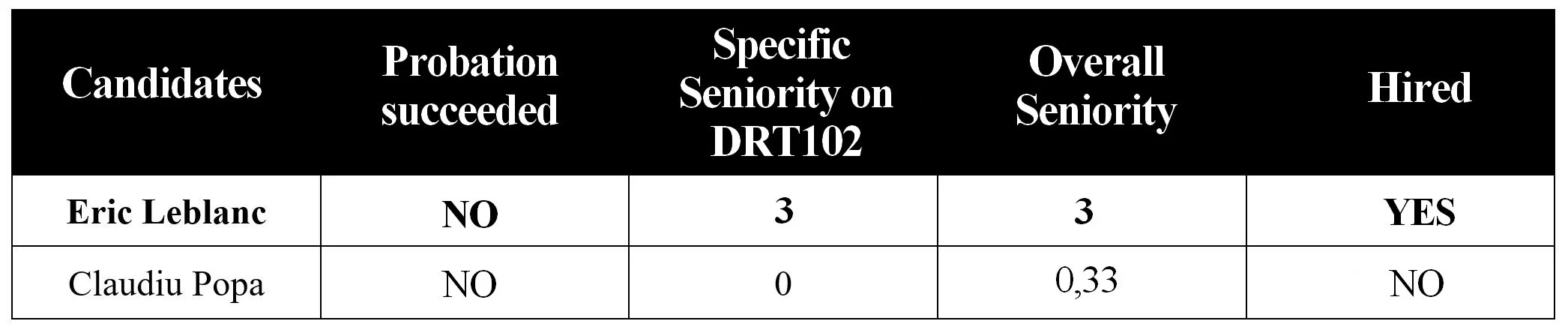
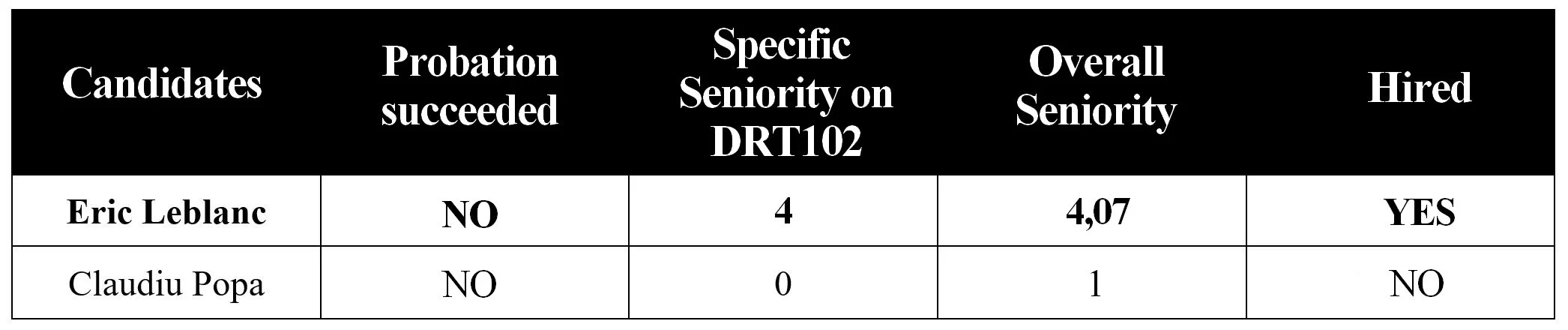
Let us look at some examples regarding the application of seniority rules for granting teaching contracts, when the hired candidate had more institutional seniority than me on the course DRT102 General Criminal Law :
Teaching contract granted in 2015 for the January-April 2016 session :
Teaching contract granted in 2016 for the January-April 2017 session :
Teaching contract granted in 2017 for the January-April 2018 session :
Now, let us look at some edifying examples of how the managers of the Faculty of Law of the University of Sherbrooke clearly failed to apply these same seniority rules for the course DRT102 General Criminal Law, when I was the candidate with more seniority than the candidates that were hired :
Teaching contract granted in 2020 for the January-April 2021 session :
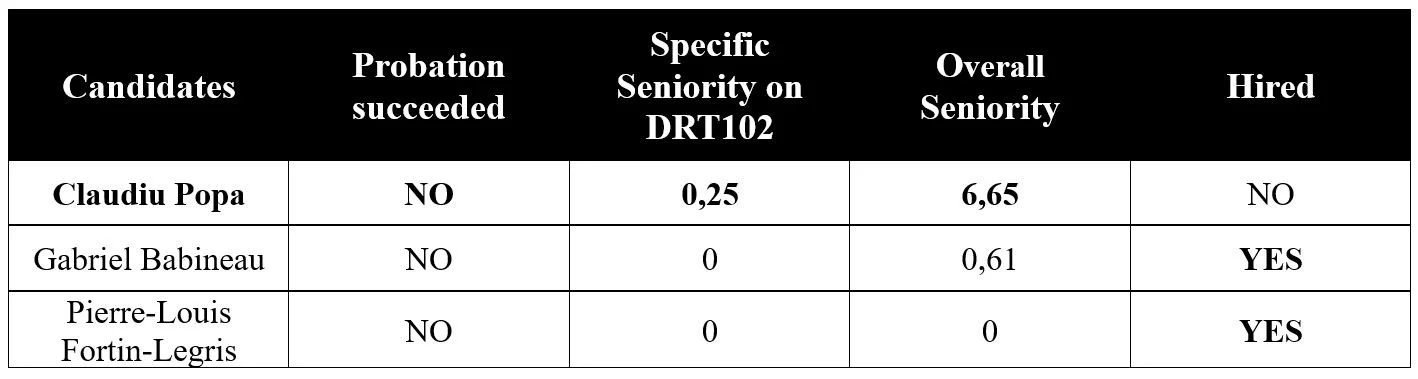
In this case, the faculty’s managers preferred to split in two the teaching contract for the DRT102 course to grant it to two different lecturers (one lecturer with no seniority on the course and the other lecturer with no seniority at all at the University of Sherbrooke – an external candidate), who each taught the equivalent of 6 of the 12 sessions of the course, rather than granting the contract to the lecturer who had specific seniority on this course and the most overall seniority points within the University among the 3 candidates.
I discussed this case with my doctoral thesis director at the time, Simon Roy, a professor of criminal and penal law who had been teaching the DRT102 course for almost 20 years at the Faculty of Law, and who later held the position of Associate-Dean at the Faculty of Law.
Initially, Professor Simon Roy had informed me that the position of lecturer for the first-year introductory course in criminal law (DRT102 General Criminal Law) had become available since Éric Leblanc, the lecturer who had held the position until then, had been dismissed from the Faculty of Law [2] (dismissal results in the loss of seniority points).
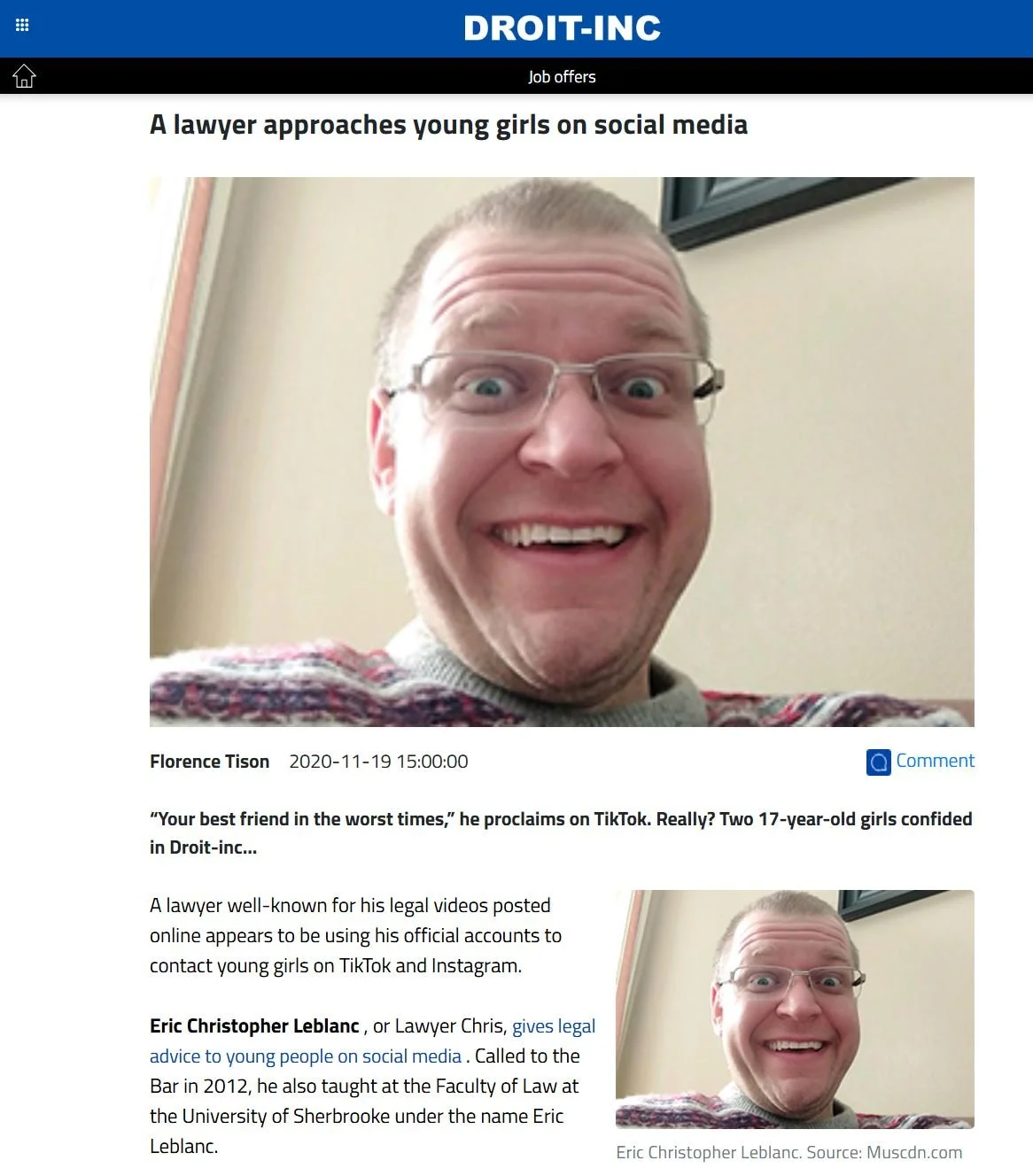
Source : Droit-inc https://www.droit-inc.com/conseils-carriere/nouvelles/un-avocat-aborde-des-jeunes-filles-sur-les-reseaux-sociaux. Original in French. English version provided by Google Chrome Browser.
Professor Simon Roy had also informed me that the Faculty of Law was still short of staff for this course, that I should request to be granted the course; given that I had seniority on the course, this contract would be granted to me.
However, inexplicably, the course was granted to two other lecturers.
When I informed Professor Simon Roy of this, he told me that the faculty managers should have respected the rules of seniority, which they did not do.
Professor Simon Roy also encouraged me to contact the faculty administration to ask for explanations, and to also contact the Lecturers' Union of the University of Sherbrooke (SCCCUS). This is what I did eventually. I will develop more on this later.
Following this incident, the faculty’s managers multiplied their abuses :
Teaching contract granted in 2021 for the January-April 2022 session :
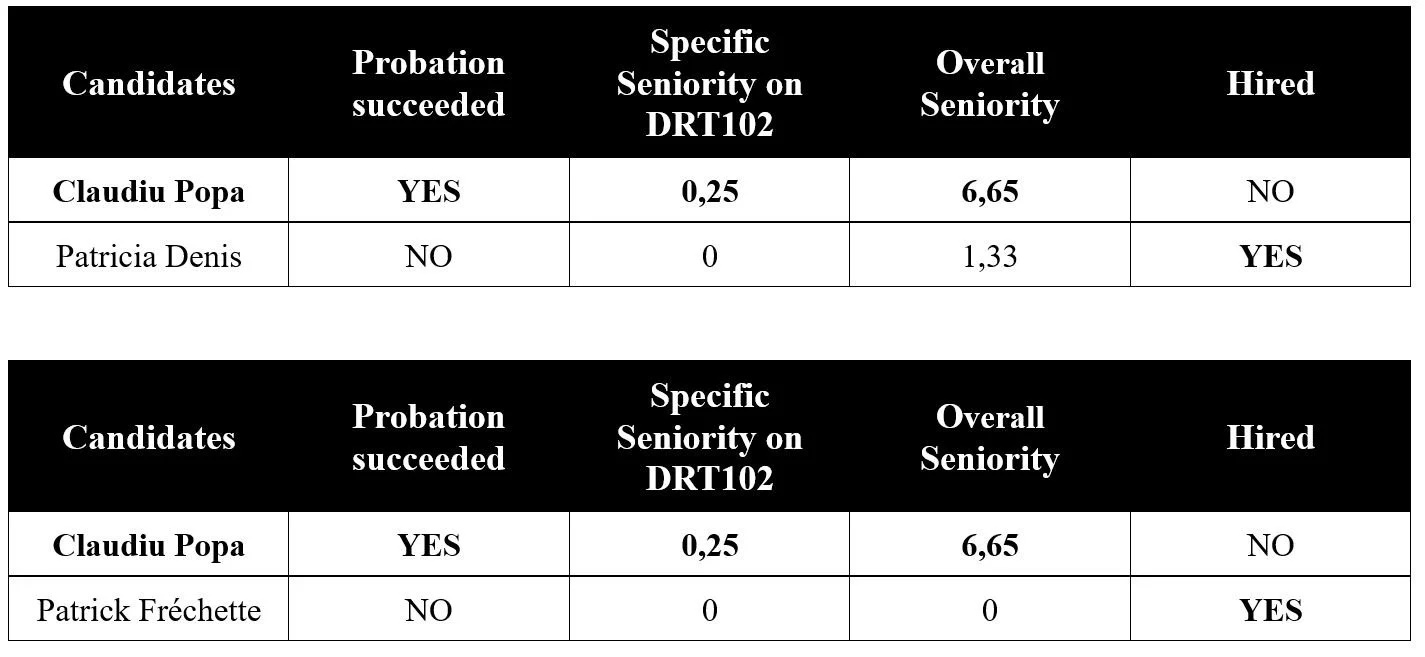
Teaching contract granted in 2022 for the January-April 2023 session :
Once I had identified and raised the issue of discrimination in the granting of teaching contracts concerning the criminal law course with the Lecturers’ Union (SCCCUS) (and since it was more than predictable that a discrimination complaint was coming), the faculty’s managers needed to "save face" regarding cultural and ethnic diversity and finally hire someone from an ethnocultural minority to teach criminal law. They turned to the Legal Aid network (of which Marie-Pierre Robert was a member of the board of directors of the Eastern Townships division, later becoming its president in 2023) and found someone (an external candidate from Legal Aid, with no institutional seniority whatsoever) who could fulfill the "order" (in violation of the rules of institutional seniority) :
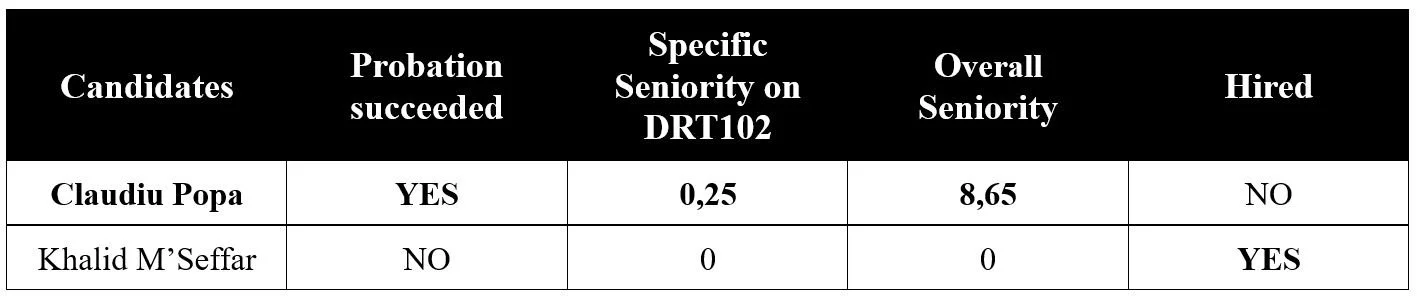
Teaching contract granted in 2023 for the January-April 2024 session :
Once the discrimination issues were “resolved” for the faculty’s managers with the help of the Lecturers’ Union (I will come back to this), old habits resumed and one of Marie-Pierre Robert’s former students from the Master’s Program in Criminal Law Practice was hired, still in violation of the institutional seniority rules :
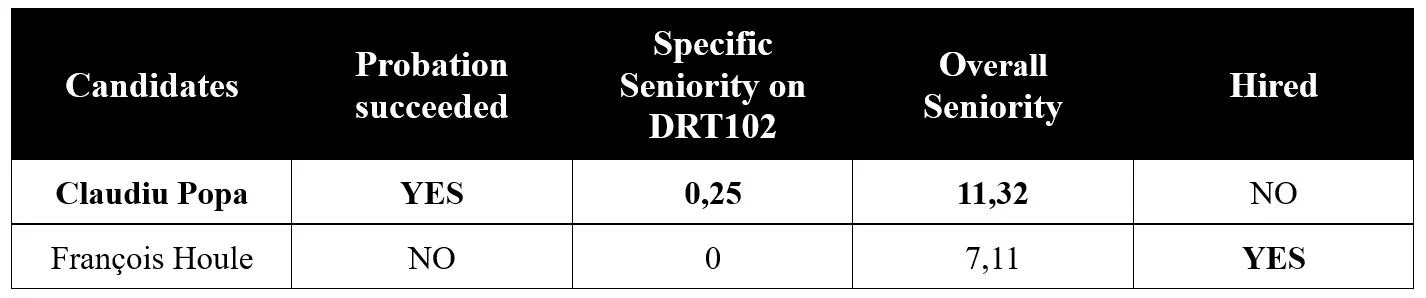
The administration of the Faculty of Law, officially informed
At the end of January 2022, I reported some of these findings to the faculty’s managers. Faced with the discovery of this type of recurring and repeated mismanagement, Dean Louis Marquis found himself in a situation where he had to make a choice : admit the problem and rectify it (settle the dispute by applying his field of expertise, the prevention and resolution of disputes, more commonly known as ADR, alternative dispute resolution), or resort to a false claim, a semblance of an explanation to evade responsibility (that of his own administration and of the previous administration of Dean Sébastien Lebel-Grenier and his Associate-Dean Marie-Pierre Robert).
He chose the second option.
Dean Louis Marquis claimed that the contract assignments would not be wrongful since (get this) the seniority rules would not apply to me, because seniority would only apply to lecturers "acknowledged as qualified on the course" and not to lecturers "not acknowledged as qualified on the course" and that, for this reason, he would not be obligated to grant the teaching contract to the candidate with the most seniority among the applications they received :

"The seniority to which you refer in your emails and the sections of the Collective Agreement you cite apply only to situations where several lecturers that have passed their probationary period are qualified on the same course, in which case seniority must be analysed. Otherwise, the analysis of the seniority does not need to be taken into consideration."
- Louis Marquis
Dean Louis Marquis's claim was essentially "pulled out of a hat" since the text of the Collective Agreement does not provide for such a thing.
Moreover, this claim did not make sense for several other reasons.
Whereas it is true that there are two categories of lecturers, "acknowledged as qualified on a course" and "not acknowledged as qualified on a course", it is incorrect to claim that the seniority rules would not apply to both categories.
What is a lecturer that is "acknowledged as qualified on a course"? A lecturer is "acknowledged as qualified on a course” after having successfully completed their probationary period (having taught 270 hours at the University of Sherbrooke [3]) and after having taught the said course 3 times (in which case the acknowledgement of qualification is "automatic" [4]) or if the lecturer submits an "application for acknowledgement of qualification" on the course to the faculty administration, after they successfully completed their probationary period (the acknowledgement of qualification is then granted "upon request" [5]).
Statistically, most lecturers at the Faculty of Law of the University of Sherbrooke are "not acknowledged as qualified" for the courses they teach. For example, for the 2022-2023 academic year, more than 70% of the Faculty of Law's teaching positions were assigned to lecturers who were not acknowledged as qualified on their respective courses.
*** The "acknowledgment of qualification" provided for in the Lecturers’ Collective Agreement should not be confused with the lecturer's professional qualifications, since most lecturers who are "not acknowledged as qualified" under the agreement may be highly qualified lawyers or notaries, holding master's degrees and even doctorates in law (even after 10, 20, or 30 years of professional experience in law, a lawyer or judge will be "not acknowledged as qualified" under the agreement when teaching their first 269 hours of courses at the Faculty of Law). ***
The difference between a "acknowledged as qualified" lecturer and a "not acknowledged as qualified" lecturer in terms of granting teaching contracts is that the "acknowledged as qualified" lecturer benefits from employment priority over the "not acknowledged as qualified" lecturer when the former has less seniority than the latter and that they both apply for teaching the same course, not that the seniority rules would apply in a discriminatory manner only to one category of lecturers and not to the other, as Dean Louis Marquis had pretended :
Section 12.08 : To be eligible to the granting of a course, every lecturer must meet the course requirements. However, only a lecturer who have successfully completed their probationary period may be acknowledged as qualified on a course. Furthermore, for the purposes of applying Chapter 14 [including sections 14.09(b) and 14.09(c)], a lecturer acknowledged as qualified on a course shall have priority over any lecturer who is not acknowledged as qualified when that course is being assigned.
Dean Louis Marquis's claim was therefore not only contrary to the text of the Collective Agreement, but also contrary to logic : if the seniority rules did not apply to both categories of lecturers, there would been no need to create a priority for one category over the other.
Thus, when two or more "not acknowledged as qualified" lecturers (who have both accumulated seniority points) apply for the same course and no "acknowledged as qualified" lecturer applies for it, the administration must grant the teaching contract to the lecturer who has accumulated the most institutional seniority points.
This is what I was told when I first applied for the teaching position in criminal law (DRT102) (in 2015, 2016, 2017, etc.). At the time, Associate-Dean Marie-Pierre Robert told me that she had granted the teaching contract to Eric Leblanc (a lecturer she had actively promoted), who was not then “acknowledged as qualified”, due to the fact he had the most seniority points on the course. At the time of these hirings, Éric Leblanc was not a lawyer and was not practicing law. He was "registered with the Bar (the Order) from December 11, 2012, to September 30, 2013, the date on which he resigned from the Bar. As of October 1, 2019, he was re-registered with the Bar and remained a member until December 16, 2020” [6] (Barreau du Québec (syndic adjoint) v. Leblanc, 2024 QCTP 51, para. 6). When Éric Leblanc was dismissed in 2020, and I had the most seniority on the criminal law course DRT102 compared to the candidates that had been hired (as seen in the tables above), the faculty’s managers suddenly changed their narrative and falsely claimed that the seniority rules would not apply to lecturers that were not “acknowledged as qualified” and that they could give the position to anyone.
In short, the text of the Collective Agreement, logic, my personal knowledge and the prior representations made to me concerning the manner in which the conventional rules regarding seniority points were applied at the Faculty of Law of the University of Sherbrooke contradicted Dean Louis Marquis’s last-minute claim.
Moreover, a great deal of external evidence corroborated this.
Official documents from the University of Sherbrooke : Various official documents from the University of Sherbrooke demonstrate that different faculties and departments managers of this institution repeatedly apply the seniority rules provided for in sections 14.09 b) and 14.09 c) to hundreds and hundreds of lecturers "not acknowledged as qualified" in order to grant them teaching contracts :
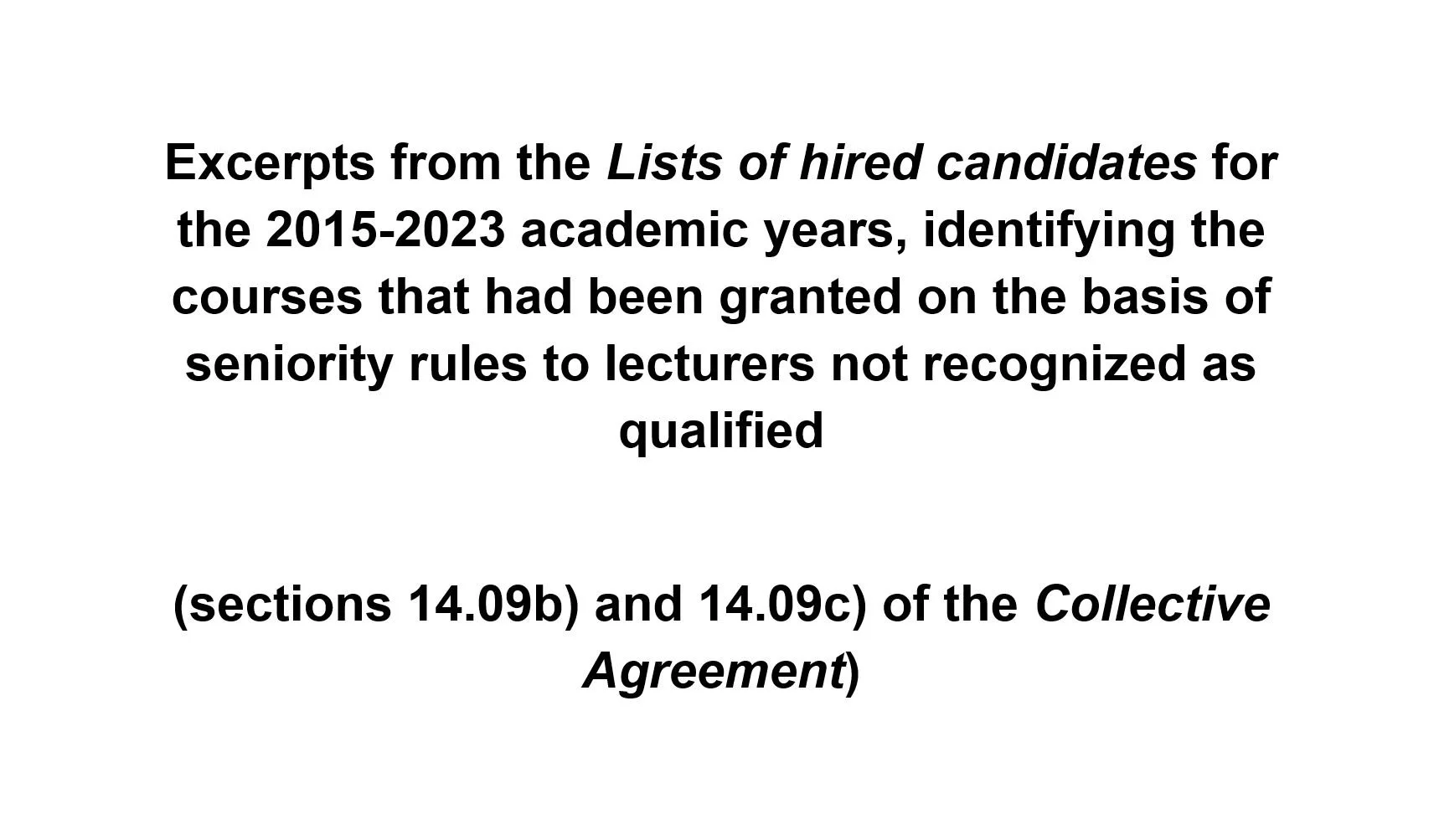
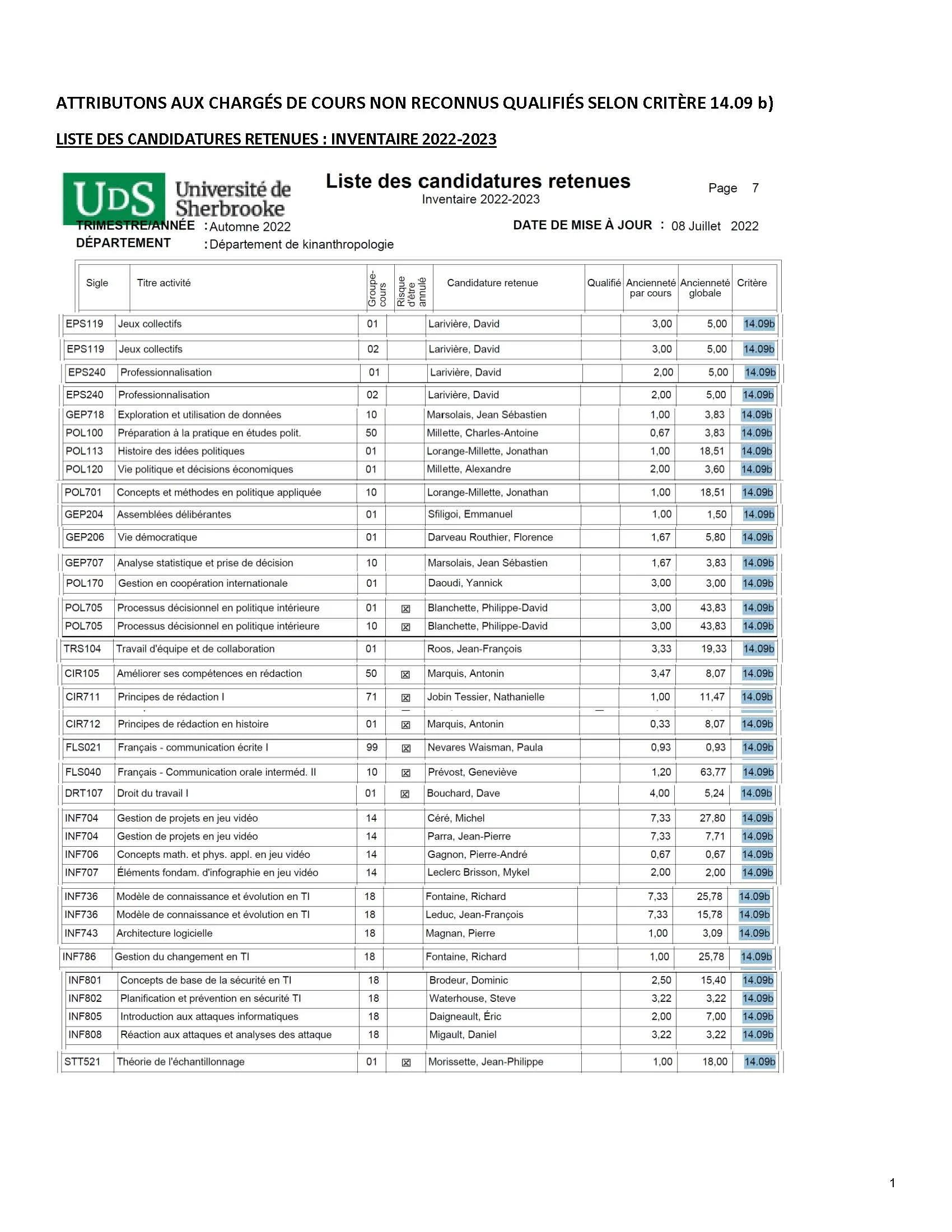
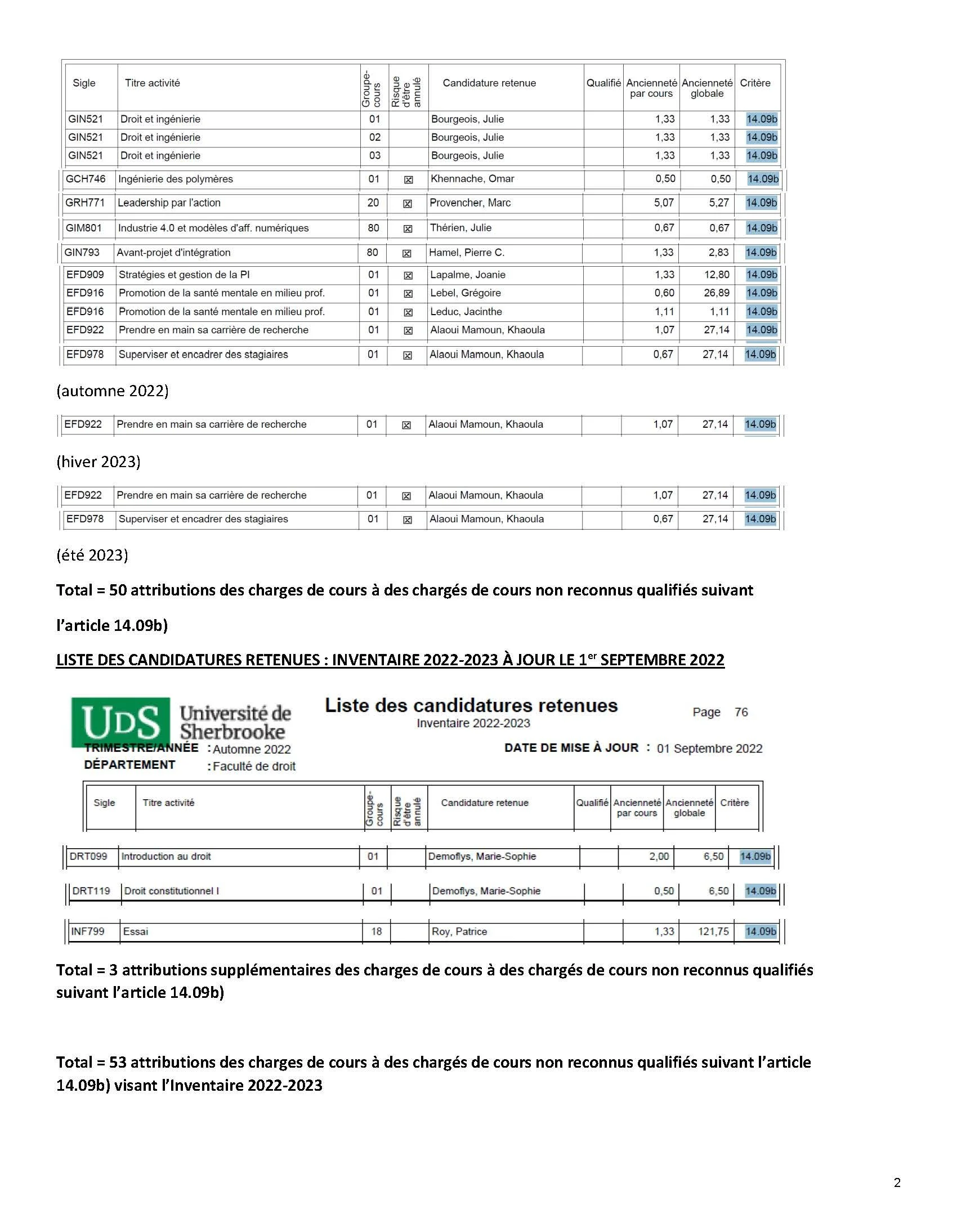
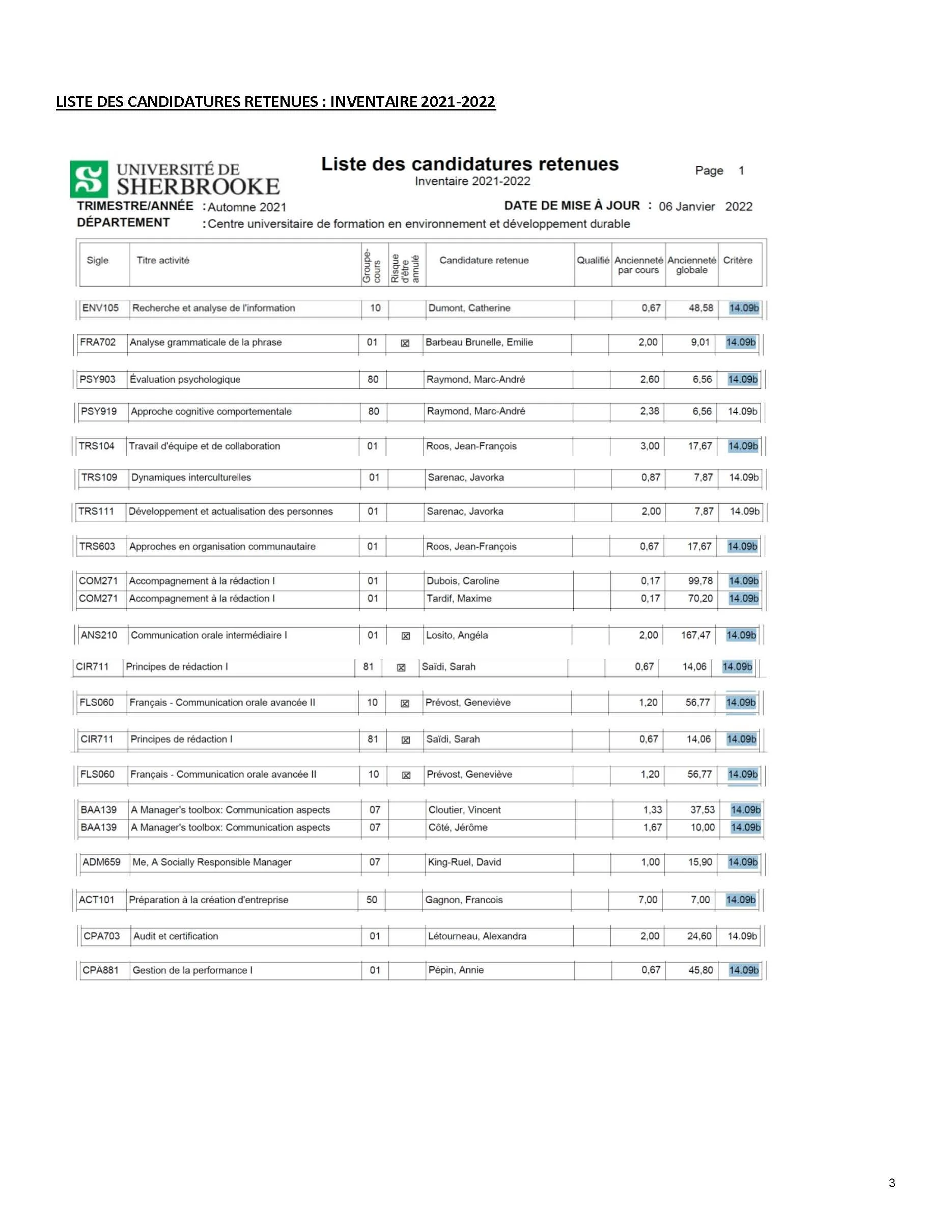
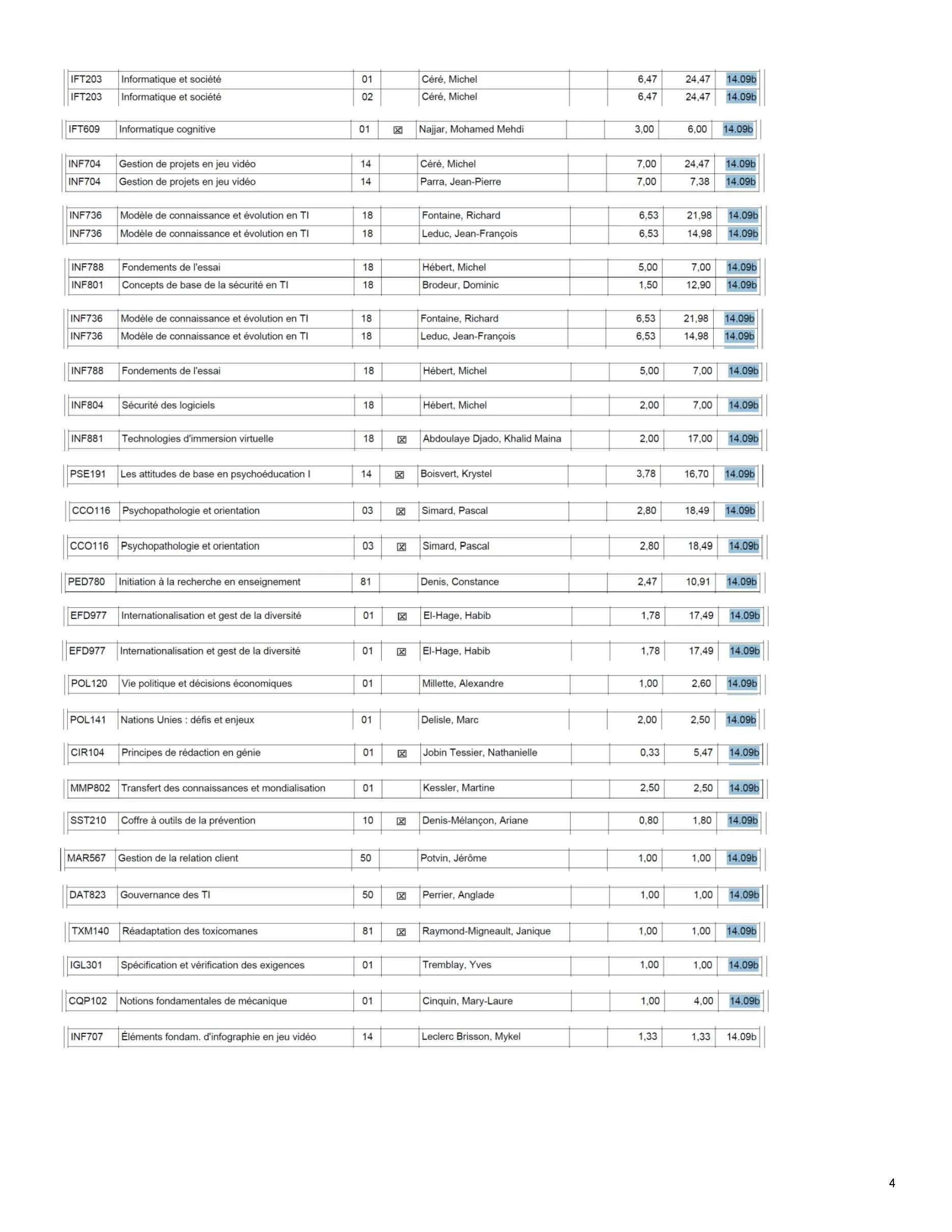
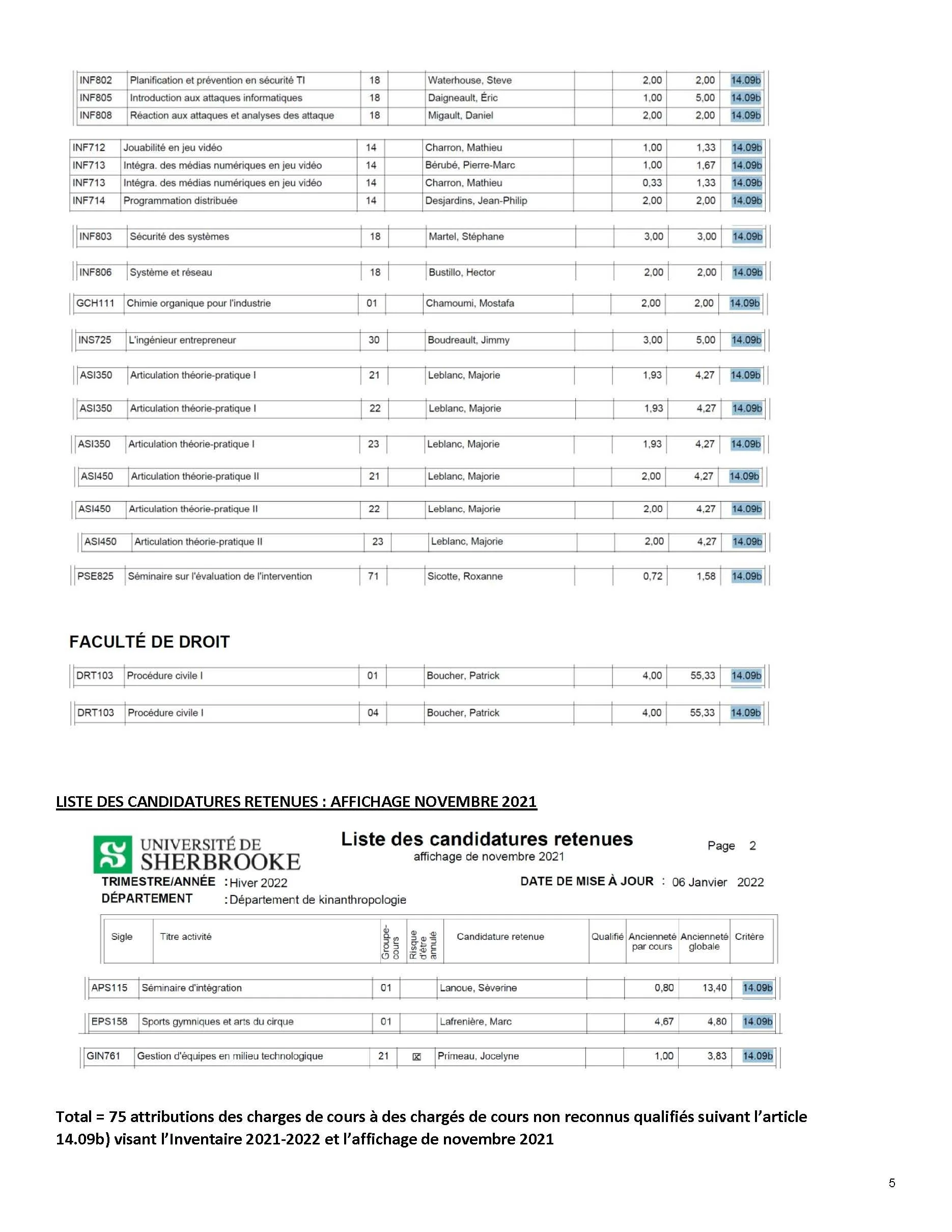
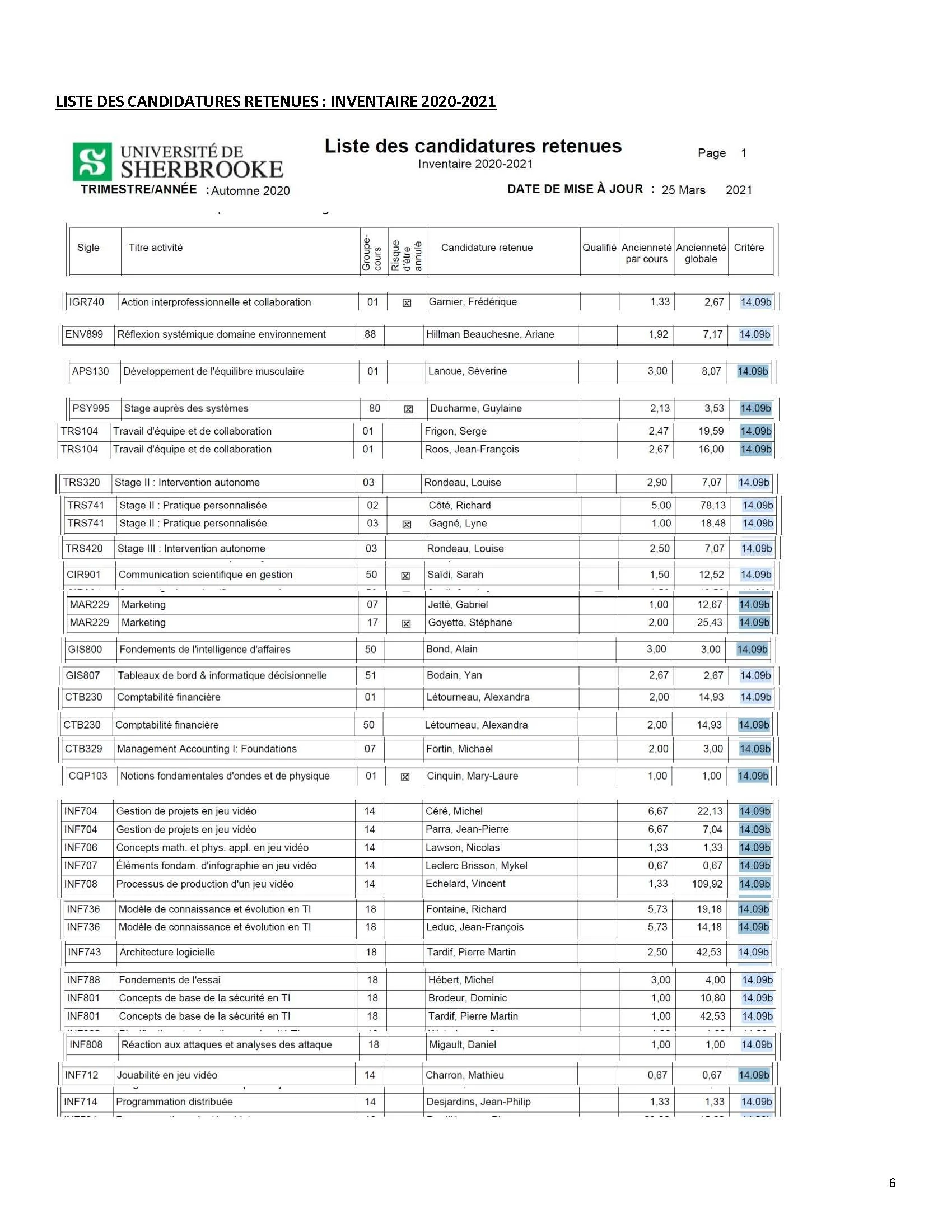
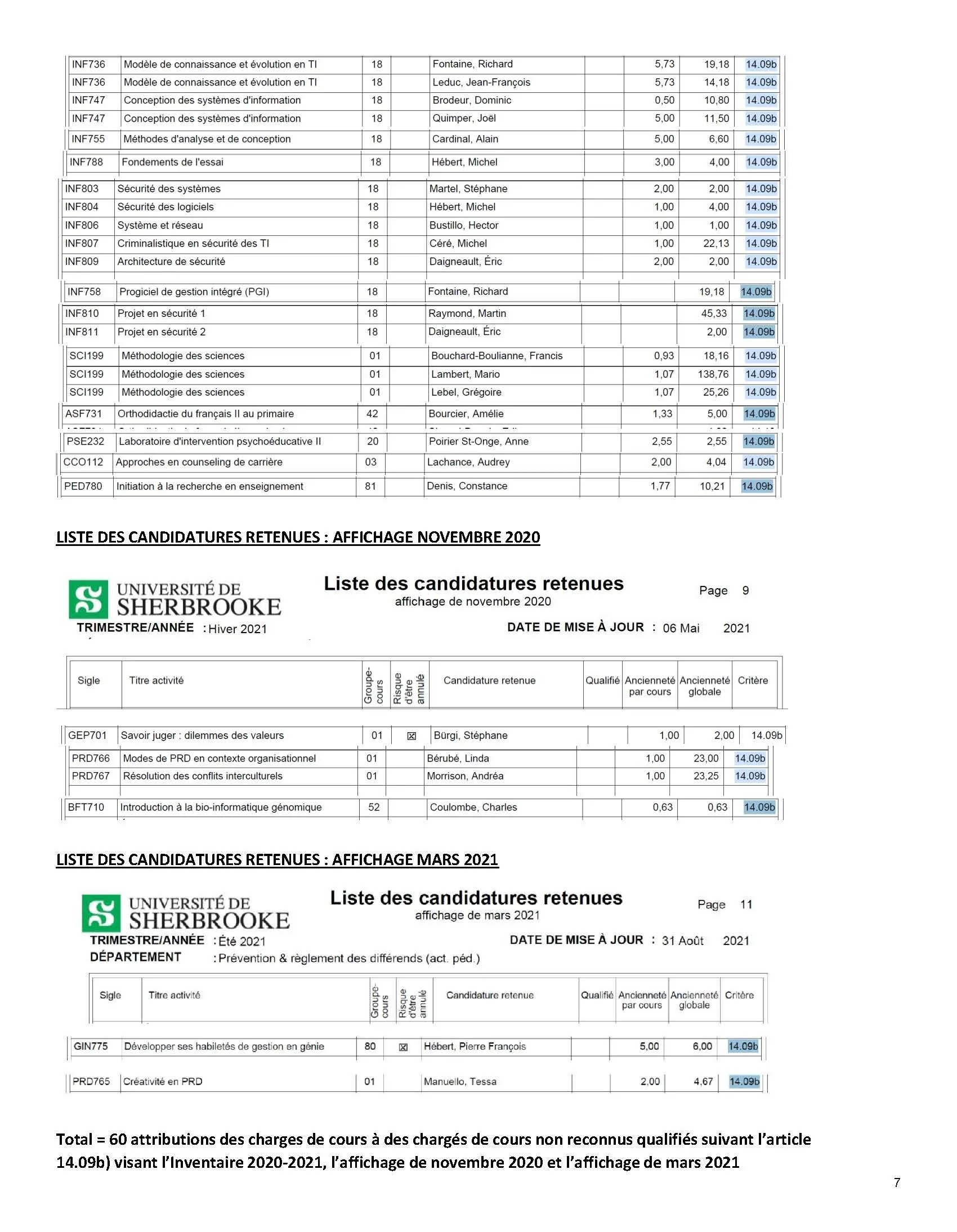
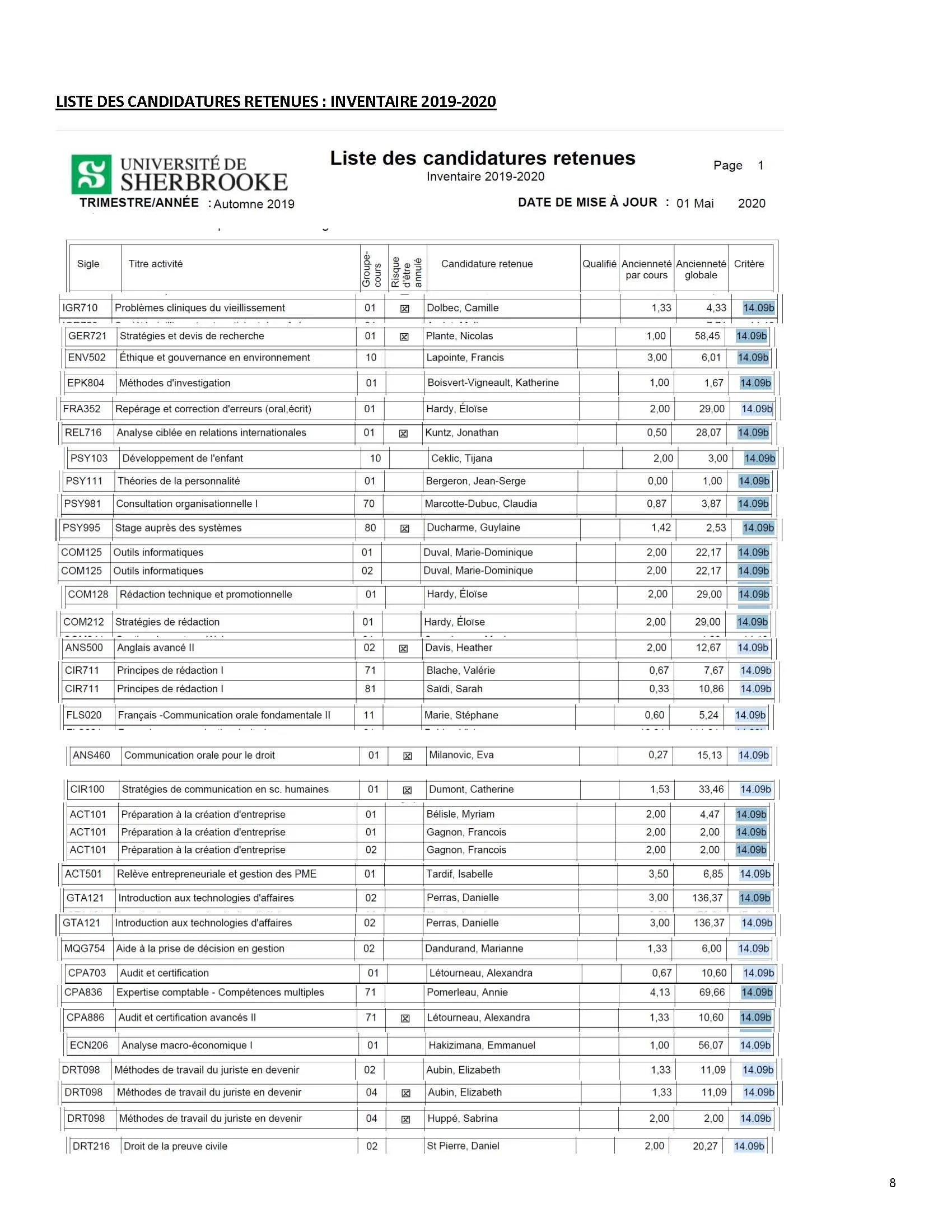
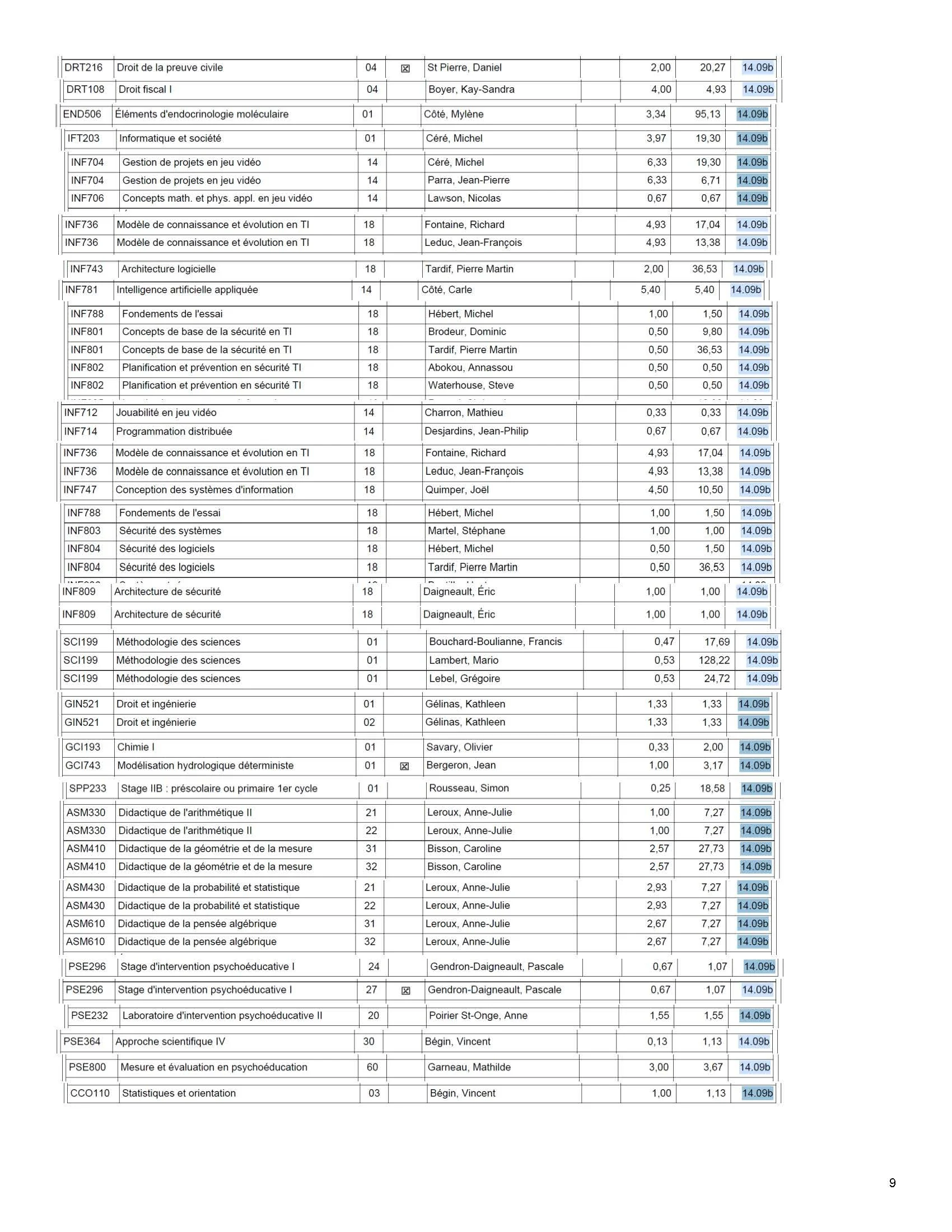
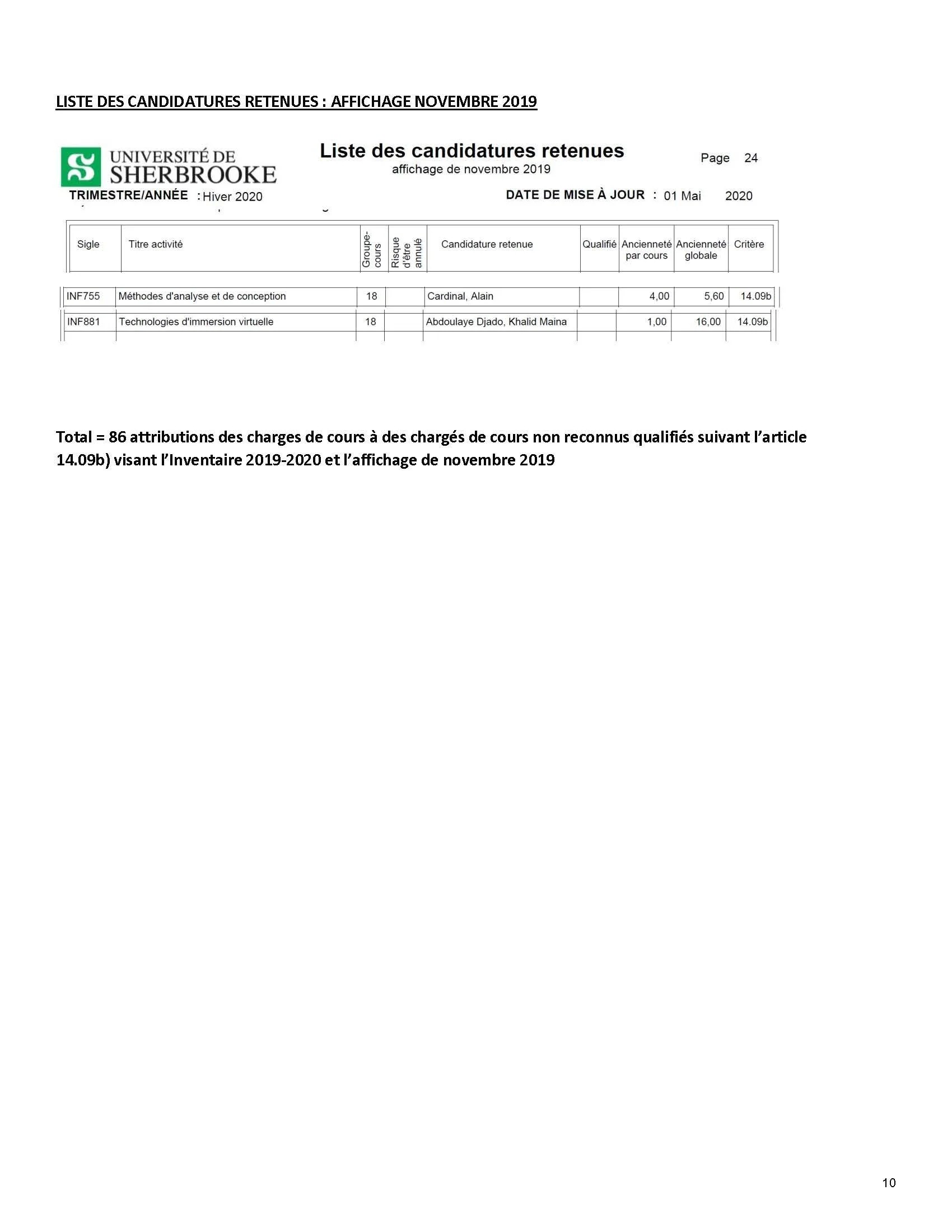
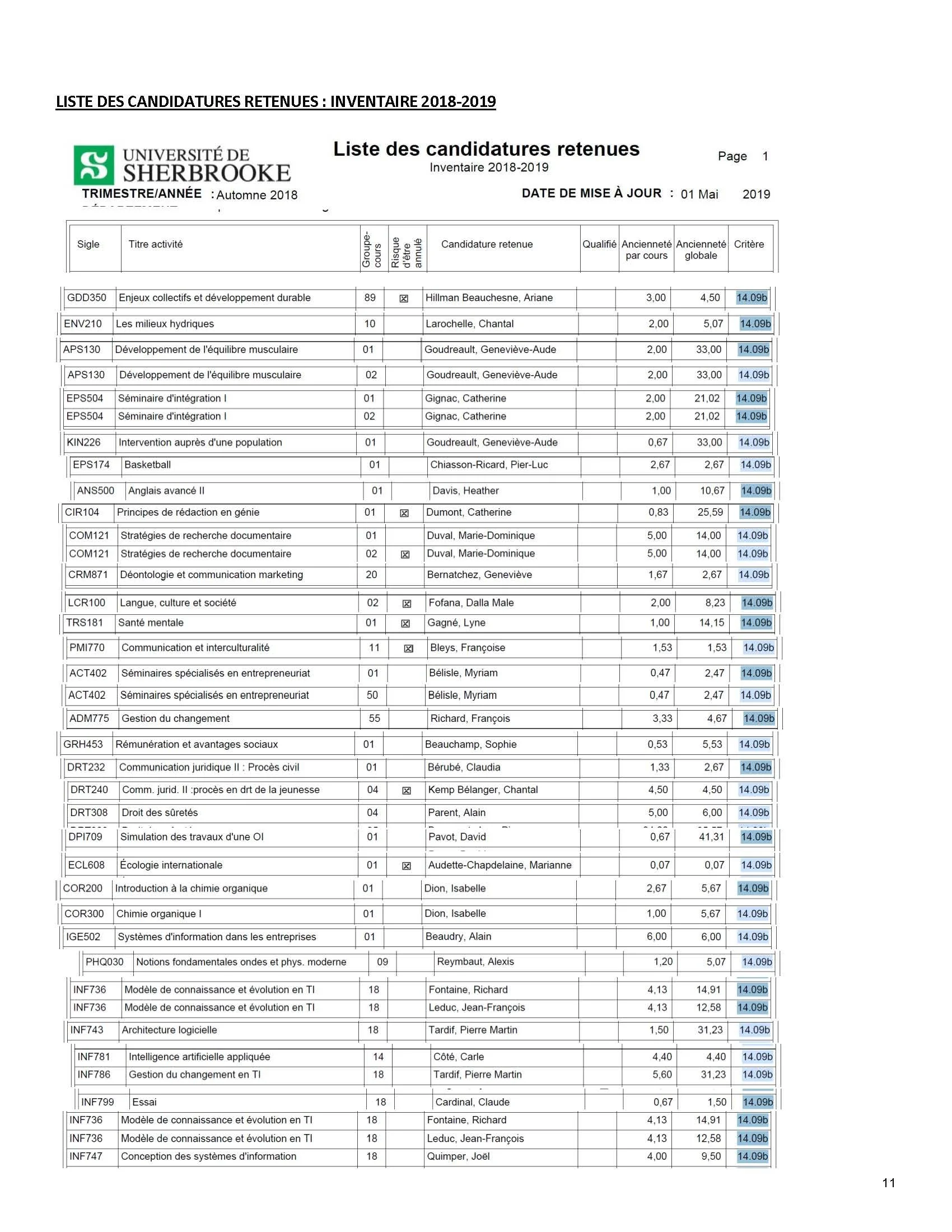
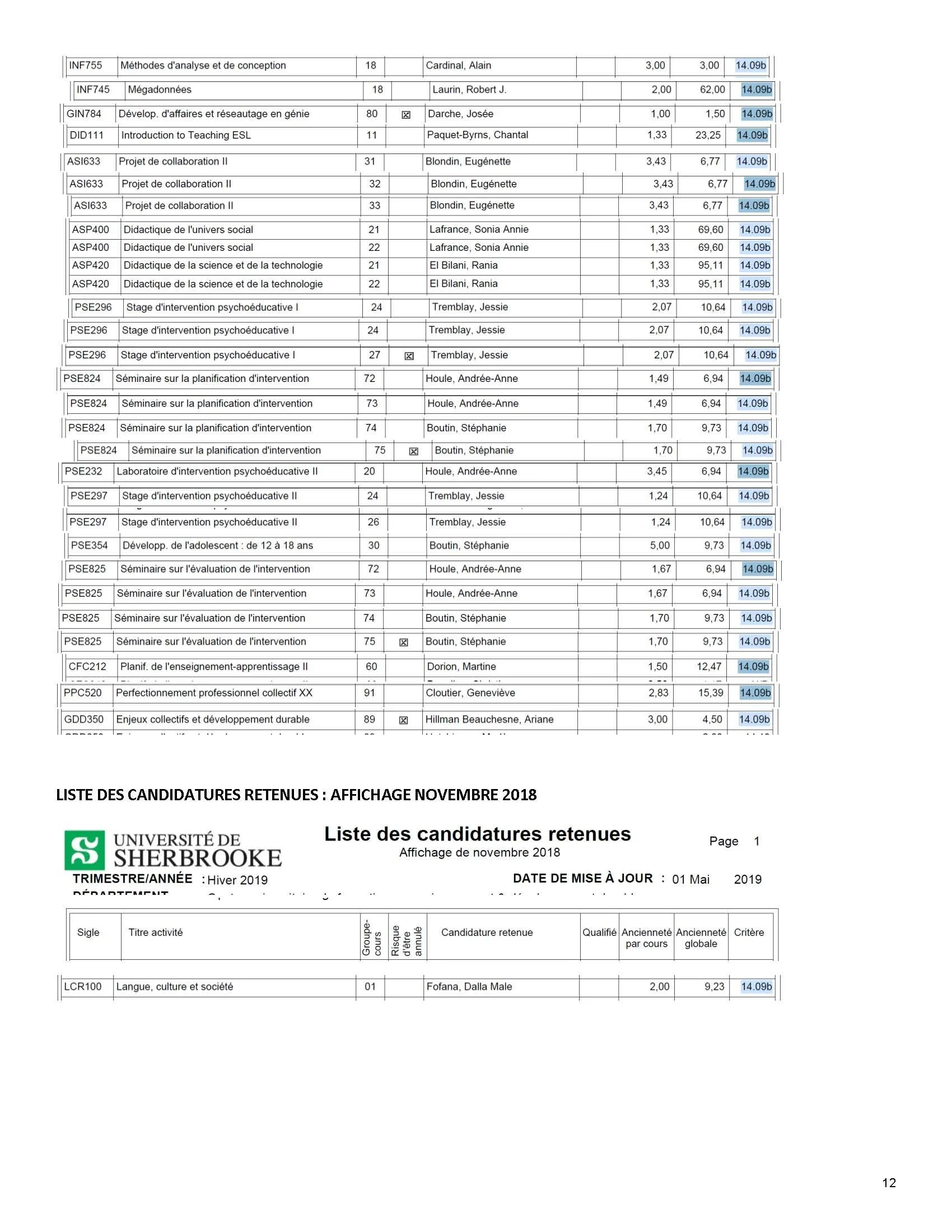
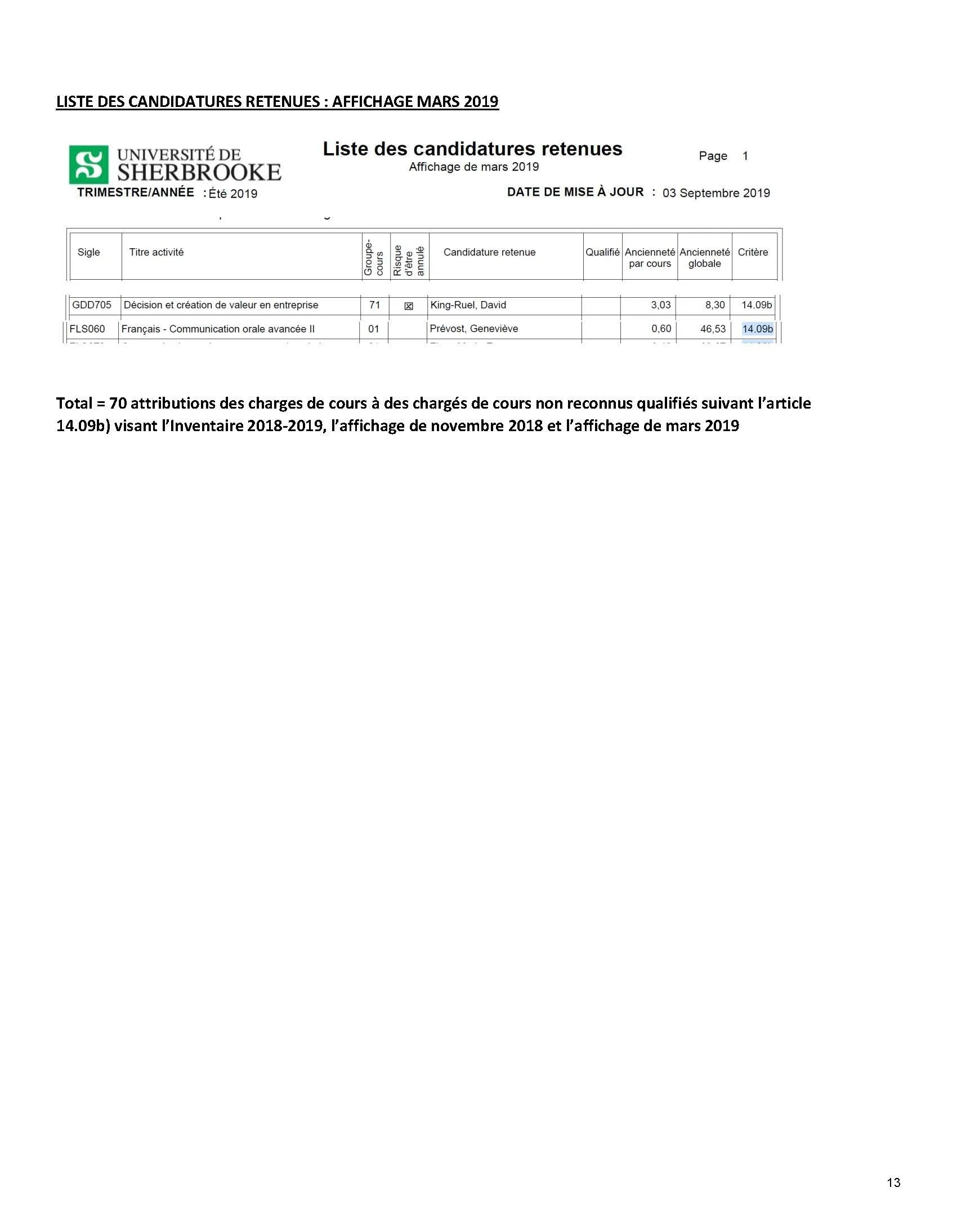
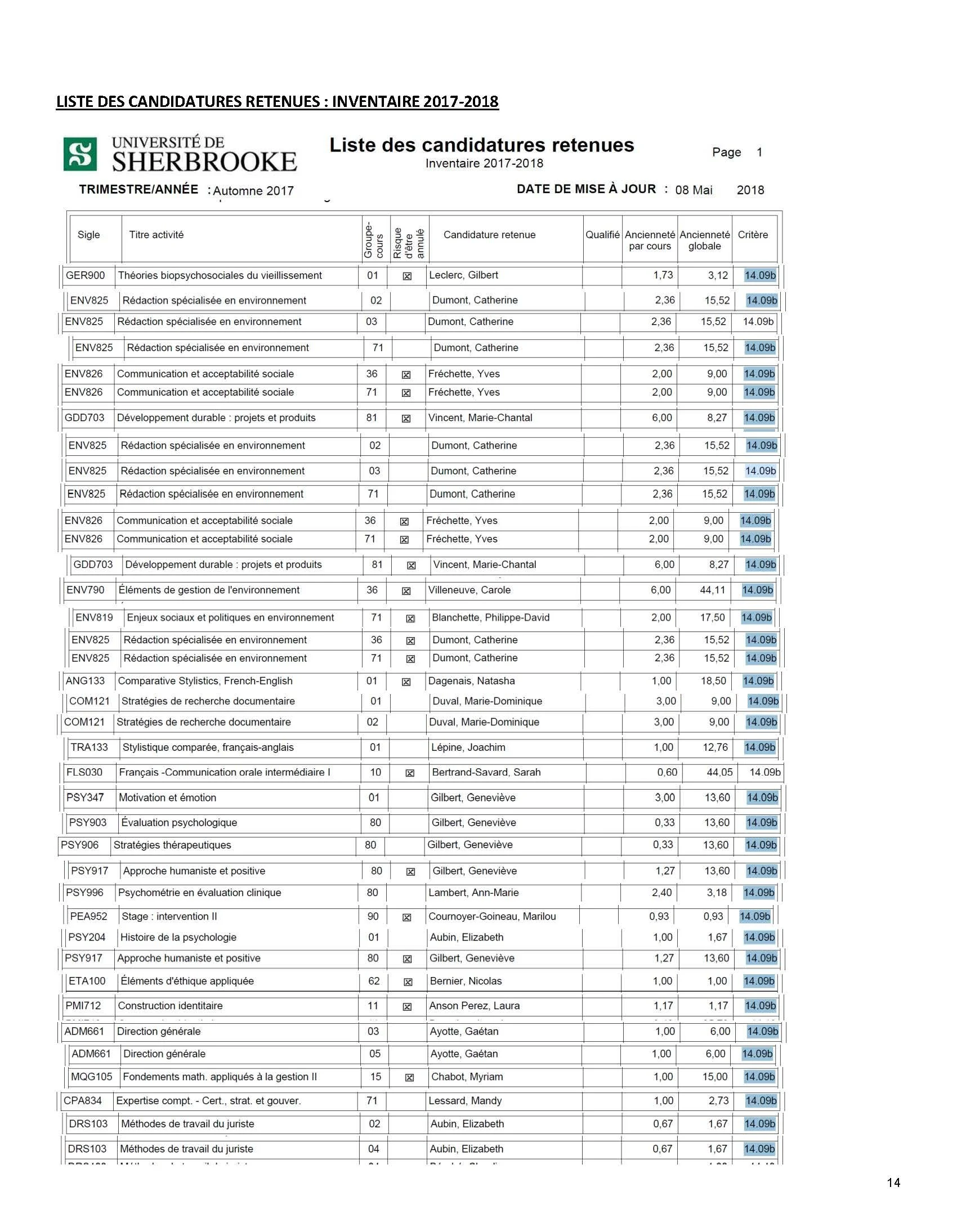
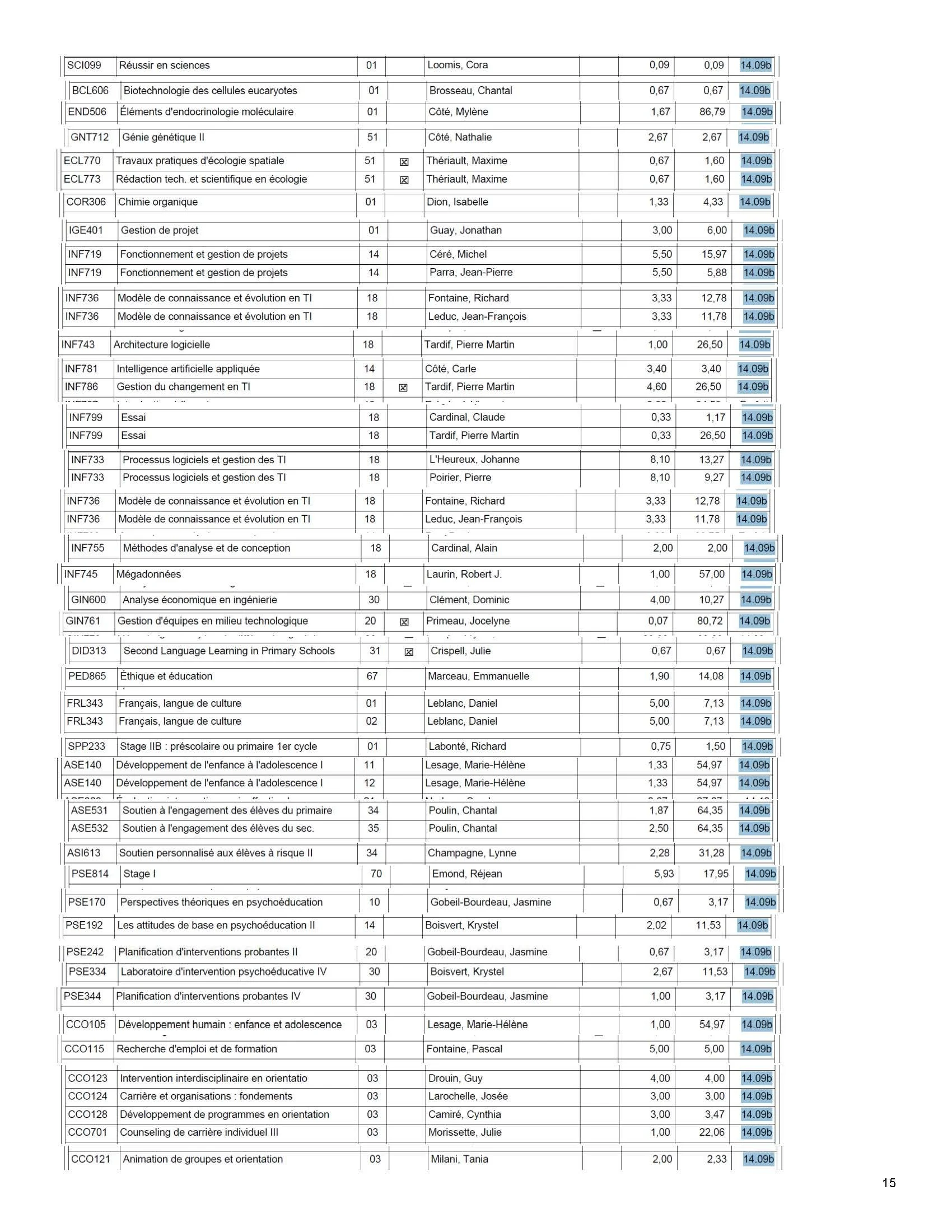
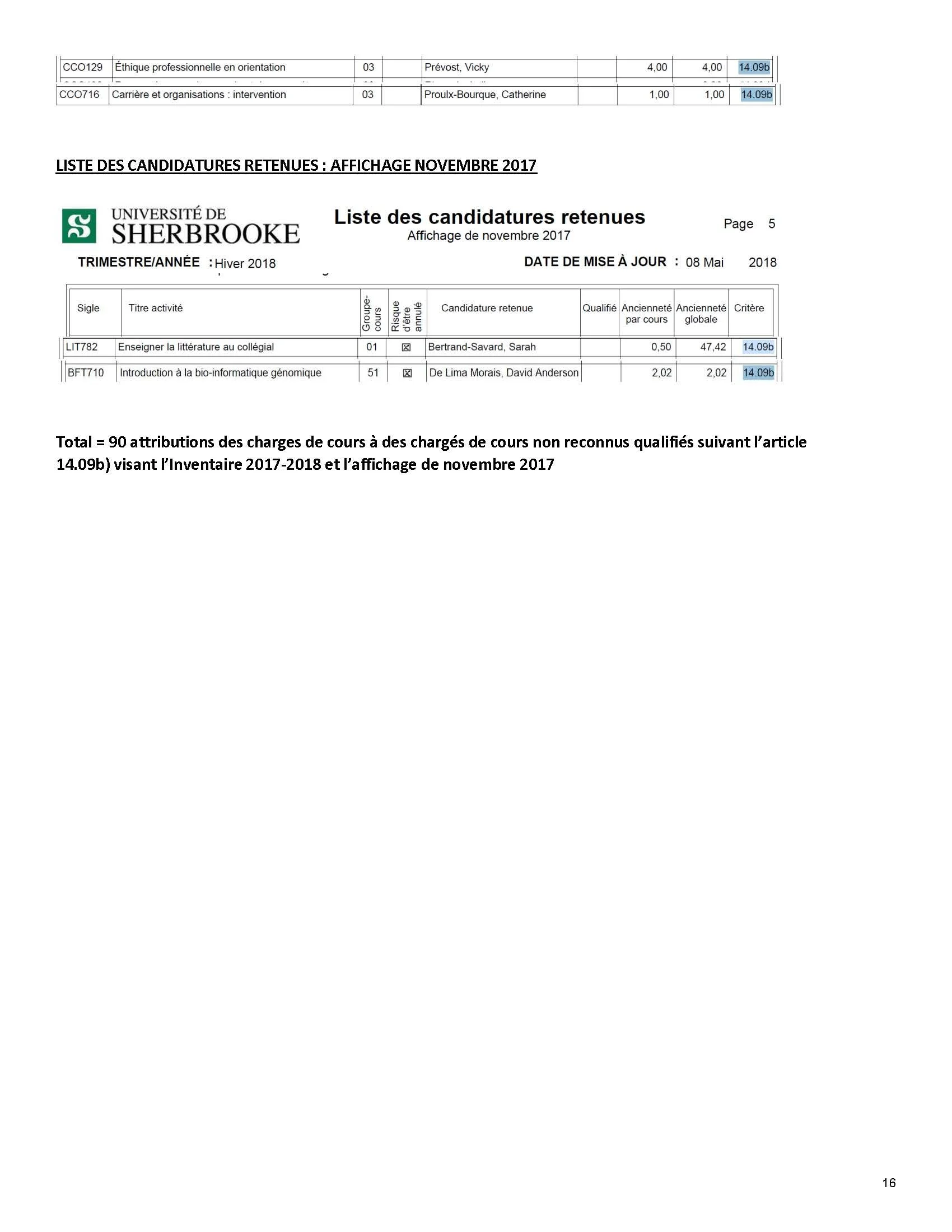
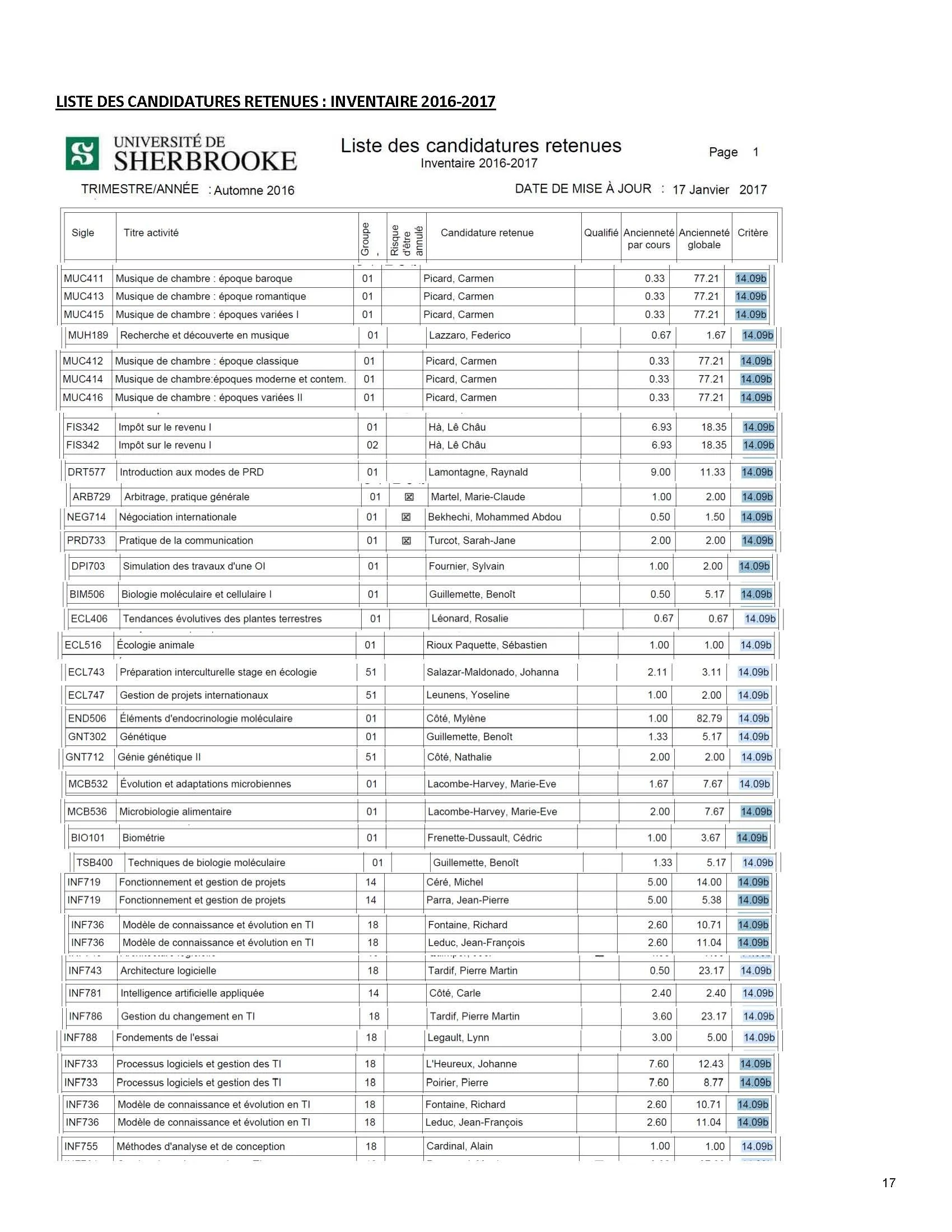
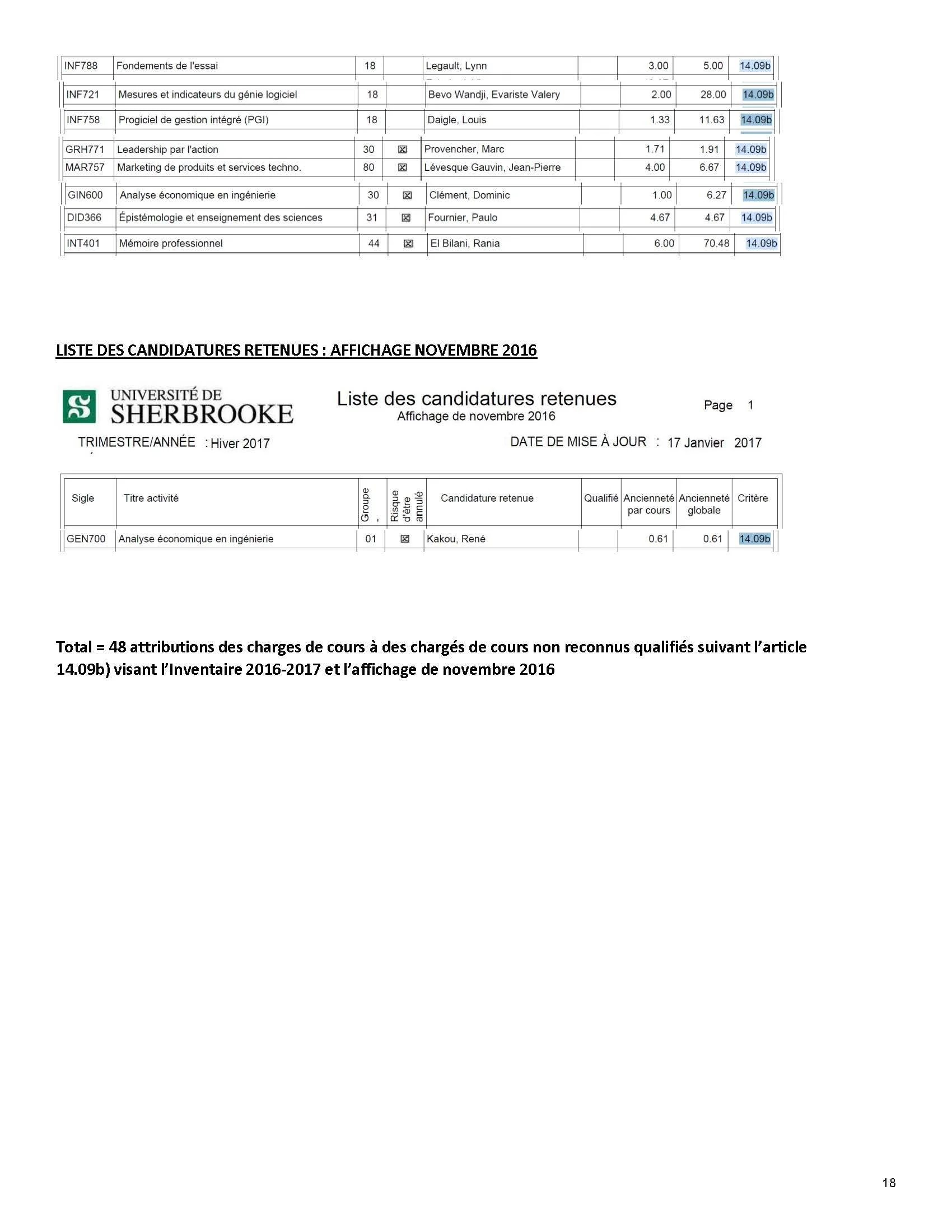
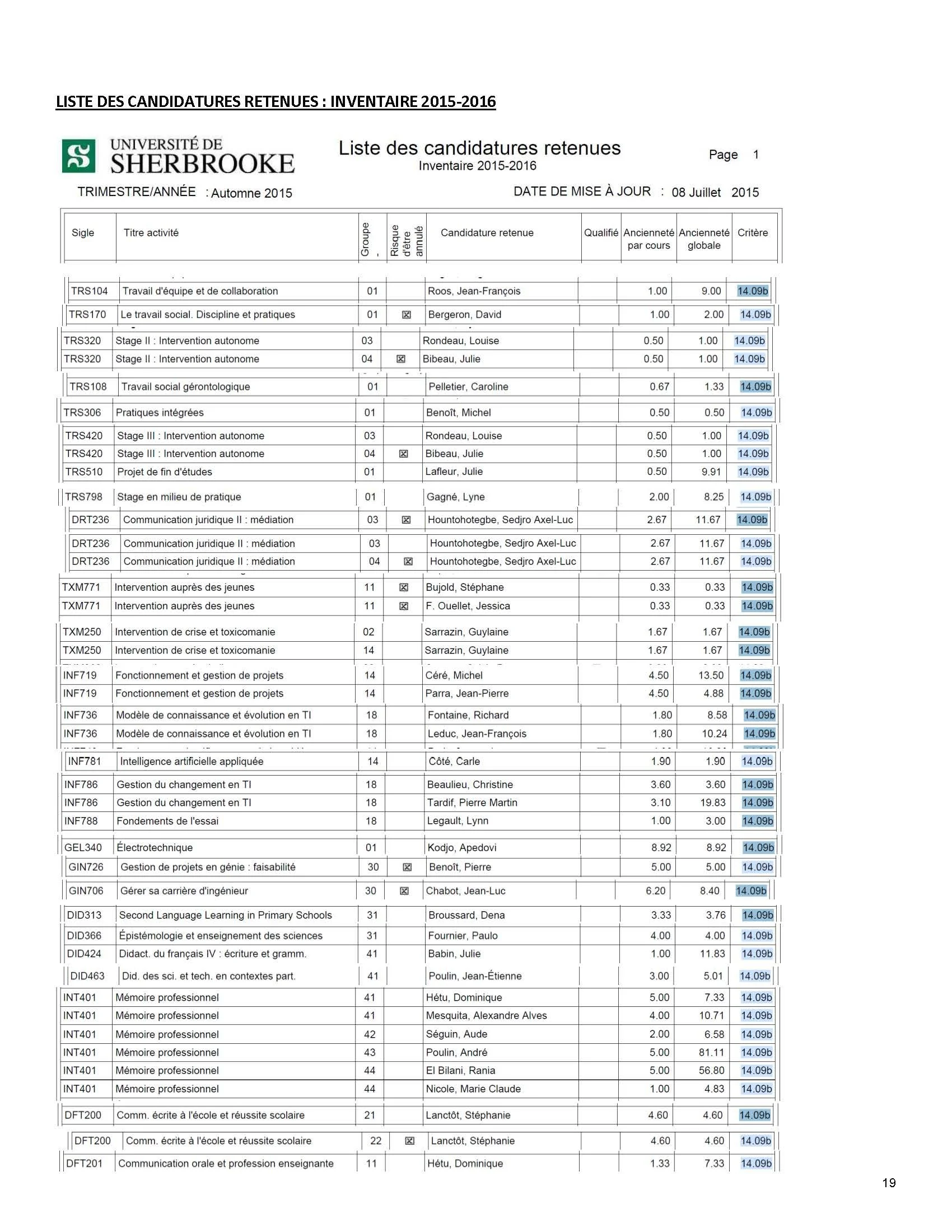
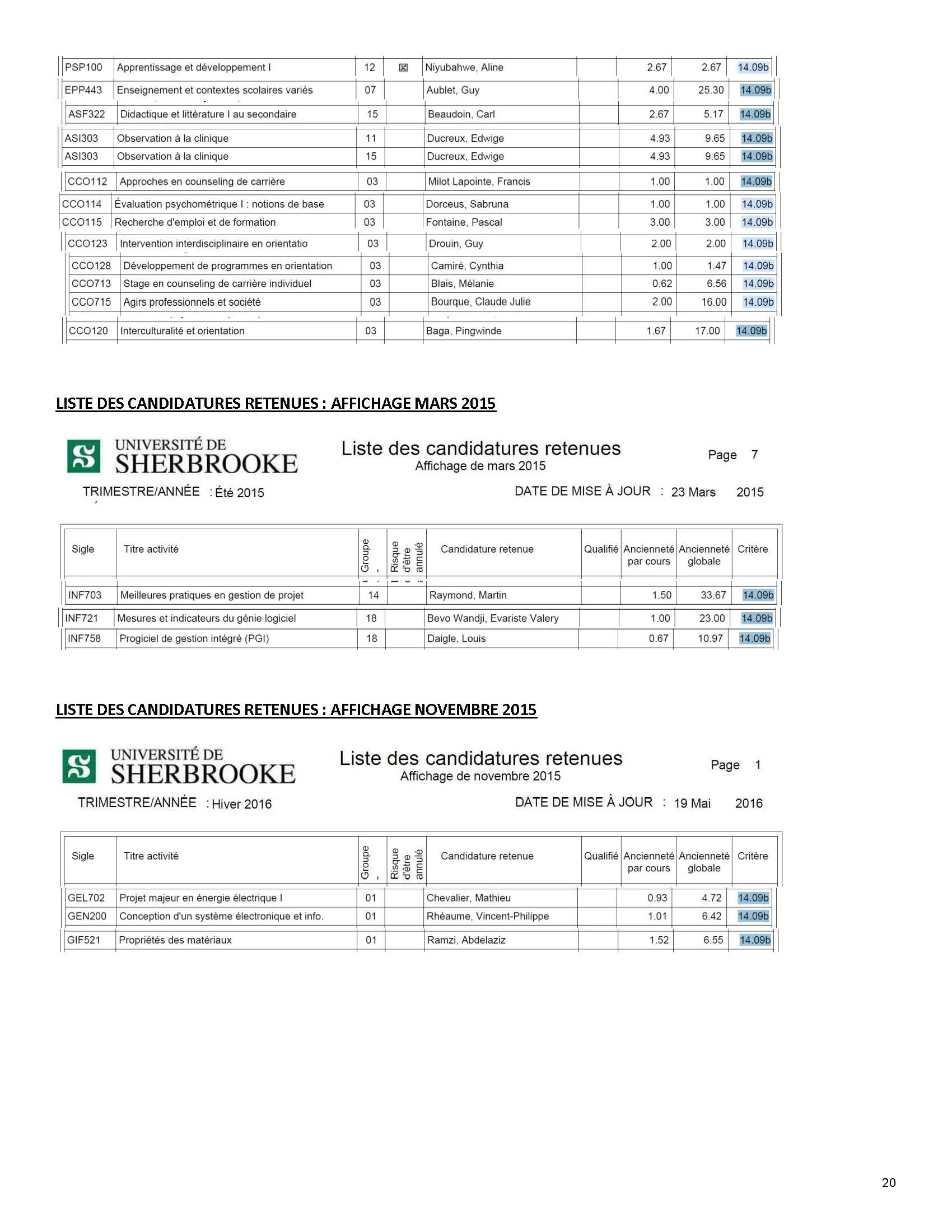
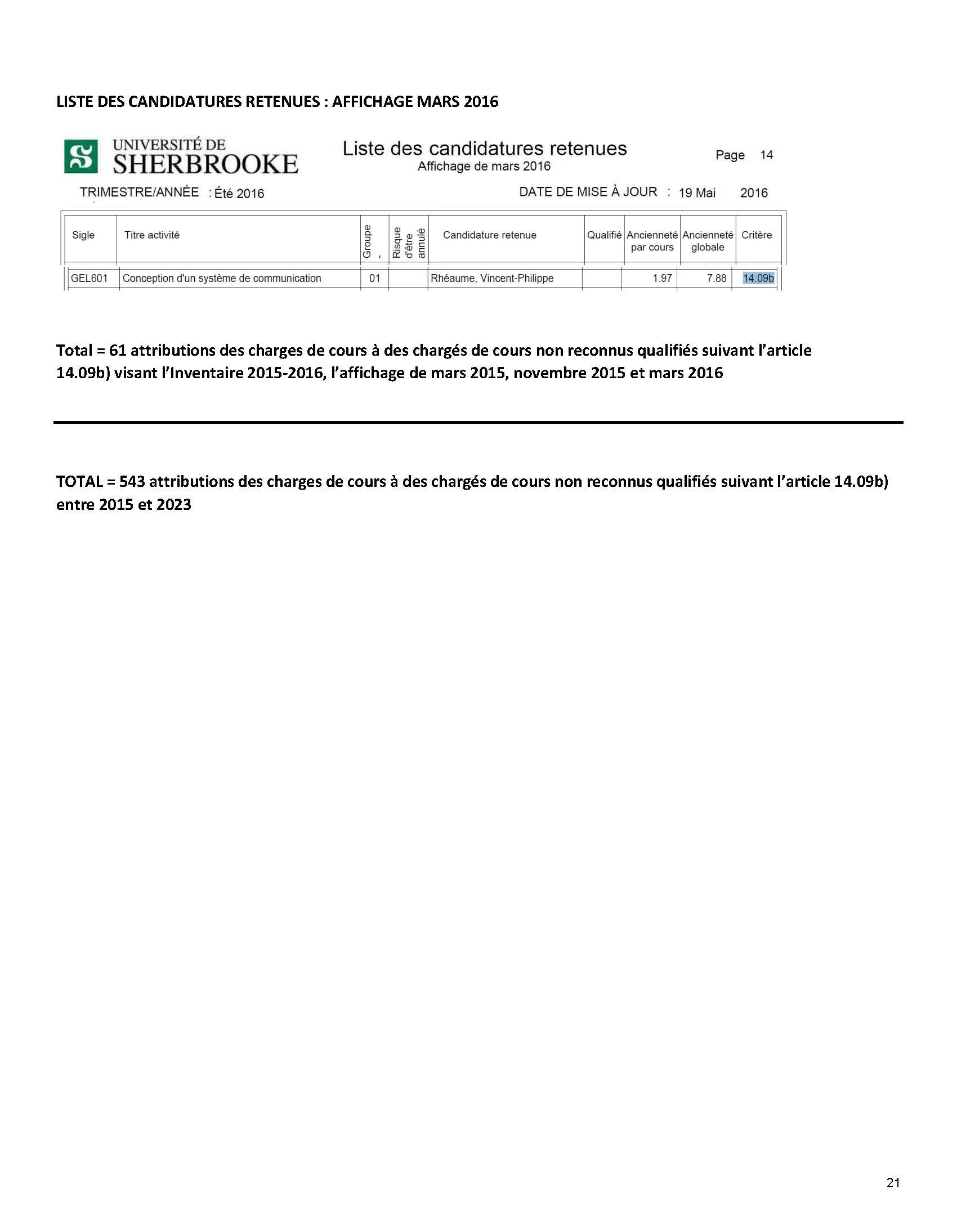
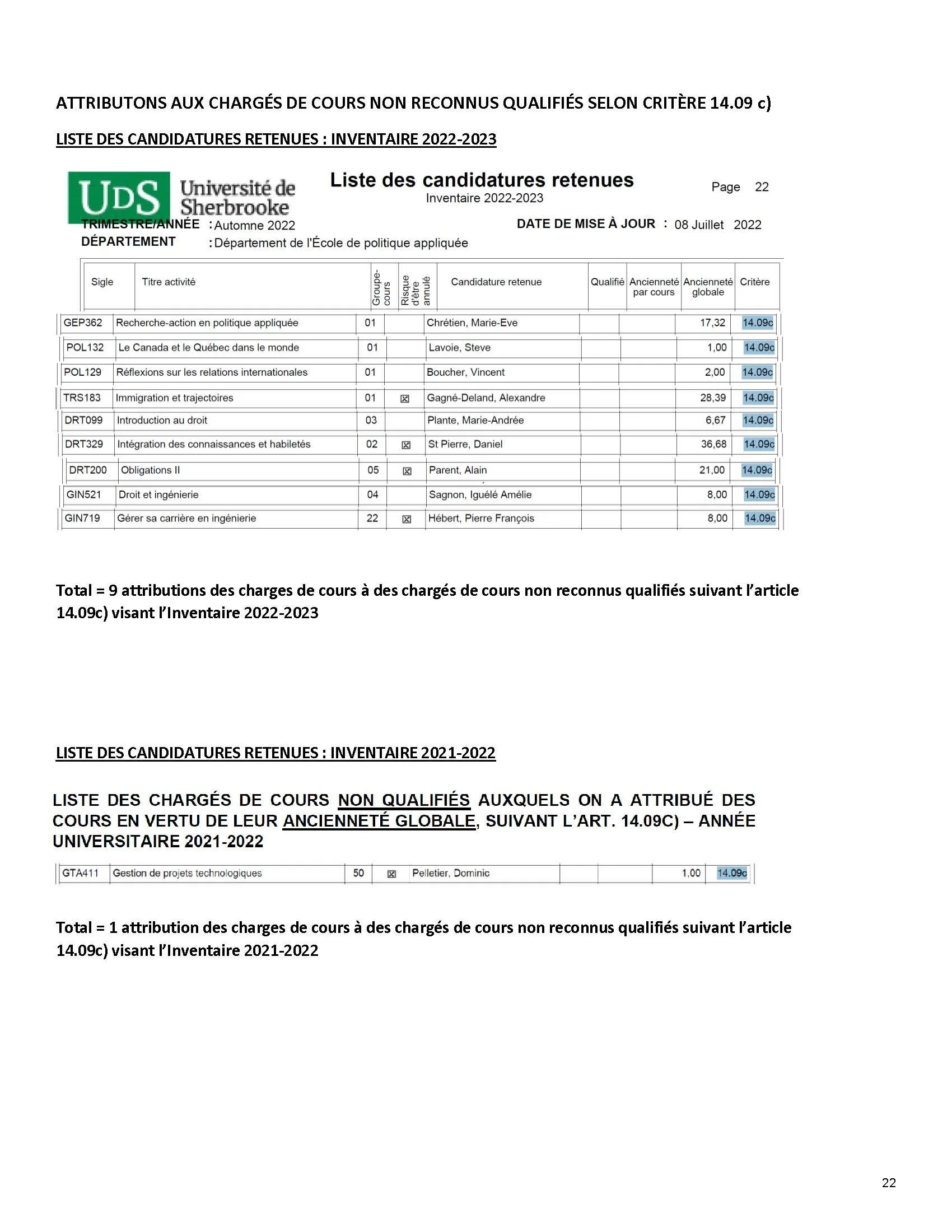
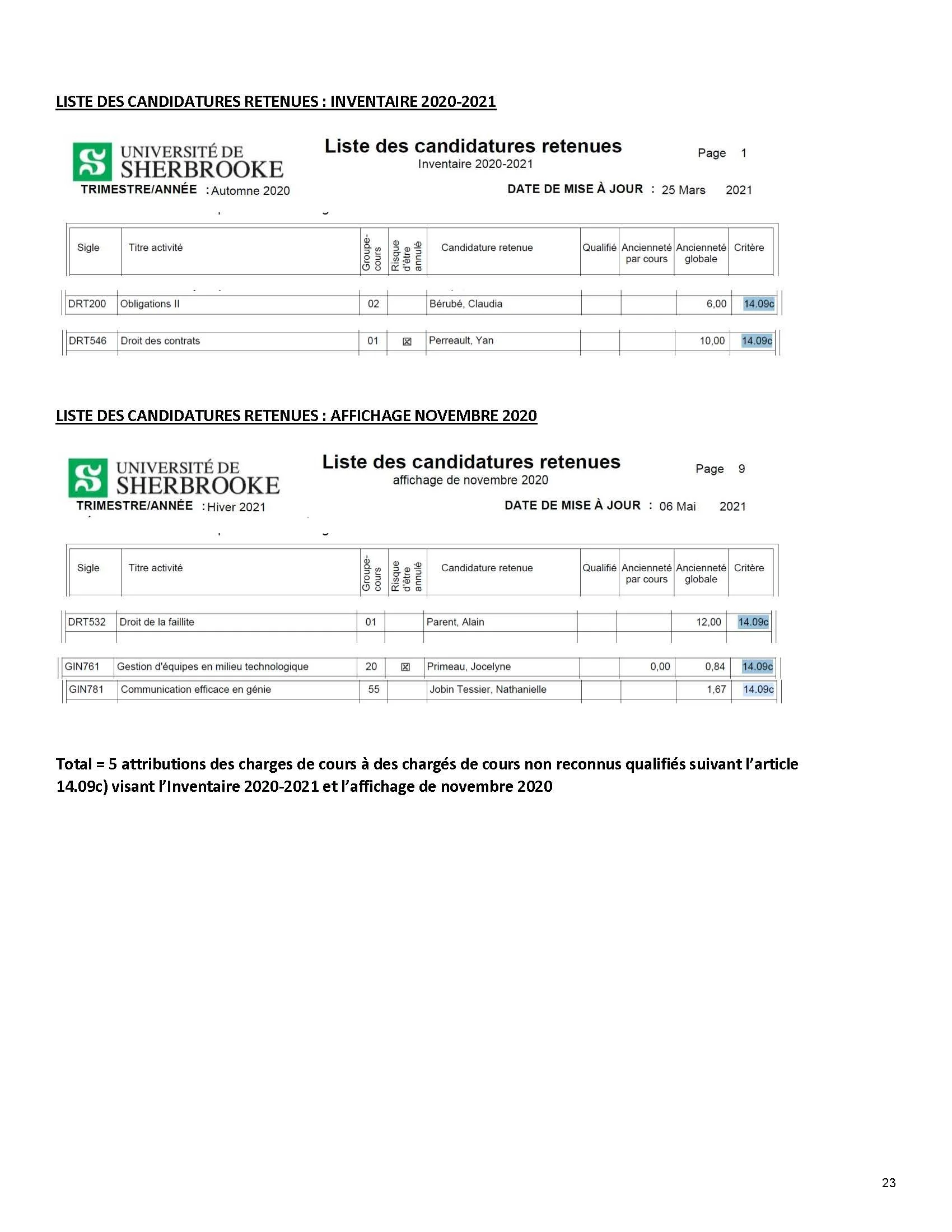
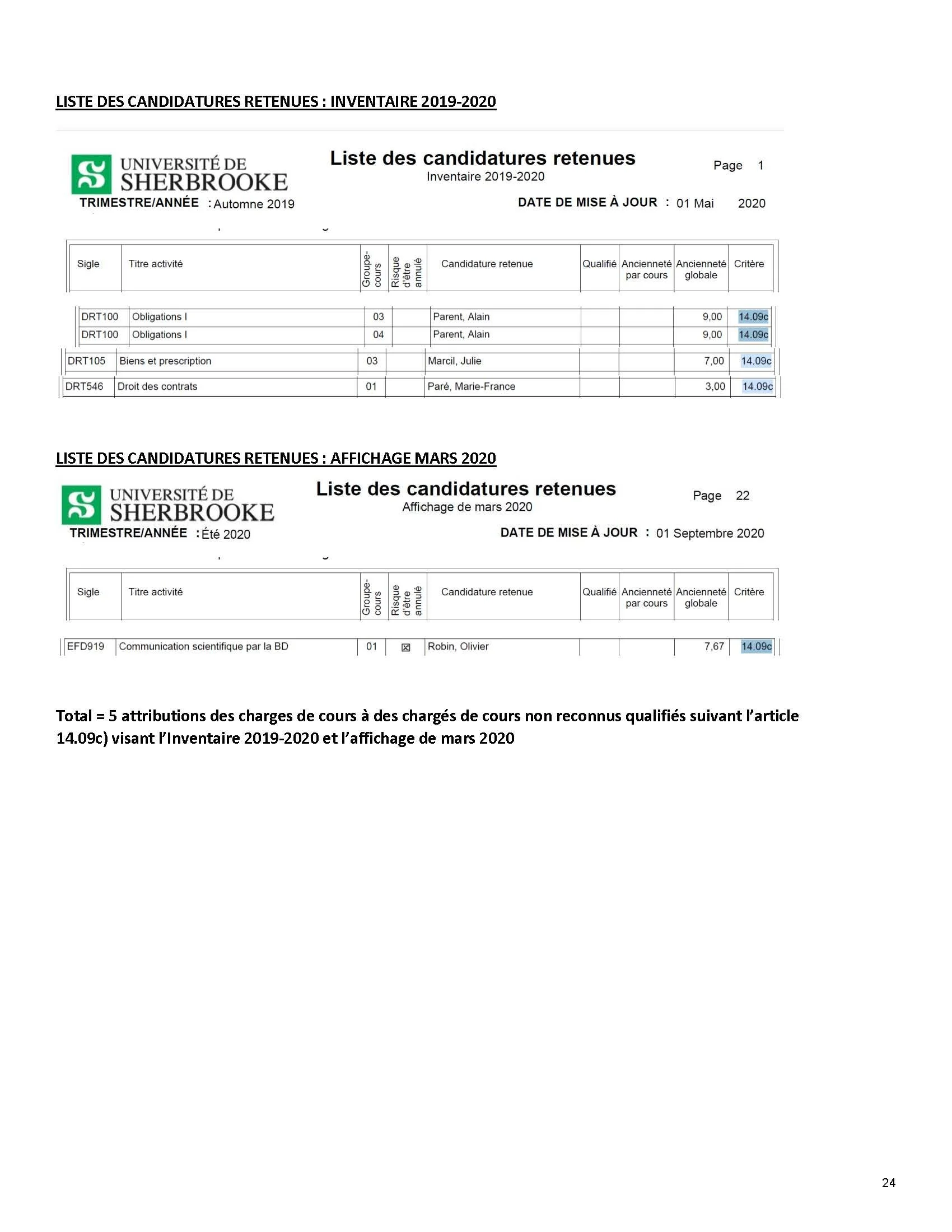
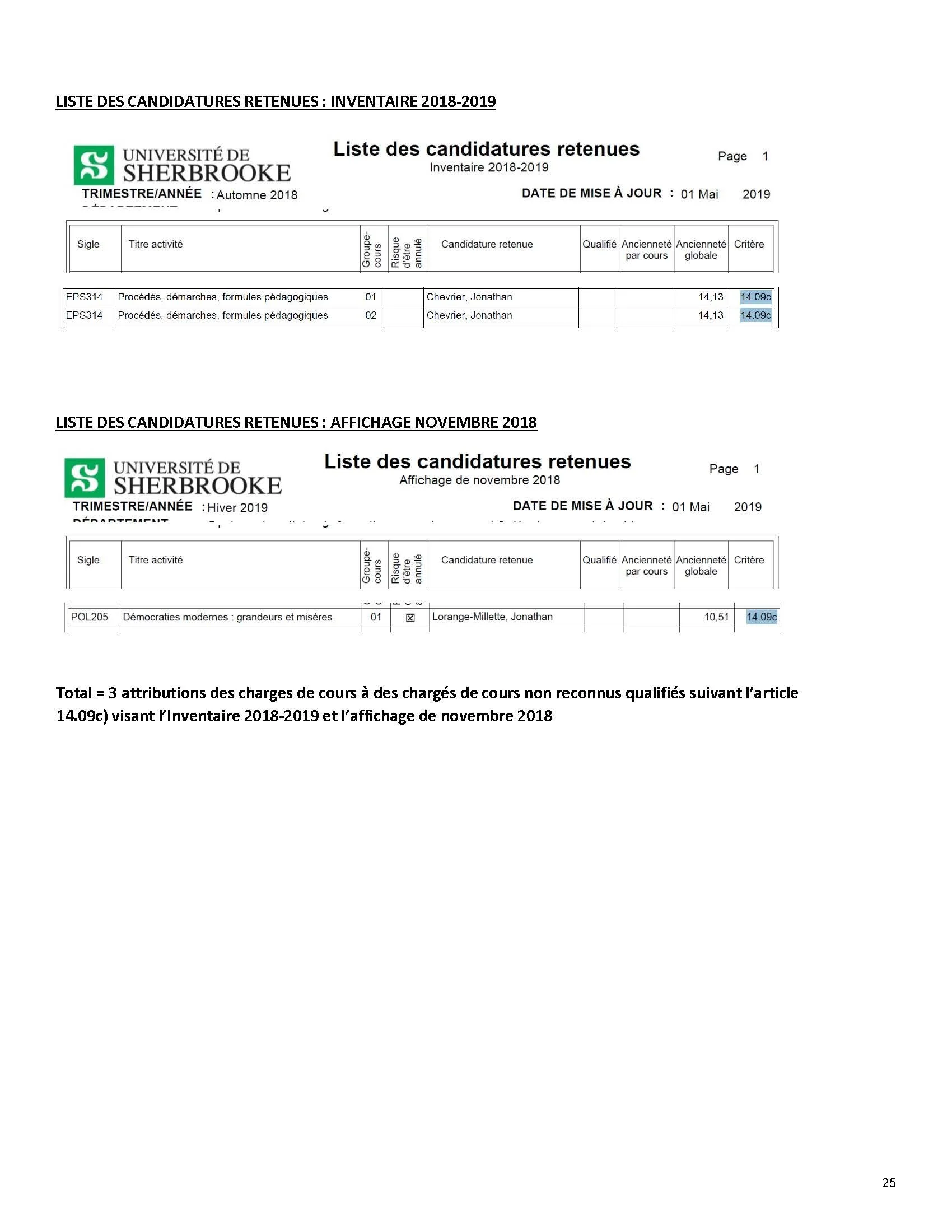
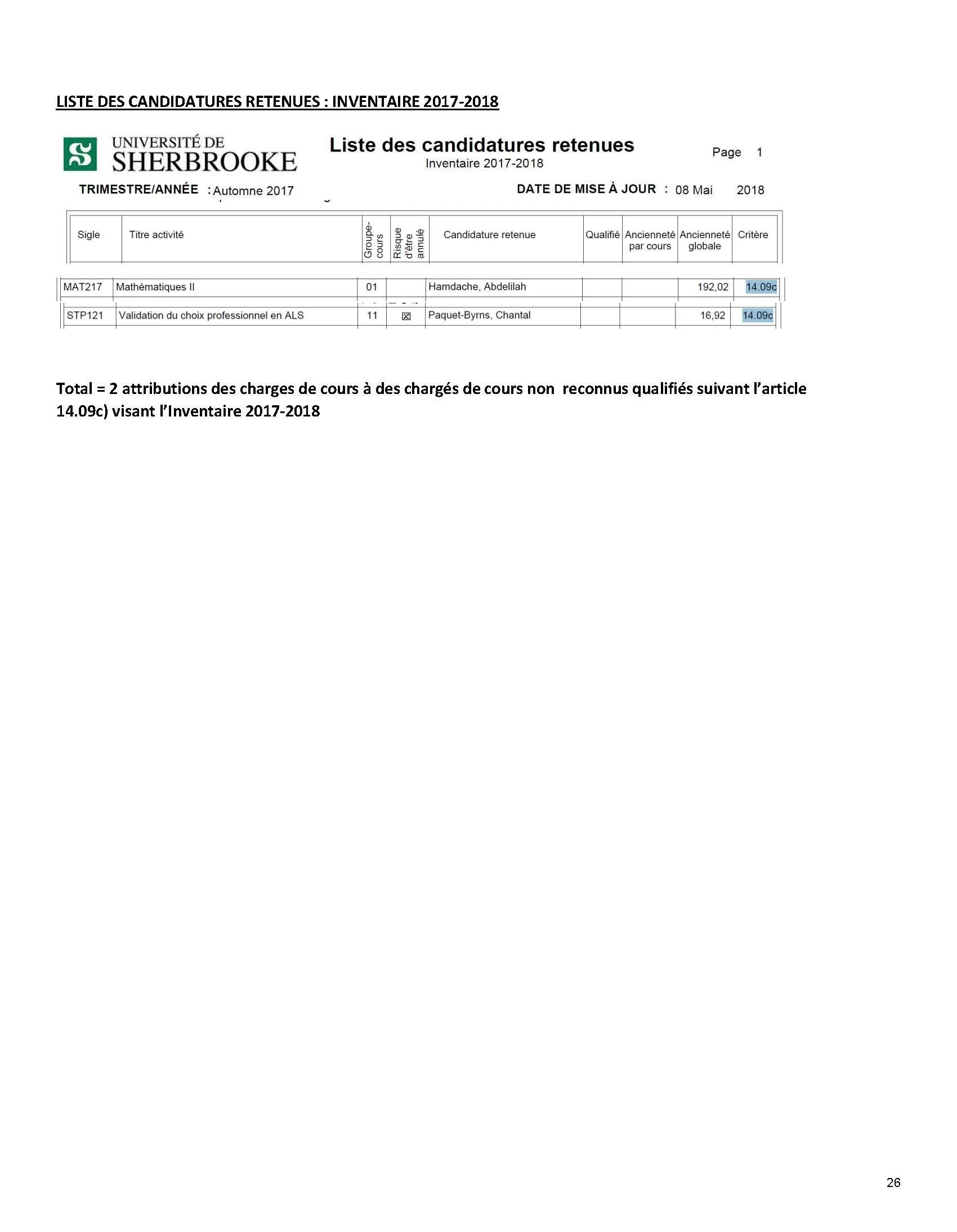
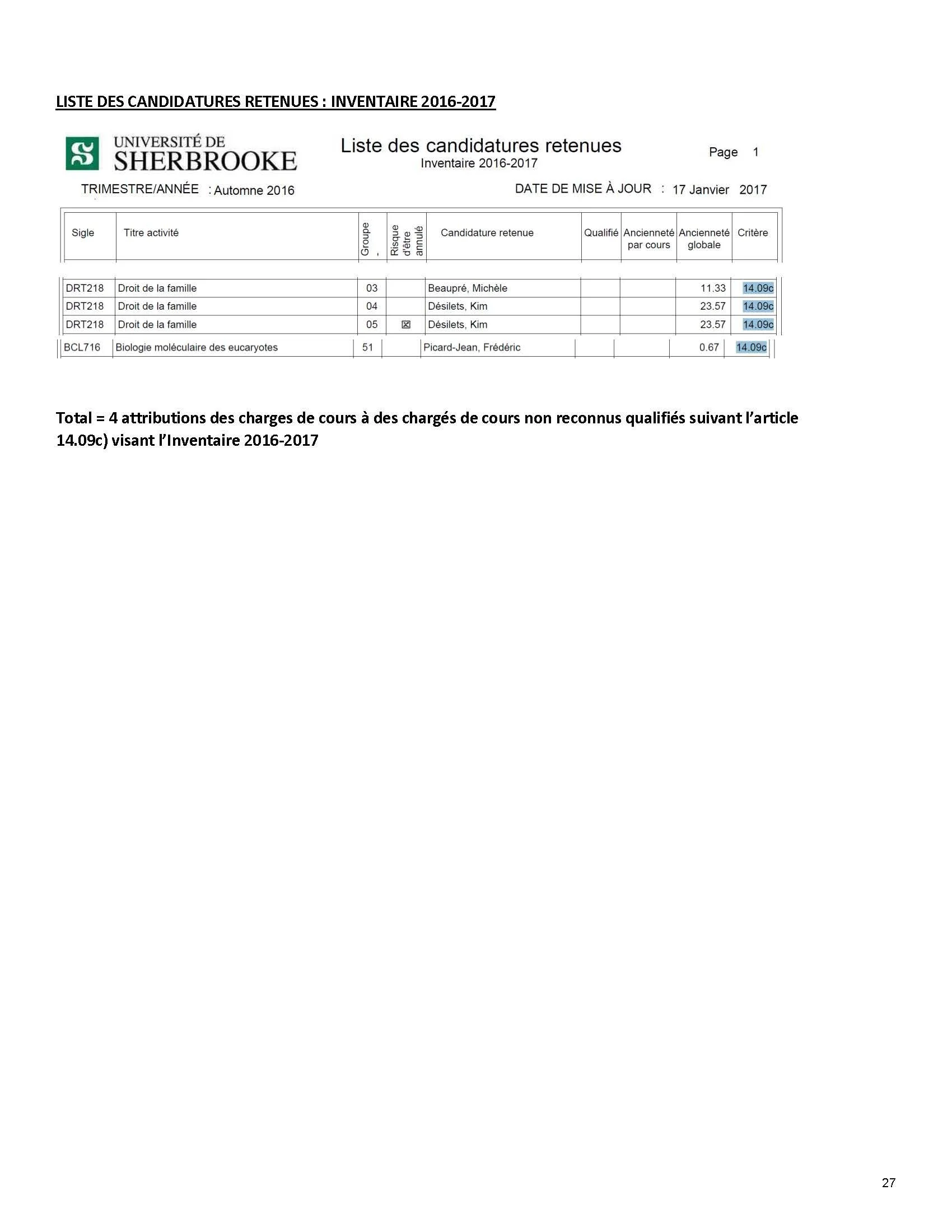
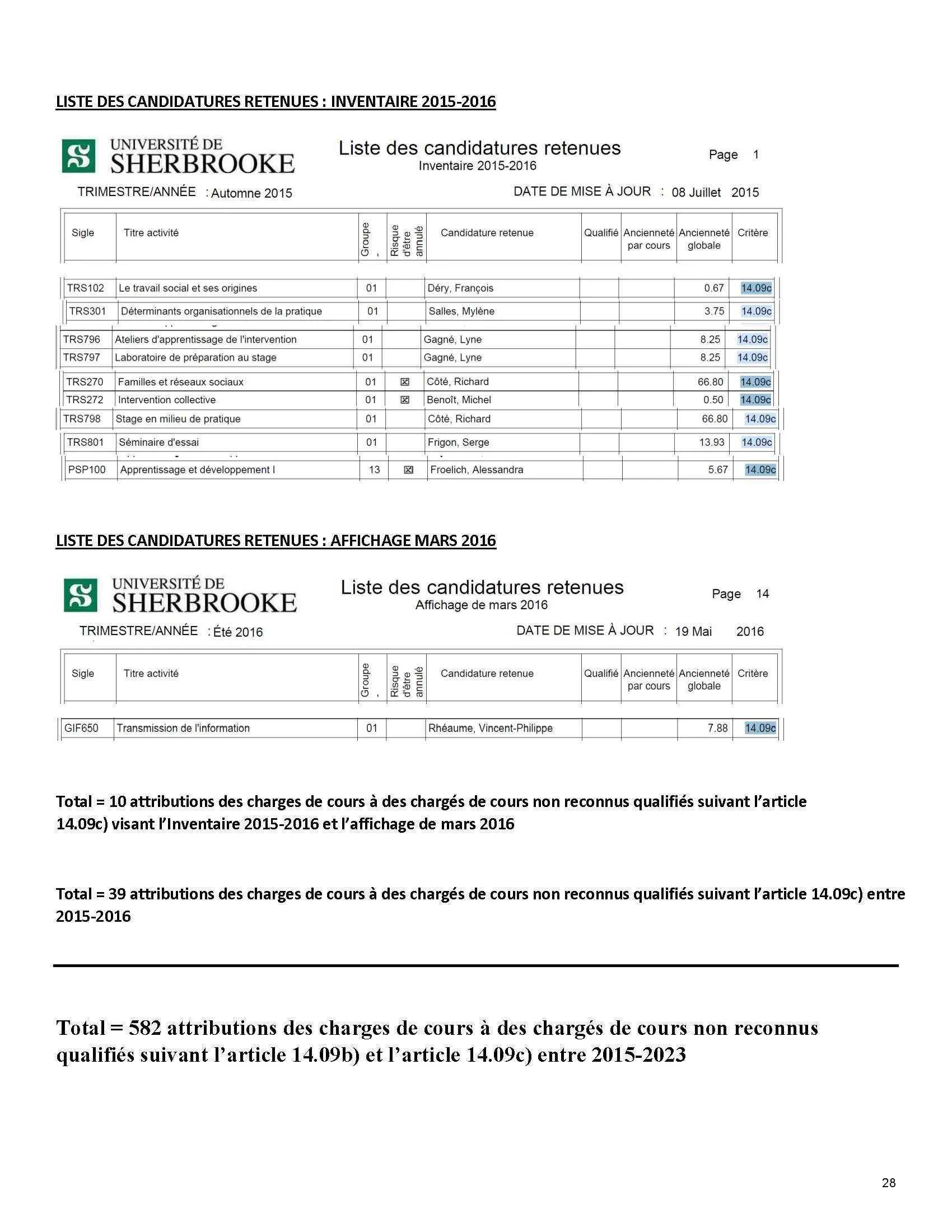
Case law : At the same time as my grievance was filed in February 2022, which specifically concerned the Faculty of Law’s managers’ violations of the seniority rules, and whilst these faculty managers claimed that they were not required to apply the seniority rules to lecturers that were not “acknowledged as qualified”, the University of Sherbrooke and the Lecturers’ Union were well aware that these seniority rules had to be applied to lecturers that were not “acknowledged as qualified”, since in March 2022, in the context of another litigation involving another lecturer at the University of Sherbrooke (Denis Pedneault), an arbitrator confirmed this application. In this regard, in the decision Université de Sherbrooke et Syndicat des chargées et chargés de cours de l’Université de Sherbrooke, 2022 CanLII 21715 [7], the arbitrator, Pierre-Georges Roy, found, based on the evidence on the record, that
“two new courses (KIN713 and 714) have been granted to Mr. Pedneault due to the seniority he has on these courses compared to the other applications received.”
According to official documents from the University of Sherbrooke, Denis Pedneault held, at that time, 0.20 seniority points on these two courses and was "not acknowledged as qualified on those courses". The management of his department granted him these two courses because of his seniority points, as he had more seniority points than the other candidates, a case essentially identical to mine, but in which the text of the Collective Agreement governing seniority rules had been correctly applied :

Source : Université de Sherbrooke v. Syndicat des chargés et chargés de cours de l'Université de Sherbrooke, 2022 CanLII 21715 and excerpt from official documents of Université de Sherbrooke (excerpt from the Seniority list of active lecturers between the summer term of 2017 and the winter term of 2019 inclusively, updated on May 31, 2019).
The Lecturers’ Union of the University of Sherbrooke : On February 10, 2022, the Union's most experienced advisor, Jean-Pierre Marier, confirmed (just as he had done for Denis Pedneault in the aforementioned litigation, where Jean-Pierre Marier had represented Denis Pedneault on behalf of the Union) that seniority rules applied to lecturers that were "not acknowledged as qualified" and that the faculty managers were required to grant those courses based on candidates' seniority. Jean-Pierre Marier wrote to me at the time :

"As no lecturer is qualified to teach this course, section 12.10 applies. The director should have […] given the course to the one with the most seniority."
- Jean-Pierre Marier
Union advisor, Lecturers’ Union of the University of Sherbrooke (SCCCUS) - CSQ
Section 12.10 of the Lecturers’ Collective Agreement provides that a lecturer who is “not acknowledged as qualified on a course” may apply under Chapter 14, to which apply the seniority rules under Chapter 14 provided for in sections 14.09 b) and 14.09 c) :
Section 12.10 : If no lecturer is acknowledged as qualified for an available course, lecturers who consider themselves to meet the requirements for that course may apply under Chapter 14.
Human Ressources of the University of Sherbrooke : On September 6, 2023, more than a year after the grievance was filed regarding the Faculty of Law’s managers’ violations of the seniority rules, a human ressources management advisor of the University of Sherbrooke, also responsible for the application of the Collective Agreement, Alexandre Simoneau, confirmed to me in writing that the Faculty of Law had to assign courses based on the seniority of lecturers, including those "not acknowledged as qualified on a course" :

"since no lecturer is qualified for the course […], the Faculty of Law had to invite lecturers with seniority to submit their applications"
- Alexandre Simoneau
Human Resources Management Advisor at the University of Sherbrooke and responsible for the application of the Collective Agreement
Clearly, Louis Marquis's claim was not only false but also misleading and self-serving, diverting attention from the recurring and repeated violations of the Collective Agreement by his own administration and by the previous administration of Sébastien Lebel-Grenier and Marie-Pierre Robert.
Since his claim did not hold up, Louis Marquis subsequently resorted to another explanation to try to justify why they routinely selected candidates with less institutional seniority than me, namely that "the Faculty" had applied the "usual” hiring procedure.
What does the Faculty of Law of the University of Sherbrooke’s “usual” hiring procedure consist of?
Since Louis Marquis invoked some sort of internal faculty hiring procedure that nobody seemed to have heard of, I asked him about the nature of this procedure :
what did this “usual hiring procedure” consist of?
what steps did the the faculty’s managers follow when granting teaching contracts?
who applied the “usual hiring procedure” and who made the final hiring decision?
what were the selection criteria that were being applied?
were the reasons for an unfavorable decision recorded in writing?
were these reasons communicated to the lecturer or not?
could a lecturer have access, under the Access to Documents Act, to the results of the evaluation of his or her application, as well as to the reasons which justified his or her hiring or rejection?
After receiving these questions, Louis Marquis stopped answering.
Later on, I found out why : the internal “hiring procedure”, which he himself had invoked, did not exist.
Following a request for access to documents, the general secretariat of the University of Sherbrooke confirmed to me that there was no record of such internal hiring procedure at the Faculty of Law of the University of Sherbrooke :

Excerpts from the University of Sherbrooke’s response to the request for access to documents relating to the hiring procedure of the Faculty of Law of the University of Sherbrooke.
When questioned by the Administrative Labour Tribunal, the University of Sherbrooke’s lawyer (Charles Gaulin from the law firm Cain Lamarre) eventually admitted, albeit reluctantly, that no such procedure did in fact exist (he was unable to explain what such a procedure consisted of).
Such a procedure is nevertheless required by the Collective Agreement (section 14.13), but to objectively (non-arbitrarily, non-subjectively) distinguish between candidates who do not have institutional seniority (external candidates, when there is no candidate with institutional seniority applying for the course) :
Section 14.13 : When the assignment mechanisms provided for in Sections 14.03, 14.08 and 14.12 have not yielded results, the director of the department or university training center or her or his representative shall recruit a candidate in accordance with the internal procedure of the department or university training center, before submitting this application to the dean for decision.
This procedure must be based on objective criteria that are known in advance (i.e. criteria that are consistent and do not change arbitrarily from one academic session to the next, from one manager to another, or from one department to another, without informing the lecturers and the Lecturers' Union) in order to ensure, as far as possible, that managers do not abuse their power to grant teaching contracts in a nepotistic or favouritism-based manner, or that they do not use their position of authority to engage in influence peddling (at the expense of taxpayers’ money and students' tuition fees) with public funds in the process of hiring lecturers. The aim is to limit, as much as possible, any potential temptation on the part of a faculty or department manager to simply call whomever they like and offer them teaching contracts as “gifts”.
However, the reality is rather grim : the way hiring takes place behind the scenes, behind closed doors, is far from the theoretical framework established by the Collective Agreement. It has been described not only by lawyer Stéphane Reynolds (as seen in the first article), but also by another lecturer at the Faculty of Law of the University of Sherbrooke, the lawyer Claudia Bérubé. She explains this clearly (during one of the podcasts of the Professional Development Centre of the Faculty of Law of the University of Sherbrooke, episode “Graduate and lecturer – Me Claudia Bérubé” of April 13, 2022 [8]) : they call the person they want to hire and offer them the course on a silver platter, without any other formalities, procedures, interviews or criteria, even when if the candidate has not applied for the course or even if they have “little to do” with the subject area of the course being offered to them :

“The Consumer Protection Law course wasn’t a course that initially appealed to me that much. I had done a little bit on that subject in practice… I had taken the course during my bachelor’s degree… but it wasn’t a subject that I was particularly passionate about… And at one point, I applied for a lot of courses and didn’t get them because of seniority. I didn’t have enough seniority. So I was disappointed.
And then the manager at the law school called me and said, ‘Hey Claudia, I’m really sorry you couldn’t get the courses you wanted, but I have the Consumer Protection Law course to offer you. It’s available.’ So I thought about it. ‘Oh really?’ I didn’t necessarily see myself teaching that course, but… maybe. So… in the end, I said yes.”
- Claudia Bérubé
Lecturer at the Faculty of Law of the University of Sherbrooke
This is another fine illustration of the fact that it is not “what” the professional knows about a particular field of law to be taught to students that counts, but rather “who” the professional knows.
Furthermore, what Claudia Bérubé does not mention here is that when a course like this is “offered” to someone… because it would be “available”… it is to allow them preferentially to build up institutional seniority (and accumulate teaching experience) because, even if this seniority that she accumulated was not on a course she wanted, at least, in the following university years, she will have accumulated overall seniority (and teaching experience) that would subsequently help her request courses that “appealed” to her.
Beyond the fact that lecturers may be deprived from obtaining a teaching position to which they would have been entitled, in a field about which they know more than “a little”, these maneuvers used by the managers of the Faculty of Law to abuse their positions of power regarding the hiring of lecturers have even broader repercussions, especially in terms of favouritism towards relatives or people they consider “their own”, and to whom these managers wish to offer privileged and preferential teaching opportunities, a salary and accelerated career development, to the detriment of others.

For example, after Marie-Pierre Robert was hired as a professor at the Faculty of Law of the University of Sherbrooke in 2007, she made sure her husband, Sébastien Pierre-Roy, was hired to teach in the department where her friend (Josée Chartier) became the hiring manager. Then, when Sébastien Pierre-Roy's appointment as a judge was announced, his teaching experience was highlighted as one of the important factors in his career that led to his appointment [9] :
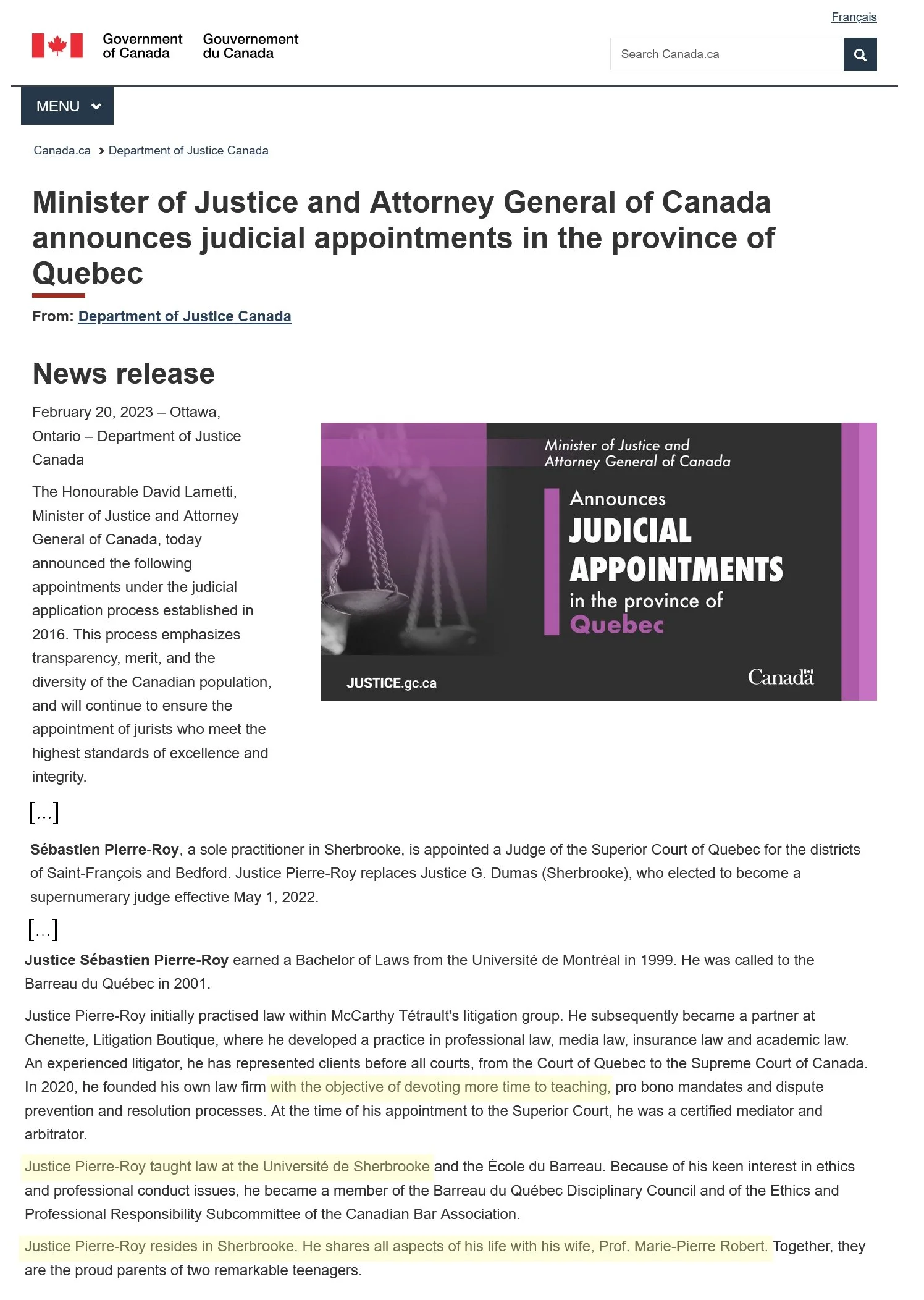
Source : Government of Canada
It was even suggested in the magazine “Paroles de droit” of the Faculty of Law of the University of Sherbrooke [10] (whose editorial committee included Marie-Pierre Robert herself [11]) that her husband had been teaching at the Faculty of Law of the University of Sherbrooke since 2008 (as if this had been a continuous and uninterrupted activity until his appointment in 2023), whereas in reality the public was being misinformed, since according to the official documents of the University of Sherbrooke, Sébastien Pierre-Roy had only taught a few courses here and there. The seniority lists of the University of Sherbrooke from 2008 to 2023 clearly indicate that Sébastien Pierre-Roy taught the equivalent of only 7.5 courses over 15 years, including the equivalent of 5 courses after his wife and her friend became influential within the Faculty of Law of the University of Sherbrooke, having offered him the opportunity to “devote more time to teaching”. Sébastien Pierre-Roy also taught a little in the postgraduate program of Criminal and Penal Law Practice, of which his wife was the director.

Cover page and excerpt from page 15 of the magazine “Paroles de droit” from the Faculty of Law of the University of Sherbrooke.
Obviously, once they have been acknowledged as qualified, favoured candidates will have virtually no trouble keeping their teaching positions for years (or even decades), but in the meantime, while they are still "not acknowledged as qualified," it requires a bit more mental gymnastics on the part of the Faculty of Law’s managers to get them there. The managers’ methodology for bringing them to the point of being "acknowledged as qualified" is quite simple to understand once uncovered, while also being fraudulent in nature (particularly through the manipulation of the seniority rules, by claiming one thing and its opposite, depending on the candidates’ situation and context in which they find themselves) :
When the "favourite" candidate, who is "not acknowledged as qualified," has institutional seniority and faces competition from another candidate who is "not acknowledged as qualified", who lacks institutional seniority, but who has a more impressive CV than the "favourite," then the management claims that seniority rules apply to lecturers that are "not acknowledged as qualified" and that the "favourite" candidate must be hired because of his or her superior institutional seniority, to the detriment of the candidate with the better CV.
When the "favourite" candidate, who is "not acknowledged as qualified," has no or less institutional seniority points and faces competition from another candidate, also "not acknowledged as qualified" but who has more institutional seniority, then the management changes its narrative and claims instead that the seniority rules do not apply to lecturers that are "not acknowledged as qualified" and therefore, they claim that they can choose either of the two candidates. In such a case, given the absence of objective criteria known in advance or of a hiring procedure, the management takes advantage of this situation in order to be able to come up, a posteriori, with fabricated reasons, modelled on the characteristics of the "favourite" candidate that had been hired, even if these explanations are of “variable geometry”, tailored to favour the candidate with whom the management has ties (former student, colleague, former work colleague, friend, "son of the other", nephew, contact or close associate of a politician, judge, prosecutor or police officer, etc.).
Caught with multiple recurring and repeated violations of the Collective Agreement's hiring rules, with a discriminatory application of seniority rules, with the absence of an internal hiring procedure, the lack of objective criteria known in advance and a clear inability to credibly explain their decisions to grant teaching contracts in my case, these managers of the Faculty of Law needed to divert the attention from these problems and come up with a ruse to sidetrack the legal debate.
The ruse
Following the fiasco of the previous deceitful maneuvers, the faculty’s managers sought to shift the narrative away from the fraudulent schemes. The two managers of the Faculty of Law of the University of Sherbrooke then devised another scheme : claiming that the reason I had not been granted teaching contracts for the DRT102 courses, for which I had the most institutional seniority compared to the hired candidates, was because I would not meet the minimum requirement of 5 years of professional and/or teaching experience in my field of specialisation, criminal and penal law…
Translation : With this new scheme, Louis Marquis and Marie-Pierre Robert sought to make believe that I had not accumulated 5 years of experience during all my professional activities between 2010 and 2022 at the time, and therefore that I would not meet the minimum requirements to apply for the DRT102 criminal law course. They had never raised such an issue before (between 2015 and 2022), but now, having run out of arguments, they were bringing it up retroactively (perhaps thinking they could exonerate themselves in this way, while shifting attention to this issue and away from the real systemic hiring problems).
While playing the benevolent card, Louis Marquis then invited me to submit an acknowledgment of qualification application for the criminal law course DRT102. I submitted a comprehensive application, with supporting evidence, copies of previous employment contracts, explanations and justifications regarding my professional and teaching experiences.
The result?
Two months after I filed my grievance (in February 2022) regarding the violations of the Collective Agreement committed by Louis Marquis’s and Marie-Pierre Robert’s administration, they “judged” (in April 2022) that the professional and teaching experiences gained between 2010 and 2022 (notably nearly 1 year as a law intern in criminal law at the Director of Criminal and Penal Prosecutions, 6 months as a Bar intern in criminal law at the Director of Criminal and Penal Prosecutions, 3 years as a criminal lawyer in private practice in Quebec, 3 years as legal consultant in private practice in Europe namely in criminal law, 2 years as a Master’s university researcher in criminal law, 5 years as a PhD university researcher in criminal law, 1 year and 8 months as a university researcher in criminal law for university professors in criminal law and with a university research center at the University of Sherbrooke, 4 years as a university teacher namely of subjects concerning criminal law) by a criminal lawyer who had been a member of the Quebec Bar since 2013, would, in their view, not be worth more than 0.8 years of professional and/or teaching experience.
Here again, just as they did with the two-tier application of the seniority rules, the non-existent internal hiring procedure and the violation of the 5-year experience rule, they had to resort to new absurdities to support their equally absurd conclusion of me having only 0.8 years of experience (not to mention the fact that they made this decision while they were in a conflict of interest, being personally interested in the outcome of their own decision).
*** The University of Sherbrooke's Conflict of Interest Policy 2500-032 [12], which applies to the managers of the Faculty of Law, defines a conflict of interest at section 4 as "a situation, whether real, potential or apparent, in which the person concerned has personal interests that could influence the performance of their official duties and responsibilities, or in which the person concerned uses their official functions for personal purposes. A conflict of interest may arise when activities or situations place an individual or an organisation to which they have ties in a position where interests (personal, institutional or other) conflict with the interests inherent to the duties and responsibilities related to their status or function at the University, thereby risking compromising the integrity of the decisions taken and undermining confidence in the University."
Since it was in their interest to render a decision that would “exonerate” themselves, these managers of the Faculty of Law should have delegated the aknowledgment qualification matter to someone else (which they did not do).
Some examples of what they claimed
They claimed in their decision that the professional experience I gained working for the Director of Criminal and Penal Prosecutions during the cooperative law internships (1 year of professional experience) "does not constitute professional-level experience", while they claimed on their website that the cooperative internships constitute a professional experience [13] :
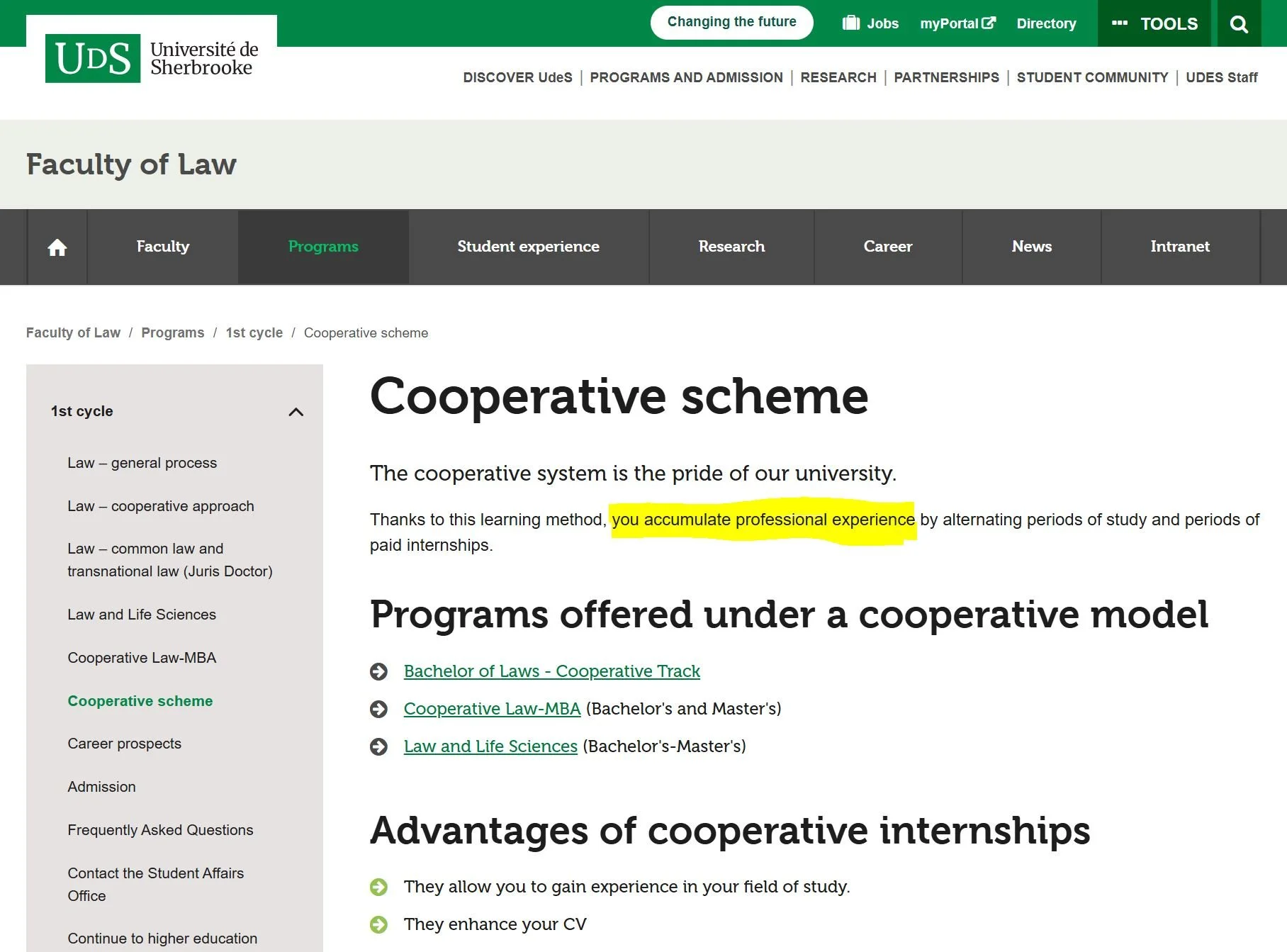
Source : University of Sherbrooke (new link here : https://www.usherbrooke.ca/droit/programmes/1er-cycle/regime-cooperatif). Original in French. English version provided by Google Chrome Browser.
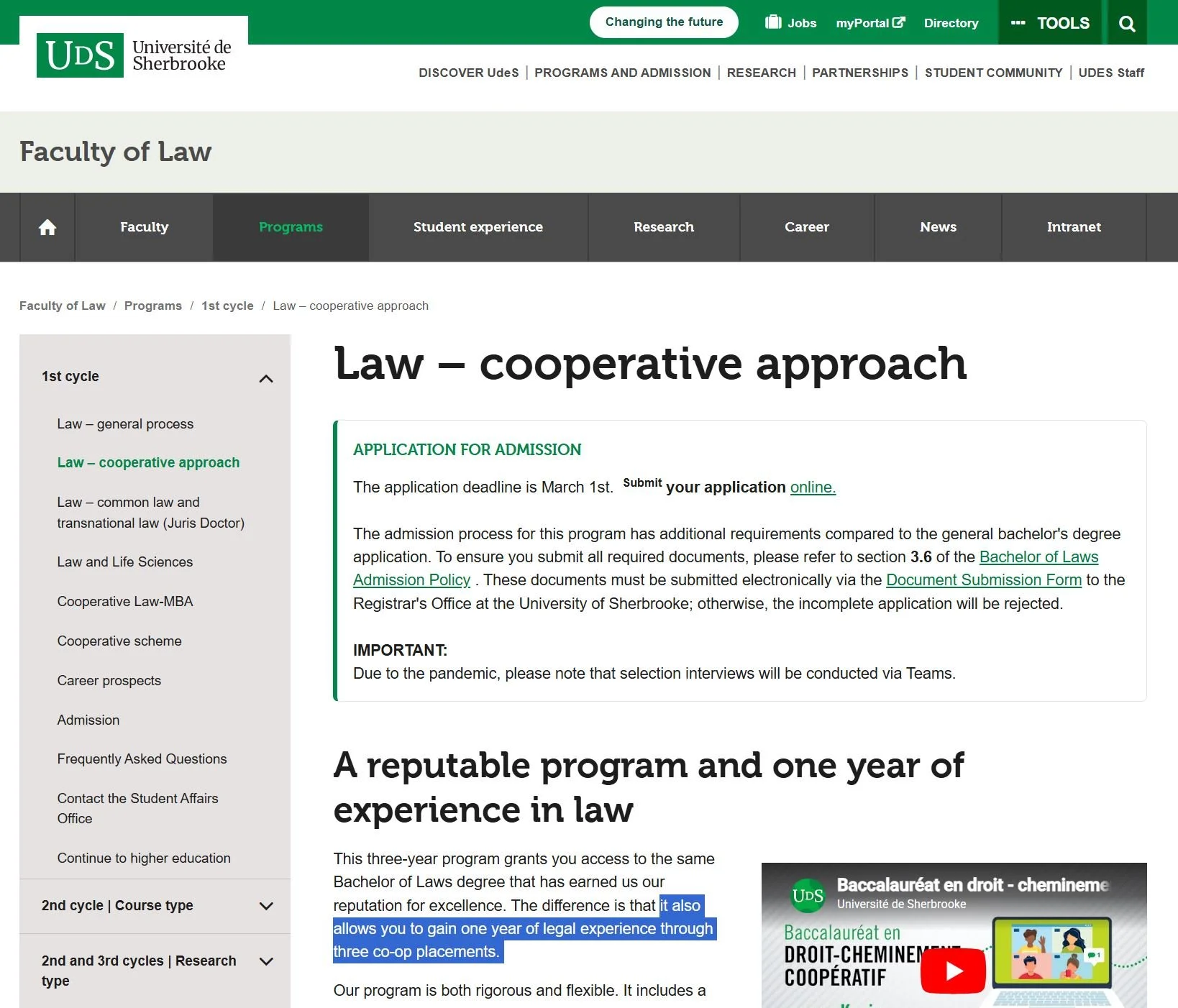
Source : https://www.usherbrooke.ca/droit/programmes/1er-cycle/droit-cheminement-cooperatif. Original in French. English version provided by Google Chrome Browser.
Later, when confronted with the falsehood of their claim, they preferred instead to claim that what was true was false, and that what was false was true, that what they stated on the Faculty's website was false (that it was merely "marketing") simply to avoid admitting the obvious fact that the work carried out in a professional environment, alongside professionals, under professional supervision, was indeed of a professional level. Consequently, based on this false claim, they excluded 1 year of professional experience from the calculation of the 5 years.
They even claimed that the professional experience gained during the Quebec Bar's professional practice internship with the Director of Criminal and Penal Prosecutions did not constitute a professional-level experience, while they knew or should have known that such a statement was false : the Director of Criminal and Penal Prosecutions publicly describes, in detail, the professional level of experience that is gained during this work [14] and Marie-Pierre Robert herself trains future interns for the Director of Criminal and Penal Prosecutions and future prosecutors at her Master's in Criminal and Penal Law Practice [15].
Source : Director of Criminal and Penal Prosecutions
Furthermore, need I add that following the successful completion of Marie-Pierre Robert’s 45-credit Master's Program in Criminal and Penal Law Practice [16], implemented with the assistance and contribution of the Director of Criminal and Penal Prosecutions [17], the Director of Criminal and Penal Prosecutions acknowledges that these studies carried out at the Faculty of Law of the University of Sherbrooke are equivalent to 2 years of professional experience [18], while the Faculty of Law of the University of Sherbrooke refuses to acknowledge the professional experience gained with the Director of Criminal and Penal Prosecutions?
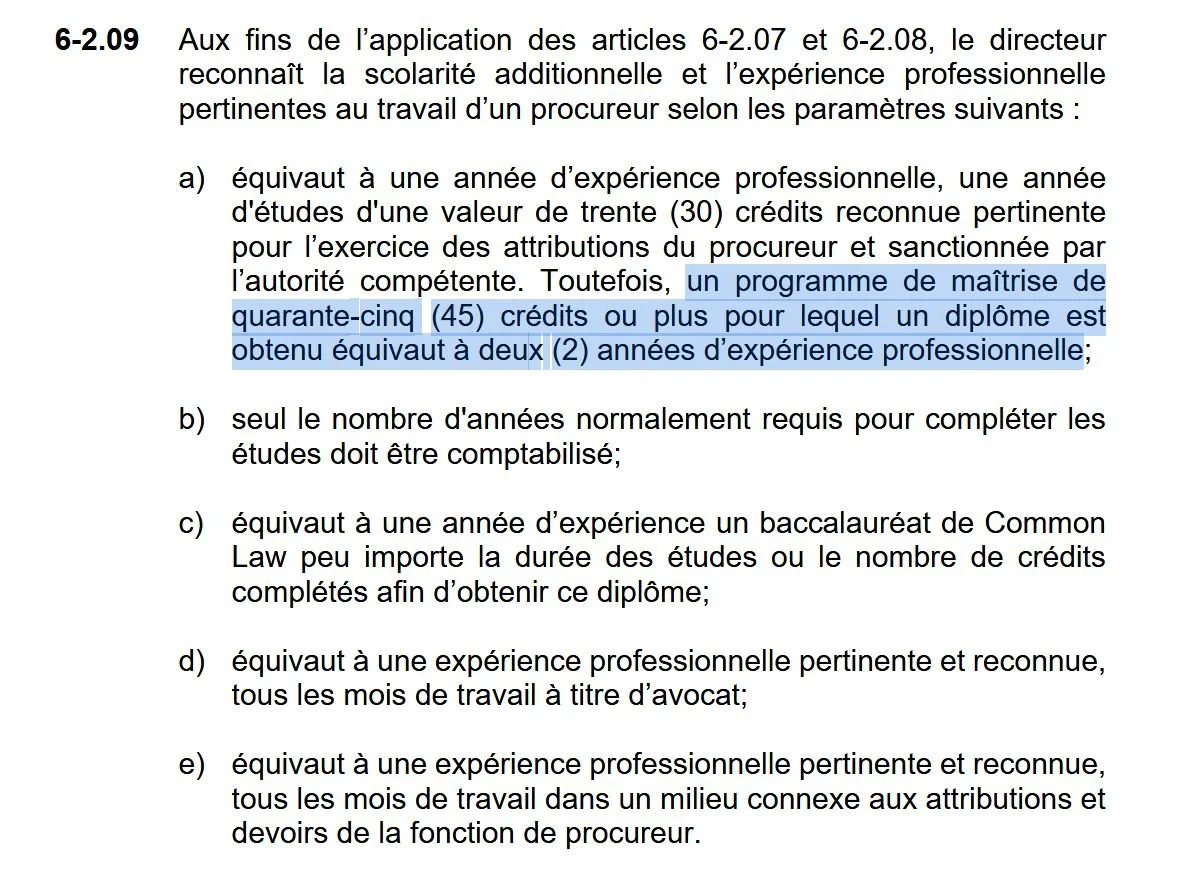
Source : Excerpt from the Collective Agreement of Prosecutors of the Director of Criminal and Penal Prosecutions (DPCP) - Agreement related to the working conditions of prosecutors in criminal and penal prosecutions between the Director of Criminal and Penal Prosecutions and the Association of Criminal and Penal Prosecutions Attorneys
Since when have academic studies been considered equivalent to professional experience, but actual professional experience itself is not considered a professional experience? Based on this absurdity, these managers excluded another 6 months of professional experience from the 5-years calculation.
Louis Marquis and Marie-Pierre Robert also disregarded the professional research experience I gained while undertaking my doctorate in criminal law at the Faculty of Law of the University of Sherbrooke (and the Faculty of Law and Political Science of the University of Bordeaux), even though this work, carried out at the forefront of the latest developments in criminal and penal law, constitutes professional experience that is acknowledged by the academic community, including by the Faculty of Law of the University of Sherbrooke. This is a key experience upon which universities recruit professionals for professorships. Often, these professional researchers are hired during their doctoral studies, even before obtaining their degree (often 2 to 3 years prior), specifically based on this professional experience. Furthermore, in my case, the Faculty of Law of the University of Sherbrooke had committed to acknowledge this professional research experience at the doctoral level through my international joint doctoral contract concluded with the University of Bordeaux, which incorporated French legislation stating in particular that doctoral training constitutes "a professional research experience" (article L612-7 of the Education Code), to which the Faculty of Law of the University of Sherbrooke was bound by signing this contract. Moreover, during my Master's degree in criminal law, which was under the supervision of Marie-Pierre Robert at the Faculty of Law of the University of Sherbrooke, in order to convince me to enroll in the doctoral program at the Faculty of Law of the University of Sherbrooke (and not elsewhere), Marie-Pierre Robert herself told me that the experience I would gain as a doctoral researcher with them would allow me to teach as a lecturer and subsequently as a professor of criminal and penal law at the Faculty of Law of the University of Sherbrooke (I may address at another time how I was recruited and how I was convinced at the time to become a professor of criminal law at the Faculty of Law of the University of Sherbrooke). Instead, despite the promises made to me, and contrary to the doctoral contract, these two deans excluded 5 years of scientific research work at the university in criminal and penal law from the calculation of the minimum 5 years required to be "acknowledged as qualified" to teach an introductory course in criminal and penal law.
These two deans also disregarded, without any explanation, all my other experience as a researcher in criminal law, including several research contracts in criminal law and the research experience I gained while working with a university research group at the University of Sherbrooke, even though they acknowledged this same research experience for other lecturers. For example, they disregarded 2 research contracts carried out in criminal law over the course of 1 year with Professor Simon Roy and Professor Marie-Pierre Robert, whereas for another lecturer, Dean Marie-Pierre Robert acknowledged as a professional experience his legal research contract completed with her (as well as the research work this candidate carried out at the Court of Appeal of Quebec as a clerk to Judge Benoit Moore) and offered him a lectureship at the Faculty of Law.

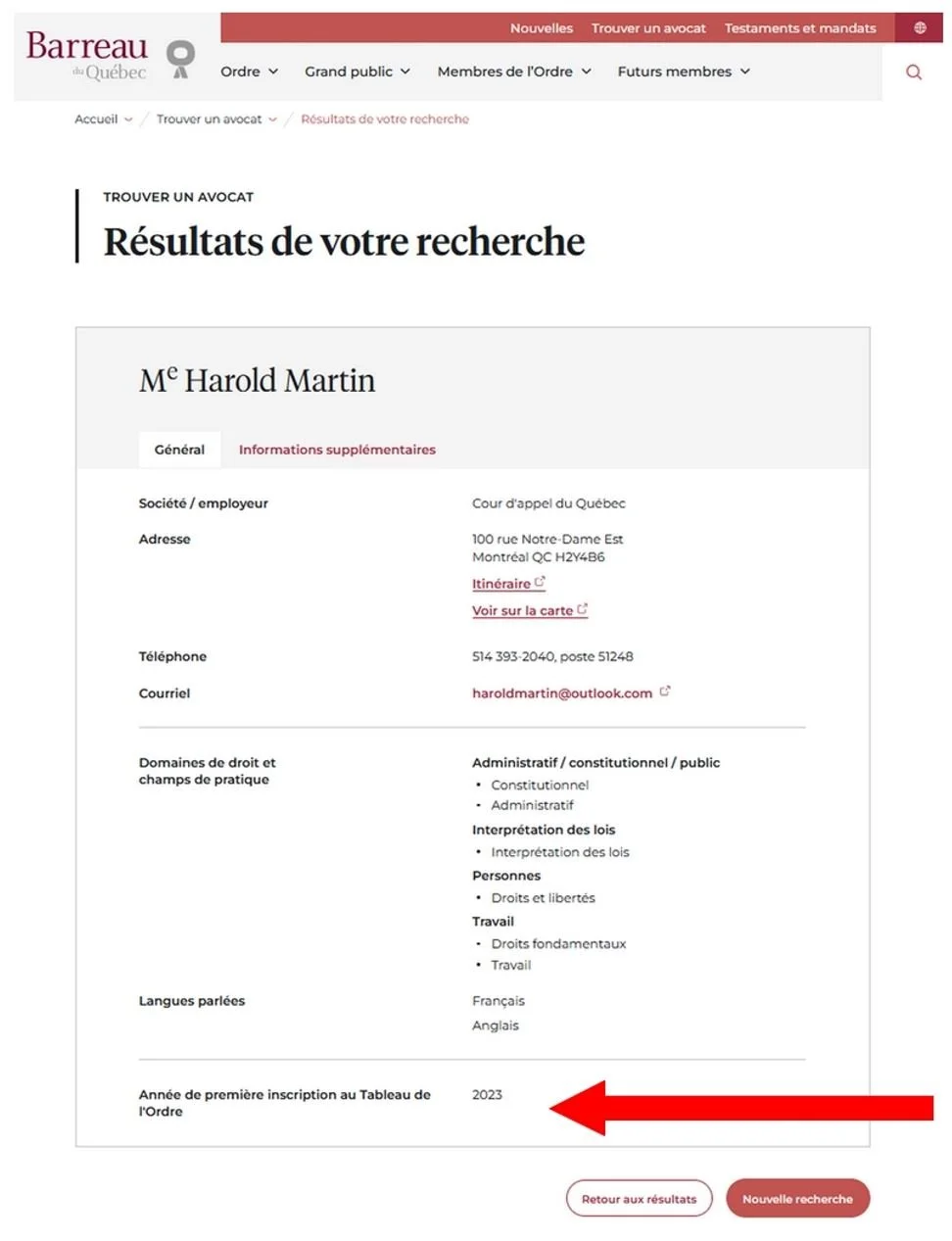
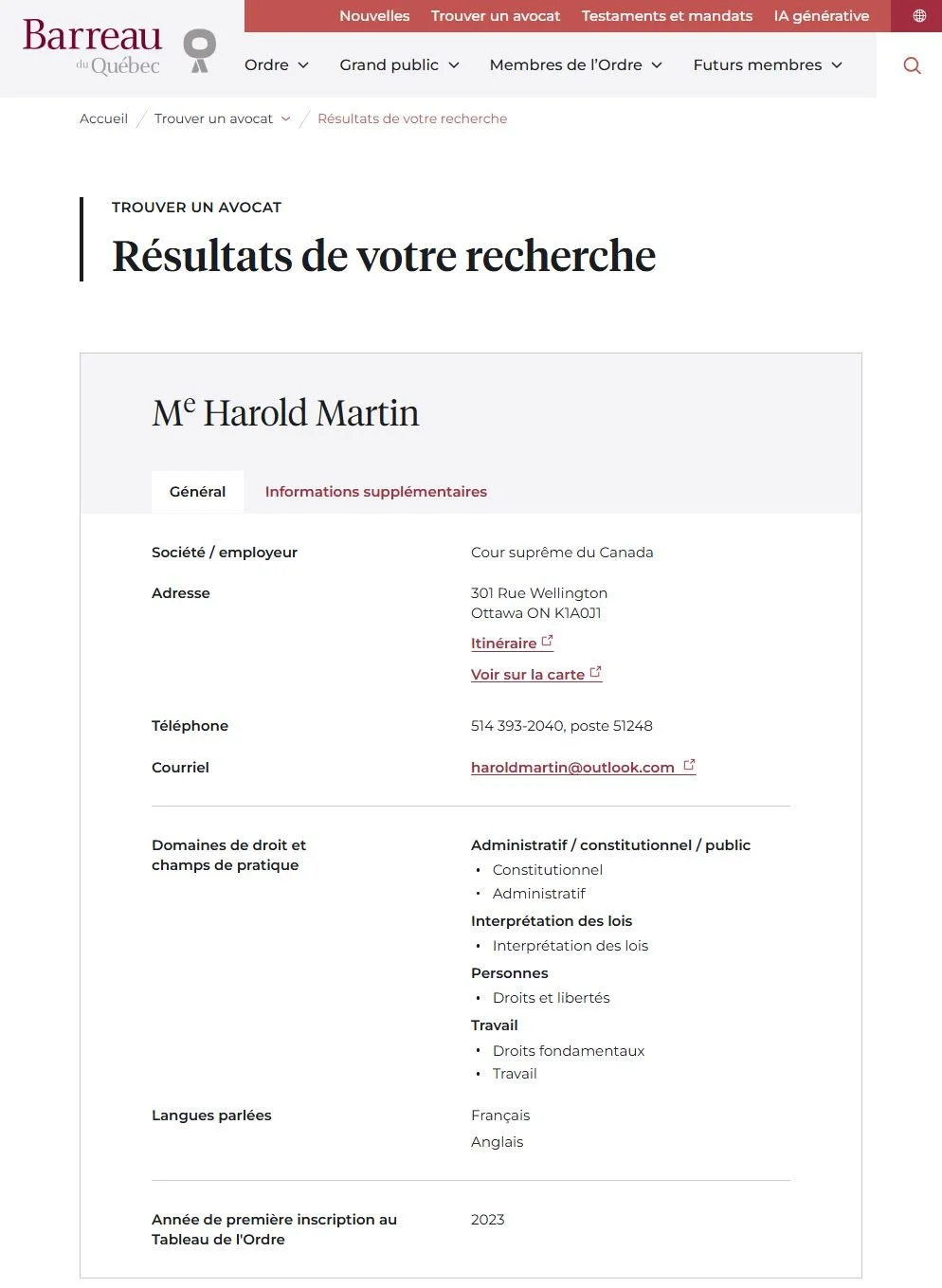
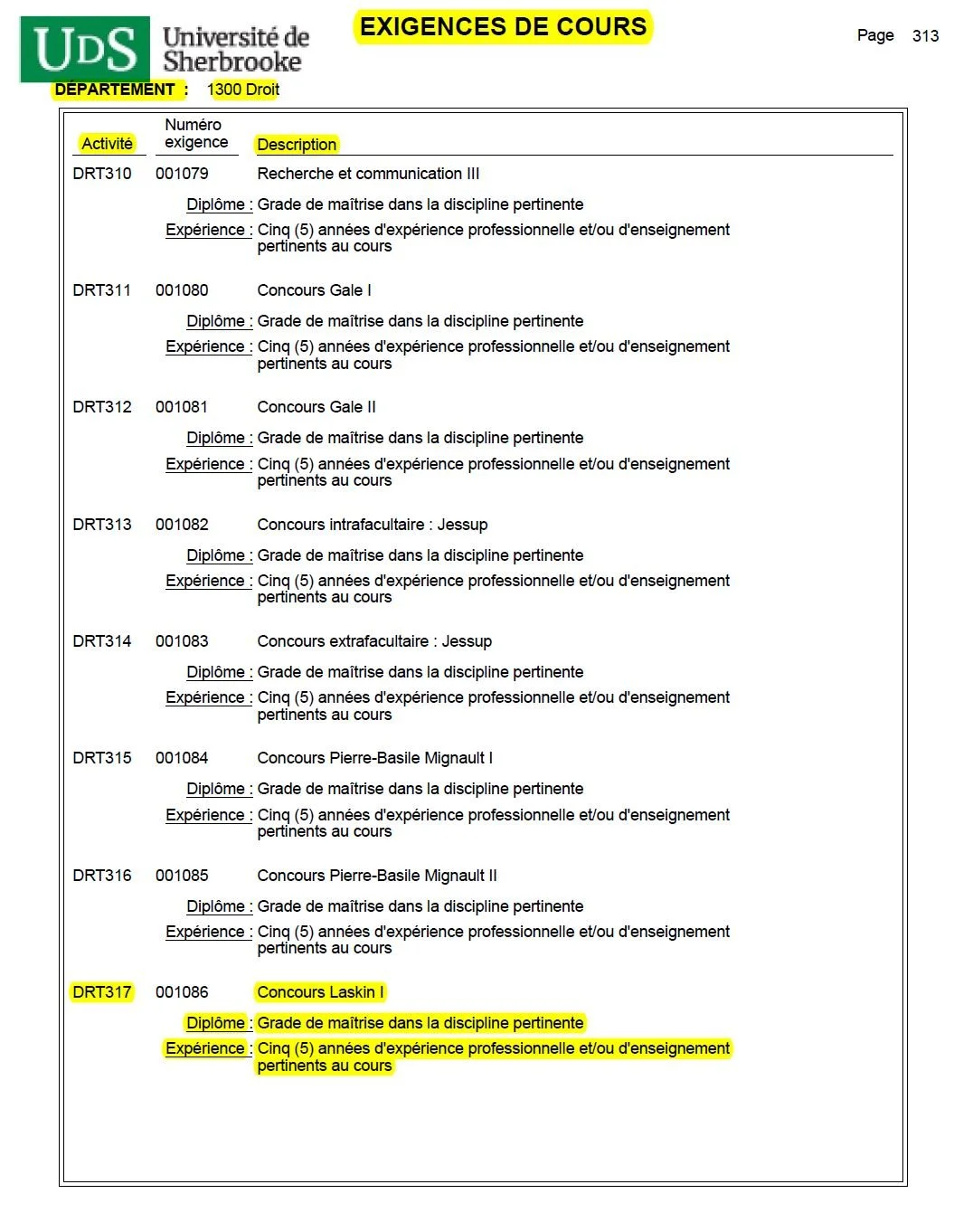
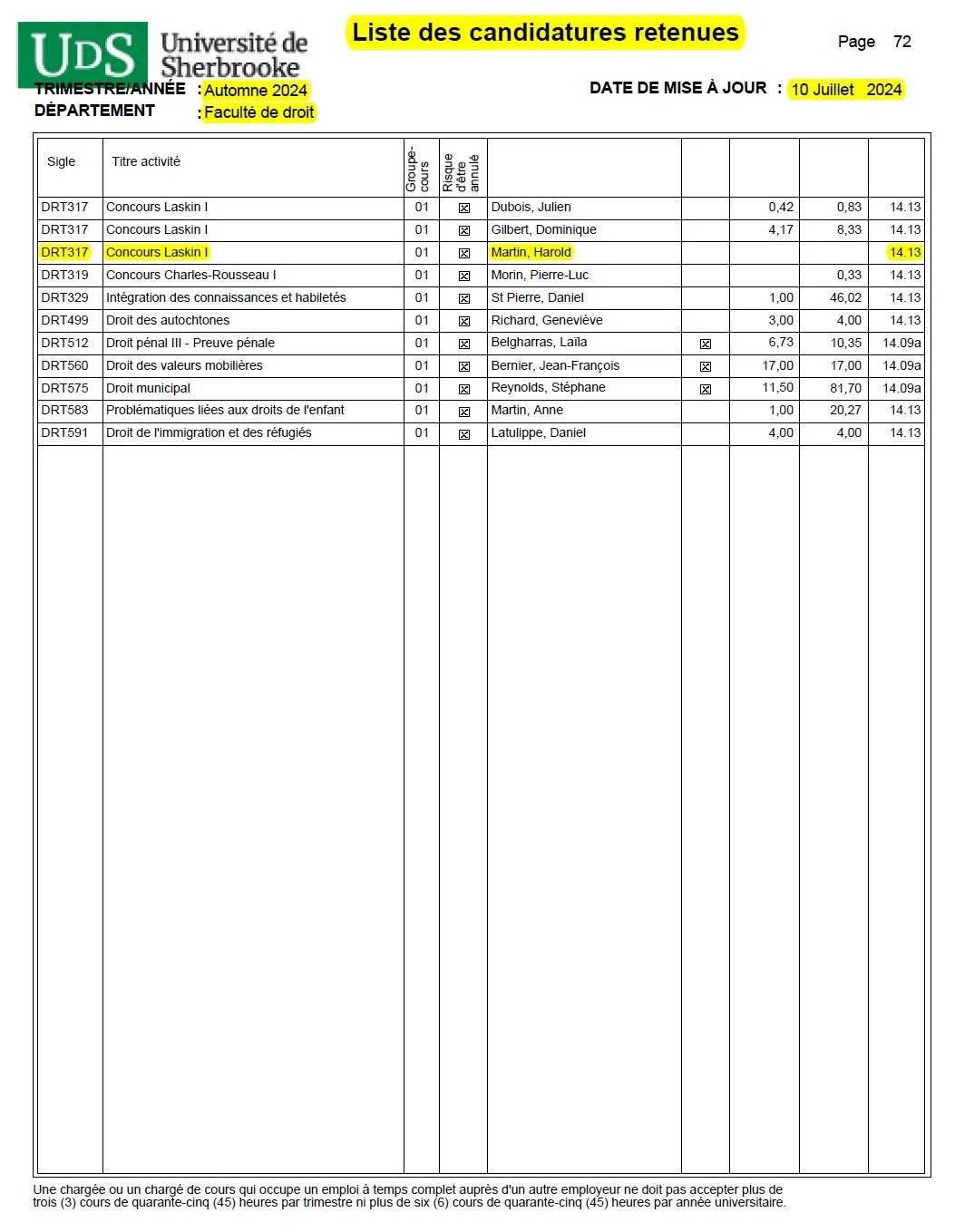
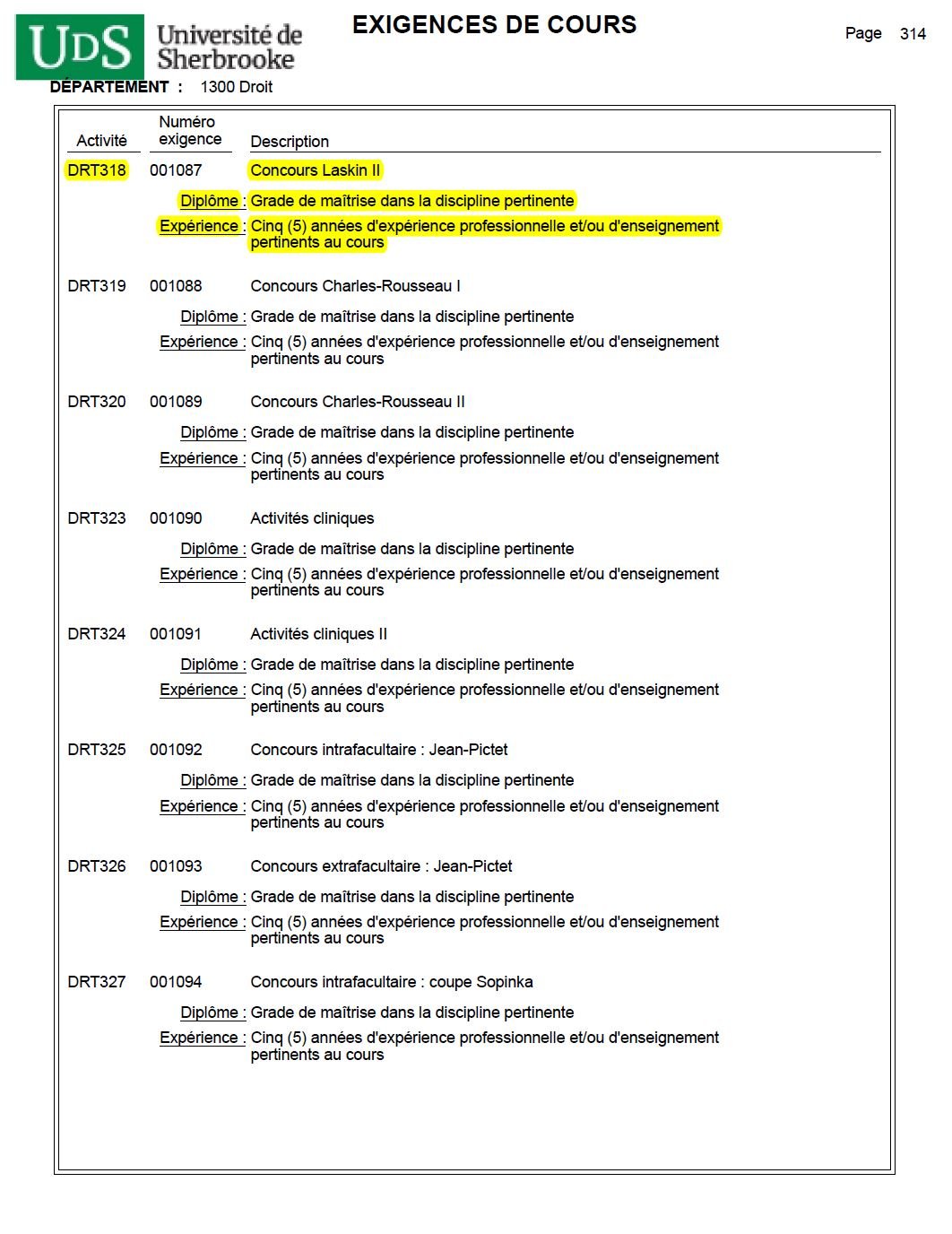
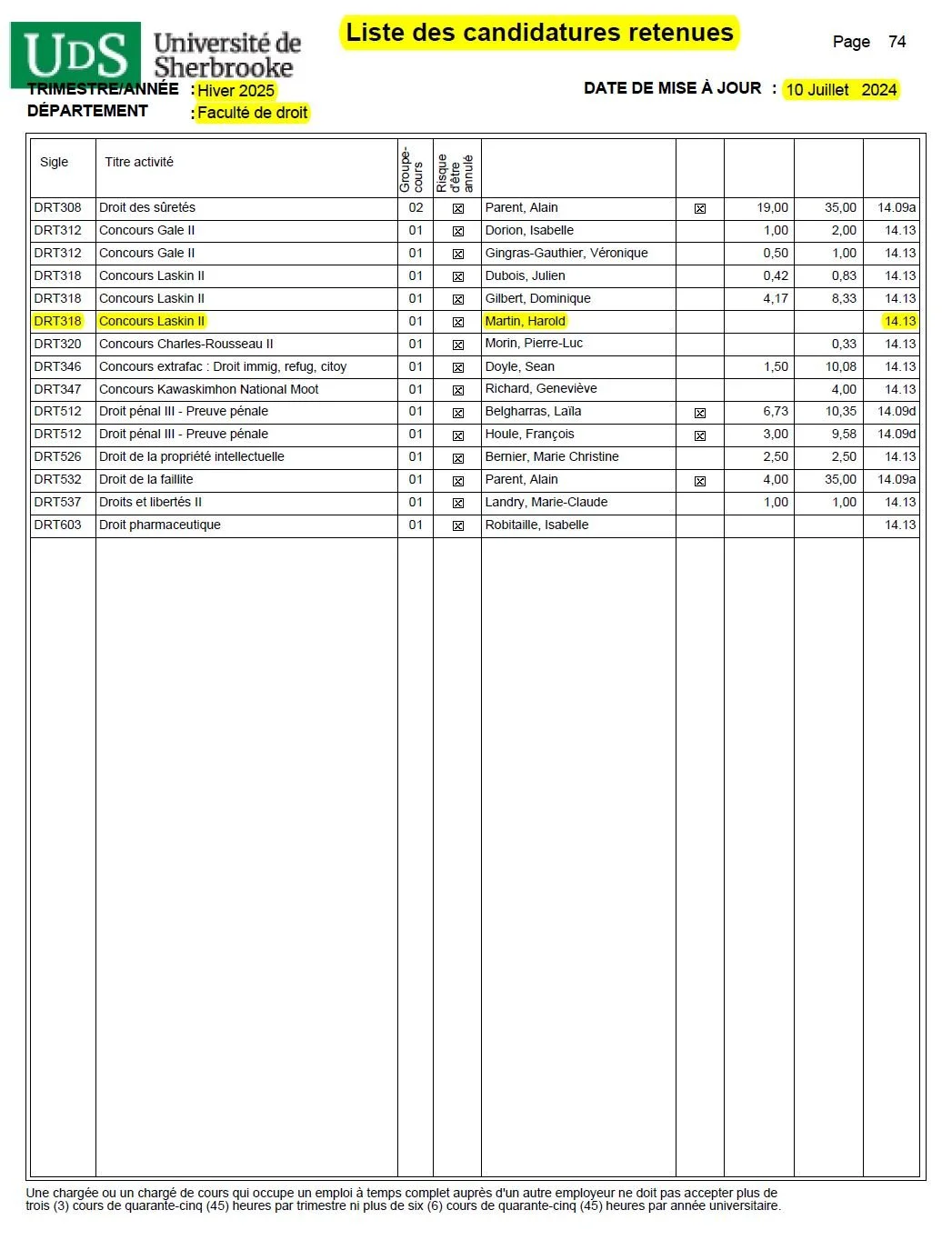
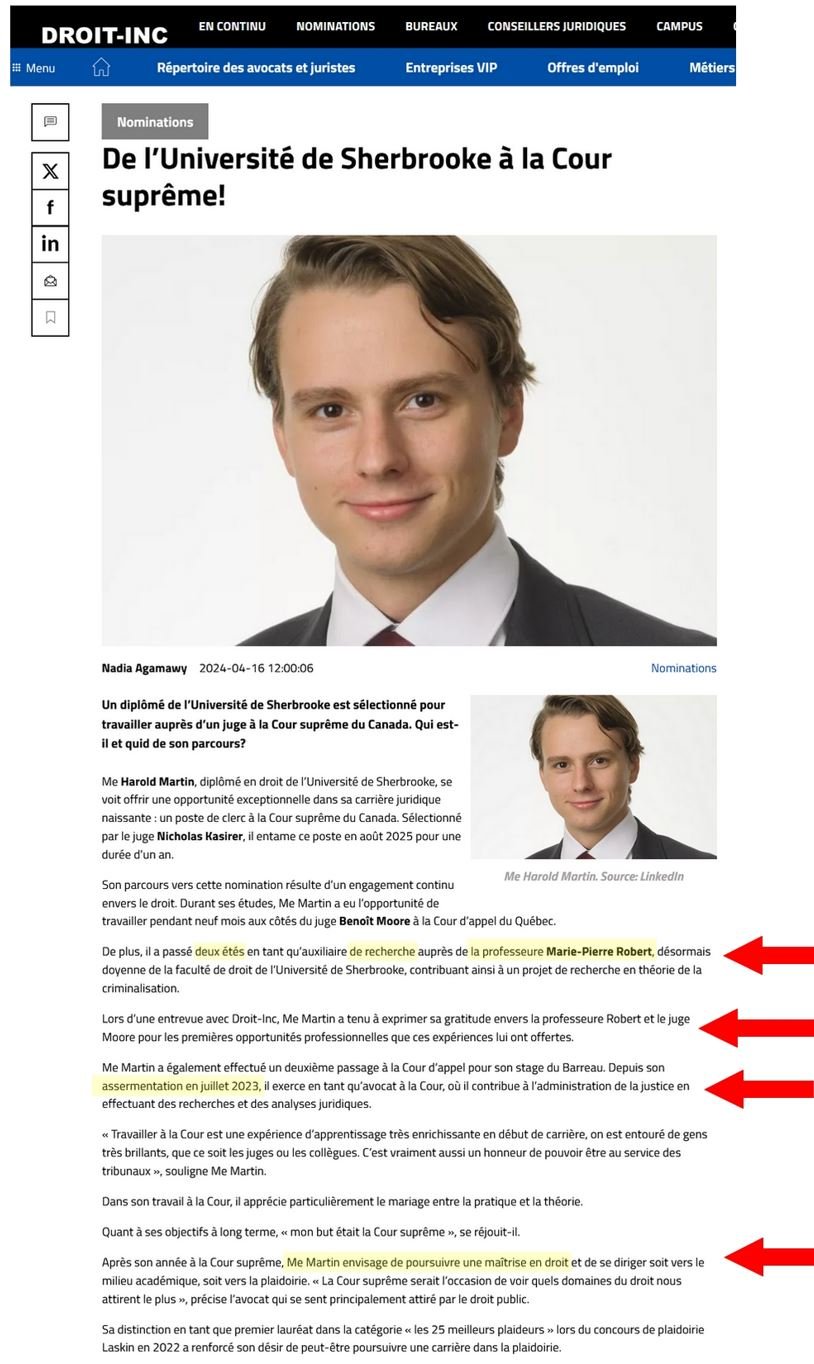
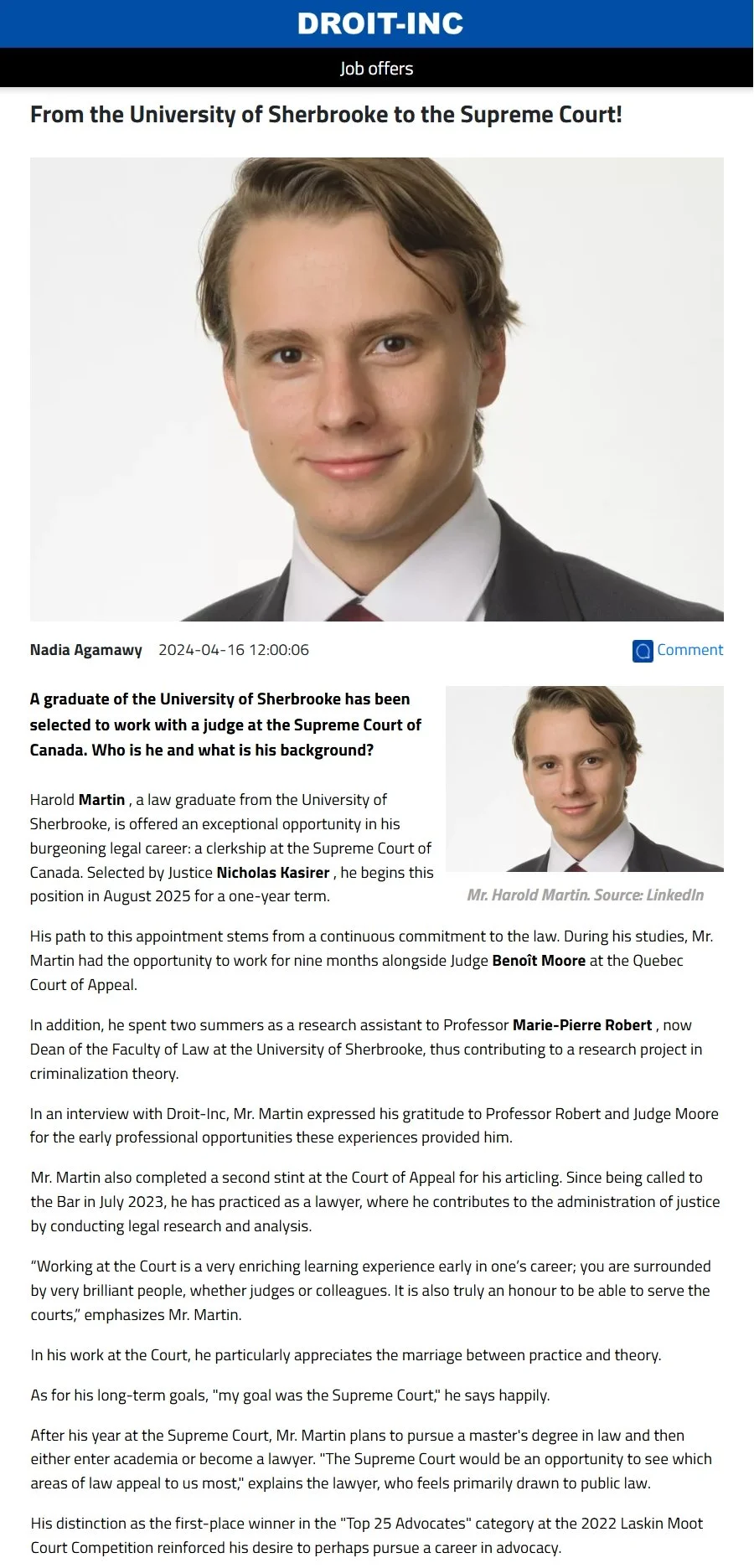
It should be noted that this candidate had only been a member of the Quebec Bar since 2023 (prior to 2023, he was a law student at the University of Sherbrooke) and that he was hired in 2024 by Dean Marie-Pierre Robert to teach as a lecturer, in violation of the same mandatory minimum requirement of 5 years of professional legal experience in the field relevant to the course. This is yet another striking example of a double standard : the same type of research experience acknowledged for some candidates was suddenly no longer acknowledged for others. It should also be noted that this candidate did not meet the other mandatory eligibility criterion for the two teaching contracts granted to him by Marie-Pierre Robert : he did not hold a Master’s degree in law at the time of his hiring. Obviously, this is in no way a criticism of the candidate (whom I respect), but only a blatant example of how Dean Marie-Pierre Robert is clearly violating hiring rules and how she is "evaluating" the same type of experience in a discriminatory, double-standard manner.
These managers even disregarded my professional experience in cybercrime law (criminal law that applies to cyberspace and cybersecurity), even though cybercrime is, for those familiar with the contemporary reality of criminal law, a central aspect of criminal law. Consequently, Dean Louis Marquis and Dean Marie-Pierre Robert disregarded another 3 years of professional experience.
These two managers of the Faculty of Law also dismissed all my professional experience practising law in private practice under the pretext that it was gained concurrently with my postgraduate studies, and that a professional could not simultaneously work and pursue postgraduate studies at the same time, even though the Faculty of Law acknowledged this same professional experience gained during postgraduate studies for other lecturers in similar situations when it wished to hire or promote them. Not only did the Faculty of Law’s managers know that "it’s possible" (see photo below), but they were actively promoting this type of multifaceted career, which combines the practice of law and postgraduate studies simultaneously, as well as the added value of the professional experiences and skills gained in this way. In the same month (April 2022) that Louis Marquis falsely claimed it was impossible for me to achieve such a work-study balance, his Faculty of Law claimed the opposite (in April 2022) and even produced podcasts to promote "practising law and pursuing postgraduate studies simultaneously". Here is an example of a promotional interview by the Professional Development Centre of the Faculty of Law of the University of Sherbrooke with Marie-Pier Baril [19], a lawyer who had chosen to do the same as me, practise law and pursue a PhD at the same time :
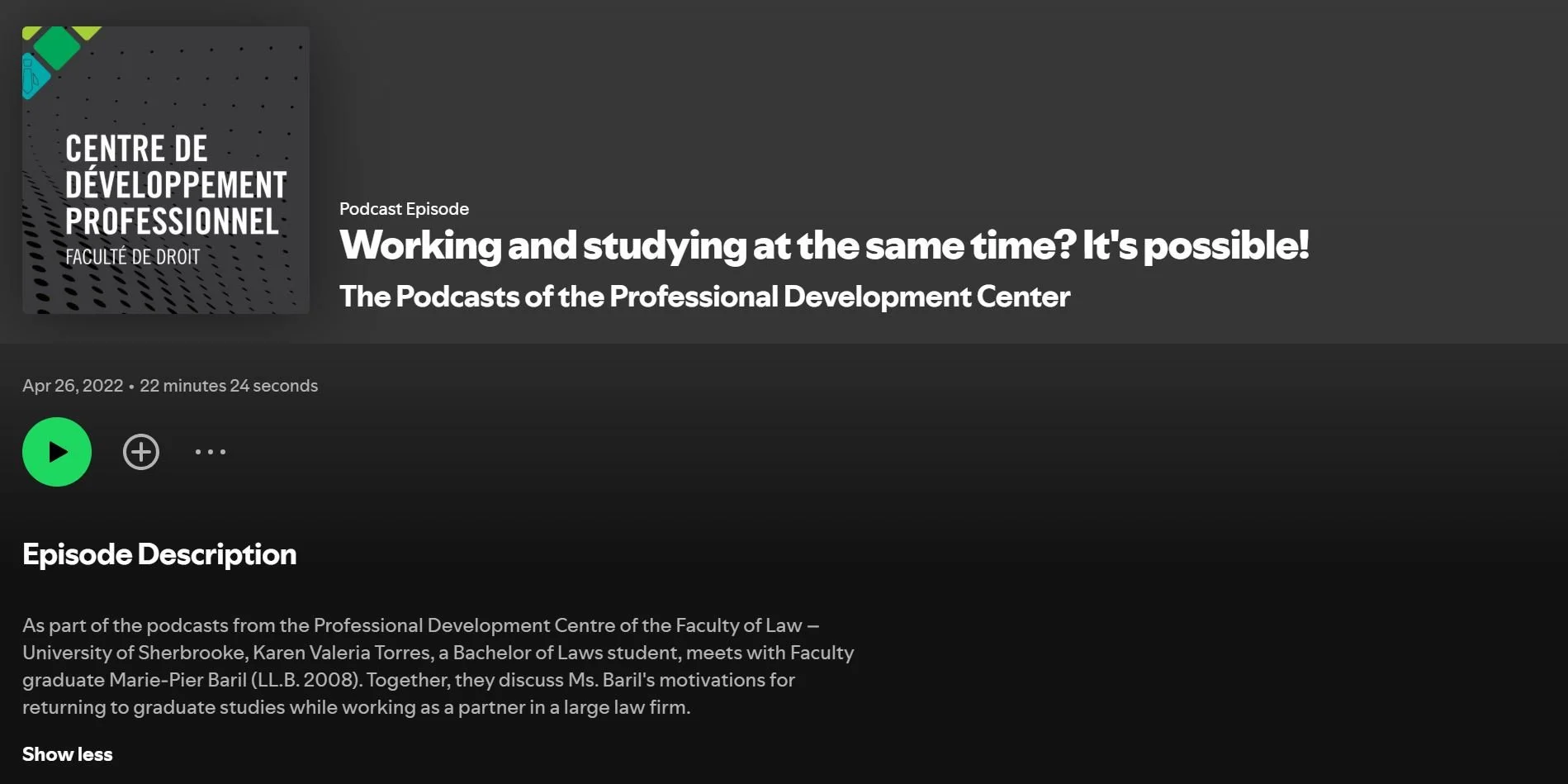
Source : Professional Development Centre of the Faculty of Law, University of Sherbrooke (https://open.spotify.com/episode/0Wf98fbxZrv00BFr37nEyl). Original in French. English version provided by Google Chrome Browser.
Consequently, based on their false claim, Dean Louis Marquis and Dean Marie-Pierre Robert excluded another 3 years of professional experience from the calculation of the 5 years.
They continued in this way their "analysis" of the "aknowledgement of qualification" application for the DRT102 course (by excluding any other work experience I had that would have required them to acknowledge that I had cumulatively more than 5 years of professional and teaching experience, that I had long been qualified to teach the DRT102 course, and that, ultimately, they were responsible for failing to apply the seniority rules in my case) until they had disregarded all my experiences from the calculation of the 5 years required.
Even after receiving a detailed 60-page request for review, Dean Louis Marquis chose to uphold "the Faculty's decision," without further justification :
“Hello Mr. Popa, After having analysed your commentaries and additional explanations related to the decision to refuse your application to be acknowledged as qualified on the course DRT102 Penal Law I - General Penal Law, the Faculty maintains its decision. Cordially, The dean, Louis Marquis, professor.”

The lack of justification for this decision was perplexing, firstly in general, since a university decision-maker has an obligation to justify any decision that affects the rights of a university member. It was also perplexing specifically for Louis Marquis since, in theory, in order to enhance his own image, he actively preached about the duties of a dean :
“The dean must demonstrate integrity, fairness, and humility in all aspects of their work. […] In my view, governance must […] operate according to rules that are known, understood, and shared. It must result in exemplary accountability and transparency. […] Those holding governance positions […] must support their proposals and decisions with sound arguments and document them adequately.”
- Louis Marquis, in Paroles de droit of the Faculty of Law of the University of Sherbrooke, vol. 12, no 1, Winter 2020, p. 7 [20].
Regrettably, the two deans demonstrated that words are meaningless without concrete and practical application, first and foremost to oneself, but also to one’s colleagues (Marie-Pierre Robert and Sébastien Lebel-Grenier). On the contrary, when the situation affected these managers personally, they quickly forgot both the importance of dispute prevention and resolution (in which one of them specialised), and their previous statements.
A poorly thought out ruse
The ruse these managers concocted by refusing to acknowledge my qualifications was rather poorly thought out, as they seemed to have forgotten that Marie-Pierre Robert herself, in her capacity as Associate-Dean responsible for hiring lecturers, had acknowledged in 2018 that I had already met the mandatory minimum requirement of 5 years of professional experience in criminal law to be hired to teach the criminal law course DRT102, a course on which she had, in fact, hired me to teach in part (hiring from which my 0.25 points of specific seniority for that course came from). According to her own statements, Marie-Pierre Robert could not have hired me in 2018 if I had not met the mandatory minimum 5-year requirement for such a position (section 12.02 of the Collective Agreement). Their 2022 ruse therefore lacked logic.
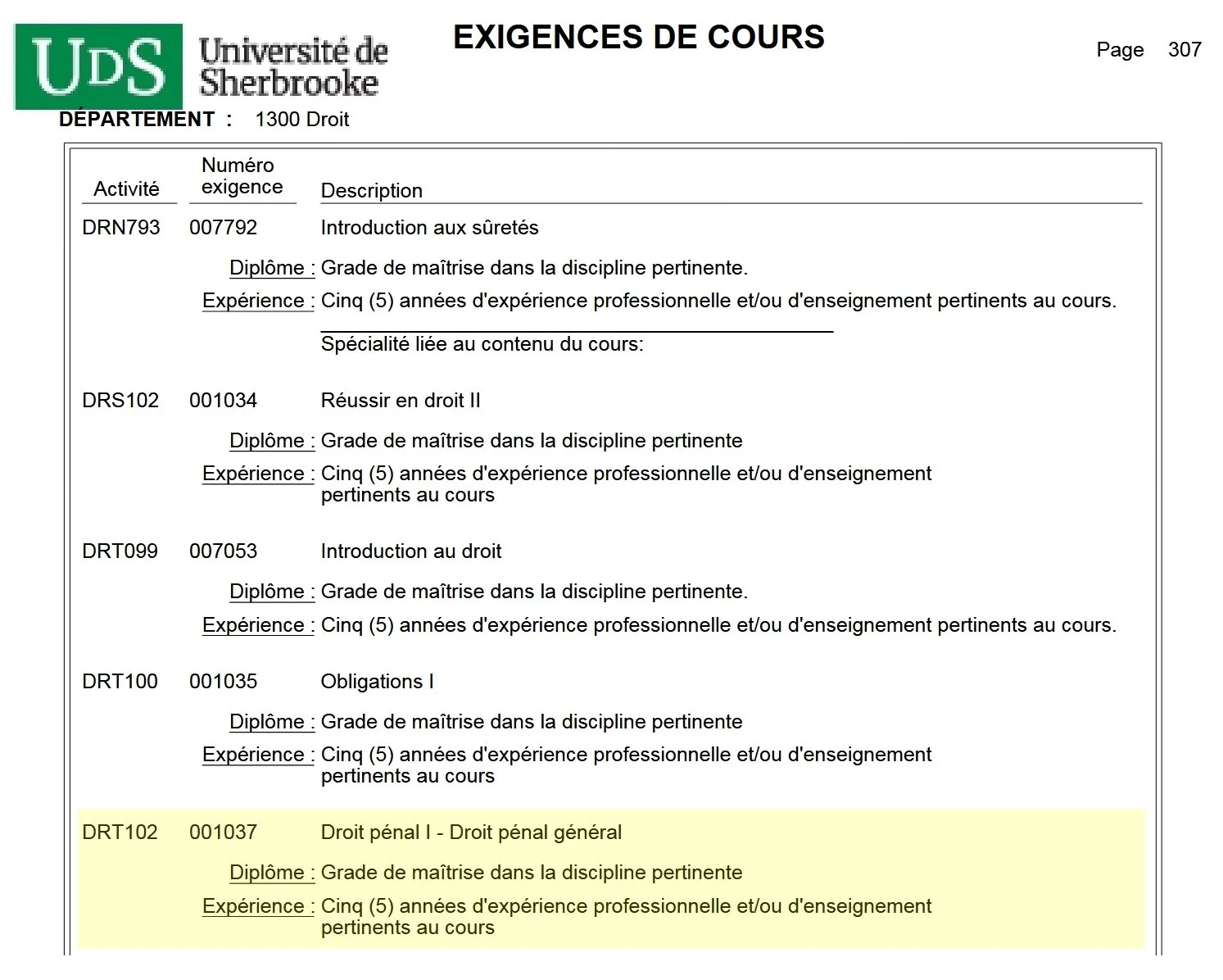
Source : Excerpt from the list of course requirements of the University of Sherbrooke.
Their claim was also illogical on another level : Associate-Dean Marie-Pierre Robert, as she then was, had acknowledged in 2015 that I had accumulated 5 years of professional experience (most of which was largely based in criminal and penal law) in order for her to hire me as a lecturer to teach the DRT132 Legal Writing course. However, this same experience in criminal and penal law that she had then already acknowledged in 2015 as being relevant to teach legal writing, was suddenly no longer relevant for her and Louis Marquis 7 years later, in 2022, to teach in the same field of law in which that experience had been acquired.
In short, the faculty’s managers admitted on 2 prior occasions that I had already met the 5-year requirement, once in 2015 and a second time in 2018. The third time, after I uncovered the systemic hiring problems and filed a grievance, suddenly the faculty’s managers realised they needed to deny what they had already admitted twice, even though, in the meantime, I had gained (and not lost) more professional and teaching experience…
But who cares? These managers of the institution which presents itself to the public as “humane” and “caring,” had other objectives : to avoid responsibility and to take revenge. To kill two birds with one stone.
From that moment on, many things happened, particularly behind the scenes within the judiciary.
The rest of the story is here : https://www.claudiu-popa.com/about-the-university-environment/cain-lamarre-law-firm-university-of-sherbrooke-disqualification-misconduct
ALL ARTICLES IN THIS SERIES :
-
-
-
-
-
-
Coming soon
-
Coming soon
-
-
-
English version coming soon.
French version available here : https://www.claudiu-popa.com/publications-juridiques/decoder-la-fraude
*****
[1] Collective agreement between the University of Sherbrooke and the Union of Lecturers of the University of Sherbrooke 2020-2025, online : ‹https://www.usherbrooke.ca/personnel/fileadmin/sites/personnel/documents/Conventions/scccus/convention_scccus.pdf› (hereinafter “Collective Agreement”).
[2] Florence TISON, “A lawyer approaches young girls on social media”, Droit-inc., November 11, 2020, online : ‹https://www.droit-inc.com/conseils-carriere/nouvelles/un-avocat-aborde-des-jeunes-filles-sur-les-reseaux-sociaux›.
[3] Collective agreement, sections 25.02 and 25.05.
[4] Id., s. 12.09, para. 1.
[5] Id., s. 12.09, para. 3.
[6] Barreau du Québec (syndic adjoint) v. Leblanc, 2024 QCTP 51, para. 6.
[7] University of Sherbrooke and University of Sherbrooke Lecturers' Union, 2022 CanLII 21715.
[8] CENTER FOR PROFESSIONAL DEVELOPMENT, “Graduate and lecturer – Me Claudia Bérubé”, University of Sherbrooke, April 13, 2022, online : ‹https://creators.spotify.com/pod/profile/cdp-droit/episodes/Diplme-et-charge-de-cours---Me-Claudia-Brub-e1h4gqq›.
[9] GOVERNMENT OF CANADA, “Minister of Justice and Attorney General of Canada announces judicial appointments in the province of Quebec, Government of Canada, February 20, 2023, online : ‹https://www.canada.ca/en/department-justice/news/2023/02/minister-of-justice-and-attorney-general-of-canada-announces-judicial-appointments-in-the-province-of-quebec.html›.
[10] PAROLES DE DROIT, “Credits”, (2024) 16-1 Paroles de droit 1, 2, online: ‹https://www.usherbrooke.ca/droit/fileadmin/sites/droit/documents/publications/PdeD_Hiver2024.pdf›.
[11] Id., “Appointments to the judiciary”, 15.
[12] UNIVERSITY OF SHERBROOKE, Conflict of Interest Policy 2500-032, online : ‹https://www.usherbrooke.ca/decouvrir/fileadmin/sites/decouvrir/documents/direction/politiques/2500-032.pdf›.
[13] FACULTY OF LAW OF THE UNIVERSITY OF SHERBROOKE, “Cooperative Regime”, University of Sherbrooke, 2025, online : ‹https://www.usherbrooke.ca/droit/developpement-professionnel/regime-cooperatif›.
[14] DIRECTOR OF CRIMINAL AND PENEAL PROSECUTIONS, “Understanding a Bar internship at the DPCP”, Director of Criminal and Penal Prosecutions, January 19, 2024, online : ‹https://www.youtube.com/watch?v=eoCpdwJ9jSE›.
[15] FACULTY OF LAW OF THE UNIVERSITY OF SHERBROOKE, “Practice of Criminal and Penal Law (CPN)”, University of Sherbrooke, 2025, online : ‹https://www.usherbrooke.ca/droit/programmes/2e-cycle-type-cours/dcp#acc-5458-1163 .
[16] UNIVERSITY OF SHERBROOKE, “Master’s in Criminal and Penal Law Practice”, University of Sherbrooke, 2023, online : ‹https://www.usherbrooke.ca/admission/programme/676/maitrise-en-pratique-du-droit-criminel-et-penal/›.
[17] David JOBIN, “Launch of the program in the practice of criminal and penal law. Finally, training perfectly adapted to the new practice of criminal law”, University of Sherbrooke, September 6, 2013, online: ‹https://www.usherbrooke.ca/actualites/nouvelles/facultes/droit/details/22678›.
[18] GOVERNMENT OF QUEBEC, Agreement concerning the working conditions of prosecutors in criminal and penal prosecutions between the Director of Criminal and Penal Prosecutions and the Association of Criminal and Penal Prosecutions Attorneys, section 6-2.09, online : ‹https://cdn-contenu.quebec.ca/cdn-contenu/adm/org/dpcp/PDF/Conditions_de_travail/Entente_procureurs_2023-2027_original_signe_DPCP.pdf›.
[19] CENTER FOR PROFESSIONAL DEVELOPMENT, “Work and higher education simultaneously? It’s possible”, University of Sherbrooke, April 26, 2022, online : ‹https://open.spotify.com/episode/0Wf98fbxZrv00BFr37nEyl›.
[20] PAROLES DE DROIT, “A faculty that pushes back the boundaries of law”, (2020) 12-1 Paroles de droit 1, 7.