Concerning the appointment of Louis Marquis as a judge to the Superior Court of Quebec - Chapter 2
Alexandra Captariu, LL.B.
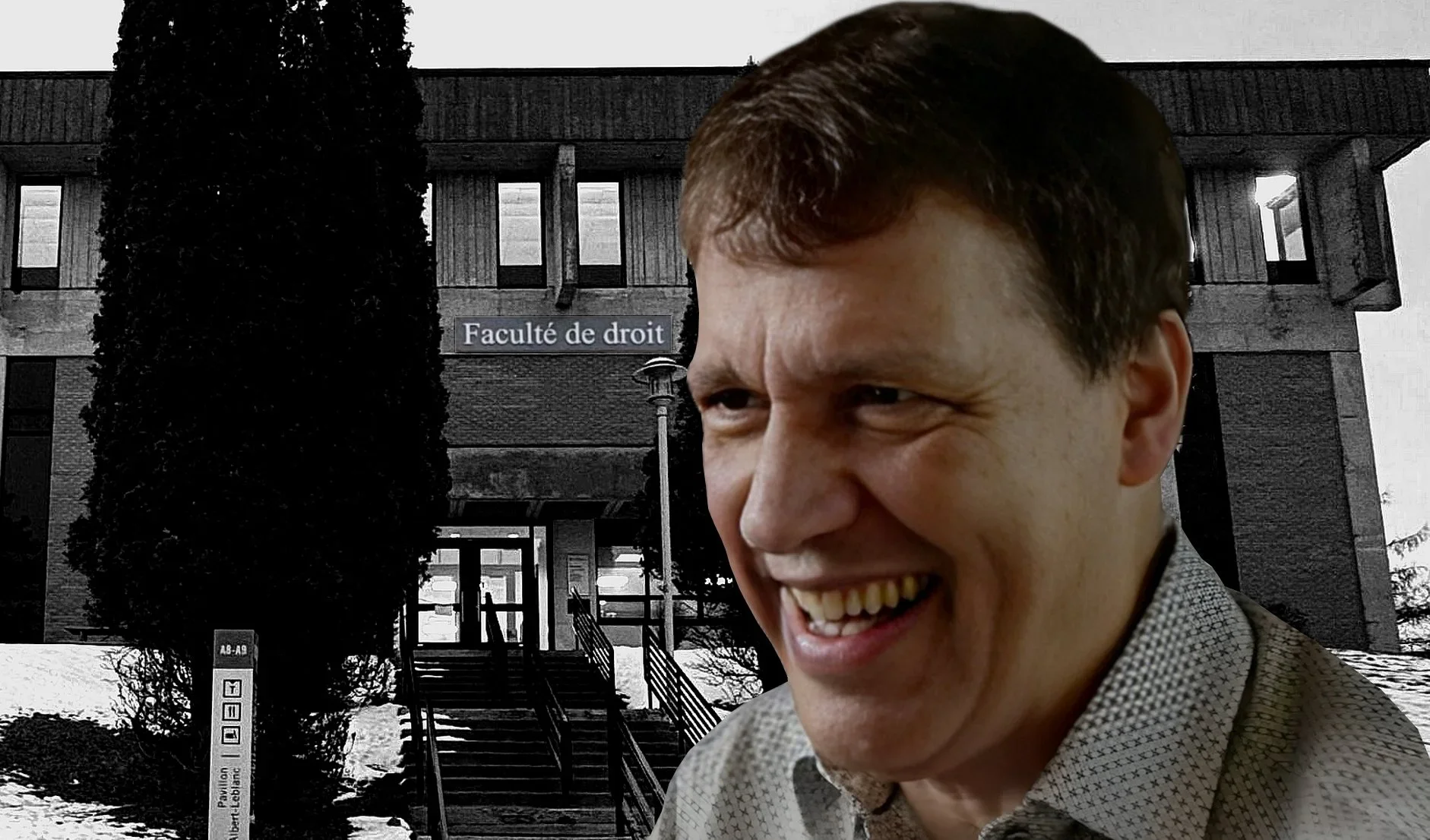
All publications in this series :
-
-
-
-
-
-
Coming soon
-
Coming soon
-
-
-
English version coming soon.
French version available here : https://www.claudiu-popa.com/blog-juridique/decoder-la-fraude
(if you open the link with Google Chrome browser, it automatically translates the article in English)
The first article concerning the nomination of Judge Louis Marquis to the Superior Court of Quebec in June 2024 highlighted his failure to fulfill his legal obligation, as a candidate for the judiciary, to be completely honest and transparent in the judicial appointment process : Louis Marquis did not disclose his involvement in litigations which he himself had generated and refused to resolve since 2022, in his capacity as Dean of the Faculty of Law at the University of Sherbrooke. Yet, he was asked in the questionnaire for federal judicial appointments whether he was involved in any past or ongoing cases. To comply with this obligation, Marquis was required not only to declare all the litigations in which he had been involved, but also to provide the Government of Canada with a full explanation and all relevant documents.
For more details, read "Concerning the appointment of Louis Marquis as a judge of the Superior Court of Quebec - Chapter 1" : https://www.claudiu-popa.com/about-the-university-environment/appointment-louis-marquis-judge-superior-court-of-quebec
Furthermore, to be appointed a judge, a candidate for the judiciary is not only required to be completely honest and transparent in the application questionnaire, but must also meet a series of criteria [1] analysed by the members of the Federal Judicial Advisory Committee, which recommends a candidate to the Minister of Justice of Canada. These requirements include namely the following :
"capacity to exercise sound judgement"
"consideration for others"
"empathy"
"common sense"
"sense of ethics"
"impartiality" [2].
This assessment must also be carried out by the Minister of Justice of Canada, and the Minister must determine whether the recommended candidate is indeed a suitable role model for serving as a judge.
A candidate appointed as a judge must also continue to meet these same requirements after their appointment, throughout the exercise of their function.
Did Louis Marquis meet these requirements at the time of his appointment?
Did Louis Marquis continue to fulfill these requirements after his appointment?
In this second article , we will see that the answer to these questions is "no".
In total contrast to these requirements and beyond the undeclared litigations, Louis Marquis had, before being appointed judge, a “closet” full of other “skeletons” :
(1) he had already been reprimanded by a court for lack of common sense and judgment, and
(2) contrary to a sound sense of ethics and impartiality required to be appointed as a judge, he has placed himself, on more than one occasion, in situations that generate conflicts of interest.
Once appointed judge, Louis Marquis continued these practices, hearing the case of a lawyer who was his friend and rendering a decision that was favorable to him.
Let us address these problematic aspects of Louis Marquis's career.
Before his appointment to the judiciary, Louis Marquis was severely reprimanded by the Court for concealing a case of harassment and physical violence
In addition to the cases mentioned in the previous article, Louis Marquis's professional past already carried the baggage of another controversy in which he was a protagonist and which resurfaced in 2023, a year before he was appointed judge.
Mandated as an investigating lawyer to investigate a case of workplace harassment, Louis Marquis instead concealed or downplayed acts of harassment and physical violence suffered by an employee at the hands of three colleagues. Louis Marquis's "investigative work" was subsequently severely criticized by the Tribunal, which rejected his findings in their entirety.
The mandate of a workplace harassment investigator generally consists of conducting an investigation following a complaint of psychological or sexual harassment. The investigator gathers testimony from the victim, the accused (those accused of harassing behavior), and witnesses, he collects other evidence (documents, photos, videos, etc.), analyzes it all in light of the evidence and the applicable legal framework, and then, prepares a report outlining conclusions regarding the legitimacy of the complaint and, where applicable, the actions and measures to be taken by the employer to stop the harassment, reprimand this type of conduct, and prevent it in the future.
In Quebec, to determine whether a conduct constitutes psychological harassment in the workplace, it is necessary to see if it corresponds to the definition provided in section 81.18 of the Quebec's Act respecting labour Standards (and the related case law) :
“‘psychological harassment’ means any vexatious behaviour in the form of repeated and hostile or unwanted conduct, verbal comments, actions or gestures, that affects an employee’s dignity or psychological or physical integrity and that results in a harmful work environment for the employee. For greater certainty, psychological harassment includes such behaviour in the form of such verbal comments, actions or gestures of a sexual nature.
A single serious incidence of such behaviour that has a lasting harmful effect on an employee may also constitute psychological harassment.” [3]
The case investigated by Louis Marquis went before the Court, and the Court found that Louis Marquis had failed to disclose several essential facts, which were crucial to the outcome of the investigation, that he had done his job poorly.
The Court completely dismissed Louis Marquis's work and redid the investigation at the hearing.
The evidence gathered by the Tribunal and detailed in the decision Fraternité des policiers et policières de Montréal c. Montréal (Ville), 2023 CanLII 33049 (QC SAT) allowed, according to the Tribunal, to arrive at the conclusion that the victimized employee (the complainant) had indeed suffered hostile and unwanted actions of verbal and physical violence from his work colleagues.
The victimized employee was compared "to a monkey" [4].
He was called “mentally deficient” [5].
He was called a "toad", a "grass snake", a "drain" [6].
He was told: "You must be fucking snakes...you must like fucking toads" [7].
He has been compared to a “crying child” [8].
He was called a "good-for-nothing, lazy, whiny" [9] or even a "fucking asshole" [10].
These kinds of gestures happened "during gatherings or at lunchtime, in short, in public. Such gestures became part of his daily life" [11].
On other occasions,
a colleague attacked him "physically by kicking him" [12] and "by slapping him on the back of the head" [13],
actions that constituted assault, a criminal offence under section 265 of the Canadian Criminal Code.
The Court emphasized in its decision that this same colleague "attacked the complainant both physically and with hurtful and denigrating words in places and circumstances where he could be seen and heard by many" [14].
These actions made the workplace harmful to the victim : depression, anxiety, crying, panic attacks, sick leave, etc. [15].
However, in spite of this, the investigating lawyer Louis Marquis concluded to no physical violence, no verbal violence, and no psychological violence that the victim could have suffered.
Investigating lawyer Louis Marquis judged that
a person being called a "monkey" is nothing more than " incivility ". An " inappropriate comparison" [16].
Criminal acts of physical violence?
Nothing more than "misconduct" [17],
thus concealing the true seriousness of such conduct and its impact on the victim.
Louis Marquis concluded in his 2020 investigation report that the victim's complaint was unfounded. Taking advantage of this cover-up, the employer (who had paid Louis Marquis for his report) quickly distanced itself from any possible responsibility for allowing such a toxic work environment to persist, stating to the victimized employee :
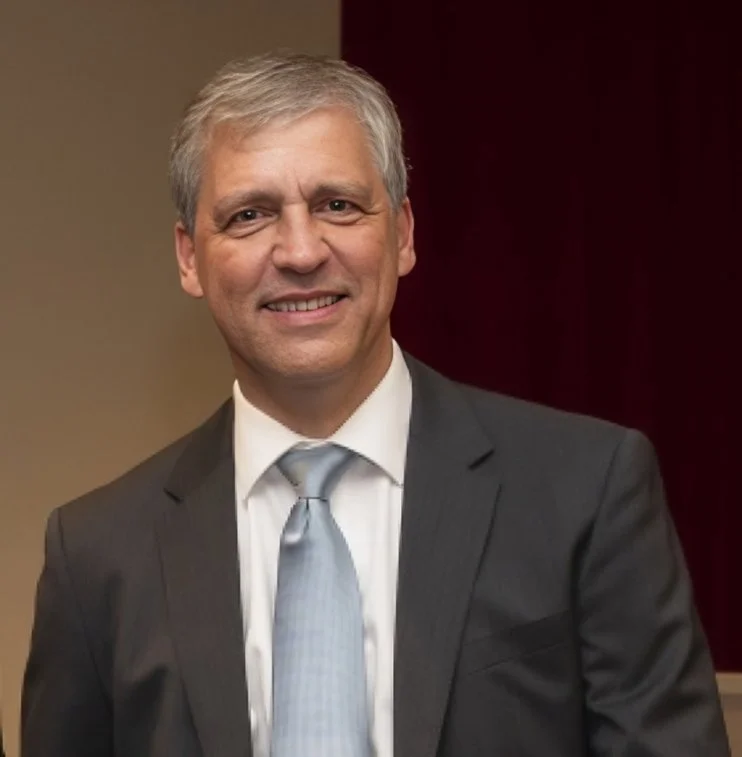
"Mr. Marquis notes that most of the allegations are not supported by a preponderance of the evidence [they do not meet the burden of proof] and therefore cannot be retained in the context of an overall analysis of vexatious conduct that could lead to psychological harassment" [18].
"Mr. Marquis cannot rule that the complaint of psychological harassment from any of the impleaded parties [the three colleagues] is well-founded" [19].
However, the fact that Louis Marquis turned a blind eye and led to believe that such serious actions were “unfounded”, actions which the Court described as having “undermined the dignity and physical and psychological integrity” of the victimized employee, did not go unnoticed.
In 2023, three years after Louis Marquis'sinvestigation report was submitted, the Tribunal dismissed his entire investigative work, having detected gross errors of judgment and law, noting that the investigation had lasted four years to reach conclusions that were "curiously" lenient towards the perpetrators, despite the "obvious seriousness" of the actions :
"it took more than four years to find out the outcome of the employer's investigation, which curiously ended with reproaches described as mere incivilities, despite the obvious seriousness of the actions taken" [20].
The Tribunal blamed Louis Marquis for his investigative work, suggesting a selective editing of the facts that benefit the employer, implying that he minimized or concealed harassing actions, and revealing that the investigating lawyer had merely alluded to
"an inappropriate comparison to a monkey, ‘accompanied by other misconduct’, without further details" [21],
while
the list of actions and gestures was "much longer and more damning, as evidenced by various testimonies heard at the hearing, thus corroborating that of the complainant, and which correspond in large part to the notes taken by the [complainant's superior] in her December 2015 report after she had spoken with him" [22].
Not only was the list far longer and more damning than the one surgically edited by Louis Marquis, but it was clearly a case of harassment that Louis Marquis could not possibly have missed. In the Tribunal's words :
“It is undeniable, moreover, without the need for lengthy elaboration, that all these actions and gestures have infringed upon the dignity and physical and psychological integrity of the complainant, and have resulted in a harmful work environment for him within the meaning of the aforementioned definition of the LNT [Quebec's Act respecting labour Standards]” [23].
In this case, as in the case described in the previous article, a correlation can be observed between the method used by Louis Marquis in his 2020 investigation report and his omissions in his 2024 appointment process : a modus operandi based on selective omission and a tendency to disregard compromising facts. In the first instance, the minimization of the facts served the interests of an employer at the expense of a harassment victim, while Louis Marquis had an obligation to uncover the truth, an obligation he failed to fulfill. In the second instance, the failure to disclose litigations against him contributed to Louis Marquis's appointment to the judiciary, while he had an obligation to be completely transparent and honest, an obligation he also failed to fulfill.
This is the person whom the Government of Canada appointed as a judge to the Superior Court of Quebec.
Beyond a professional past marked by discriminatory actions and a reprimand from a Court for concealing acts of violence, Louis Marquis'sapplication for the judiciary also raised other questions due to an intertwining of circumstances generating conflicts of interest, in which Louis Marquis repeatedly found himself.
Before his appointment to the judiciary, Louis Marquis repeatedly found himself in situations that generated conflicts of interest
Acting simultaneously for an entity targeted by a harassment investigation and for the one responsible for conducting it, appointing private business partners within the publicly funded institution he led, or propelling his wife into key positions at the Faculty of Law, are just a few examples that illustrate a portrait of a judicial candidate that deviates remarkably from the model of judge that the Government of Canada committed to provide to the public.
Louis Marquis worked simultaneously for the entity being investigated for harassment and for the entity mandated to conduct the investigation
According to his curriculum vitae, Louis Marquis worked from 2011 until his appointment in 2024 for or with the firm PRDSA (“Professionnels en règlement des différends S.A.”). He claimed several titles there, including : lawyer, accredited mediator, accredited arbitrator, investigator, “international expert in civil justice” (whatever that means), expert speaker, and trainer.
While Louis Marquis was working for the PRDSA firm, he also maintained close institutional ties with the University of Montreal : associate professor at the University of Montreal (from 2013 to 2016), consulting lawyer and mediator for the Mediation Clinic of the University of Montreal (from 2017 to 2019), lecturer and "external" examiner of Master's theses for the University of Montreal, on several occasions.
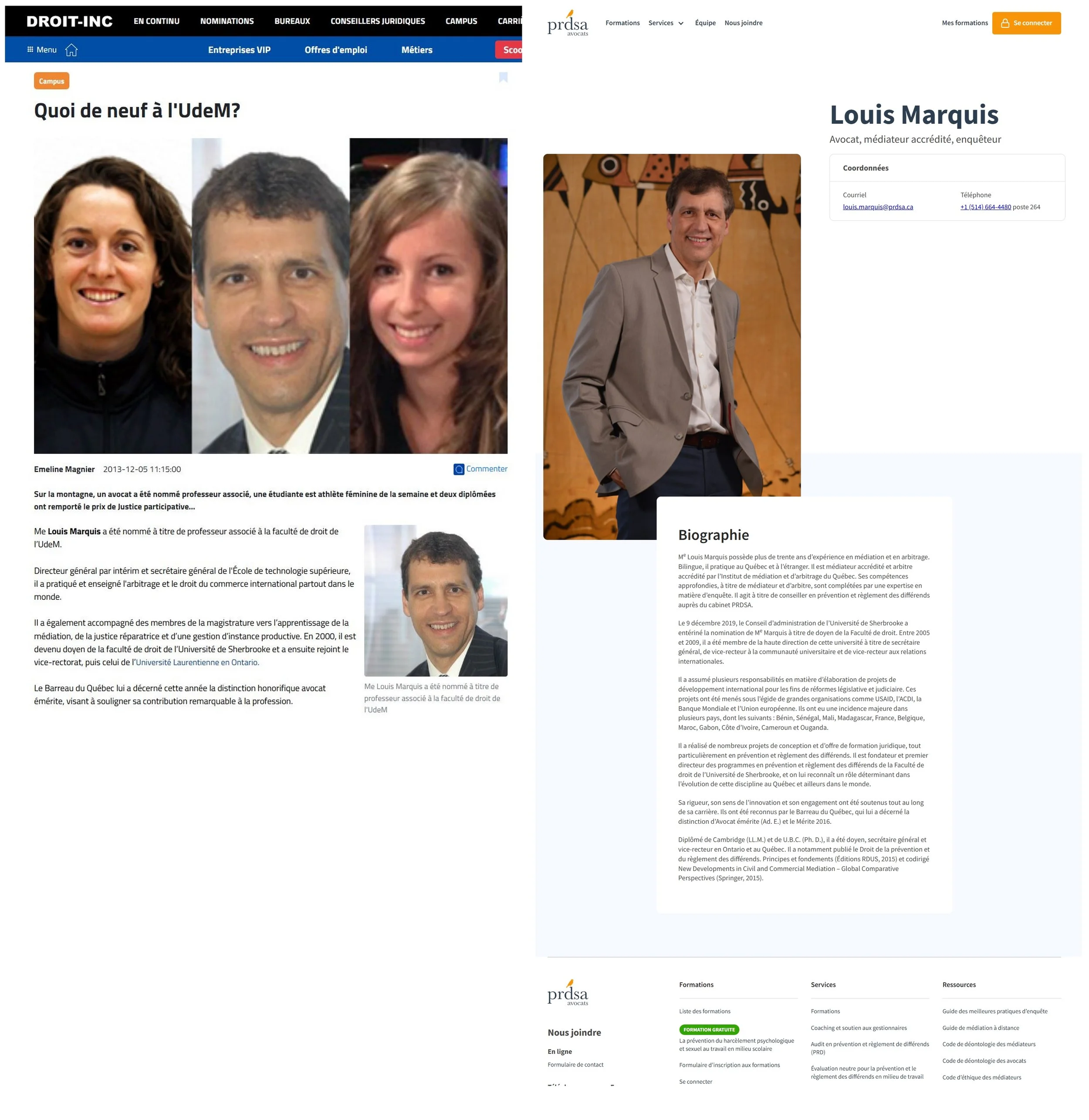
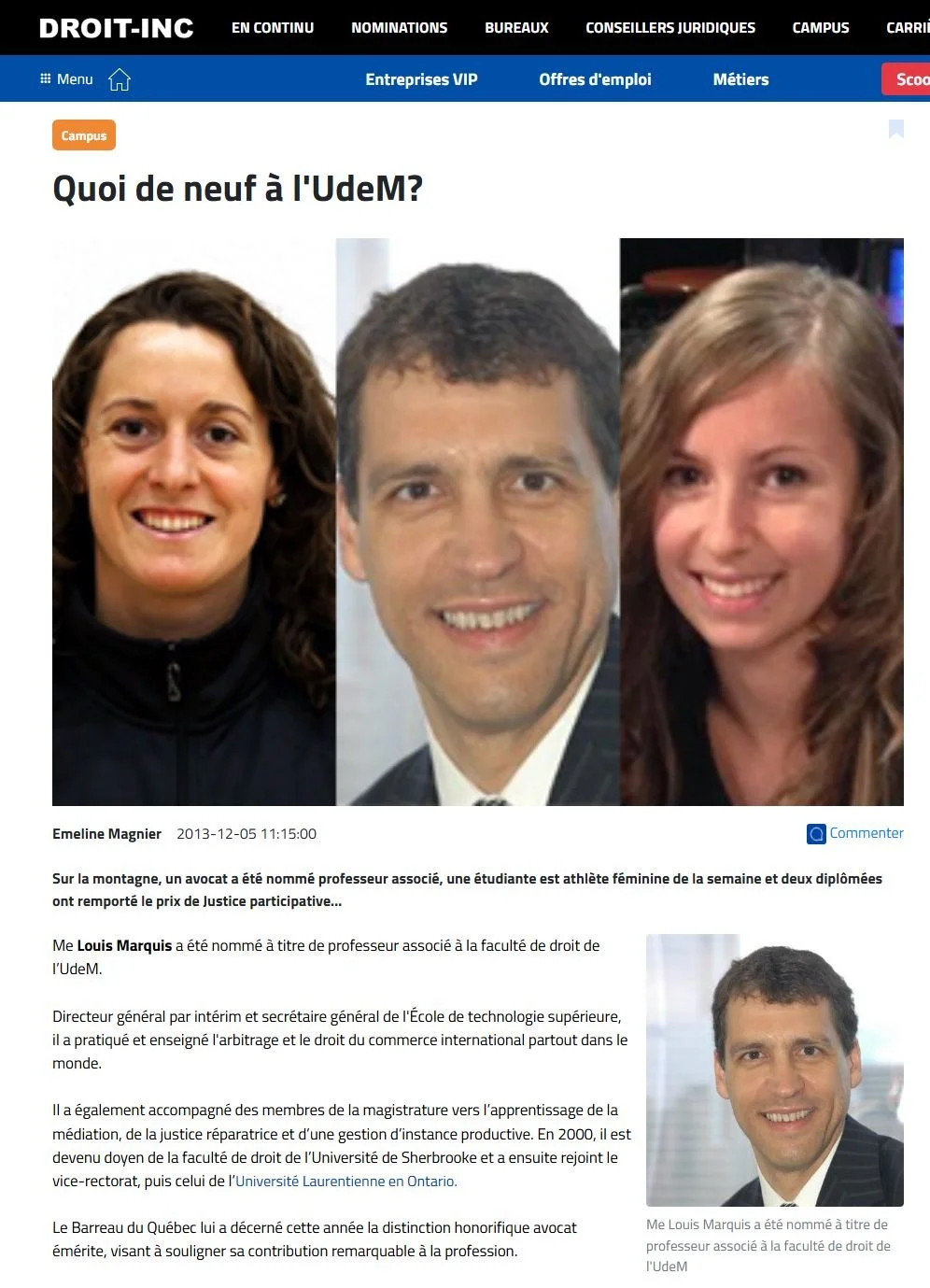
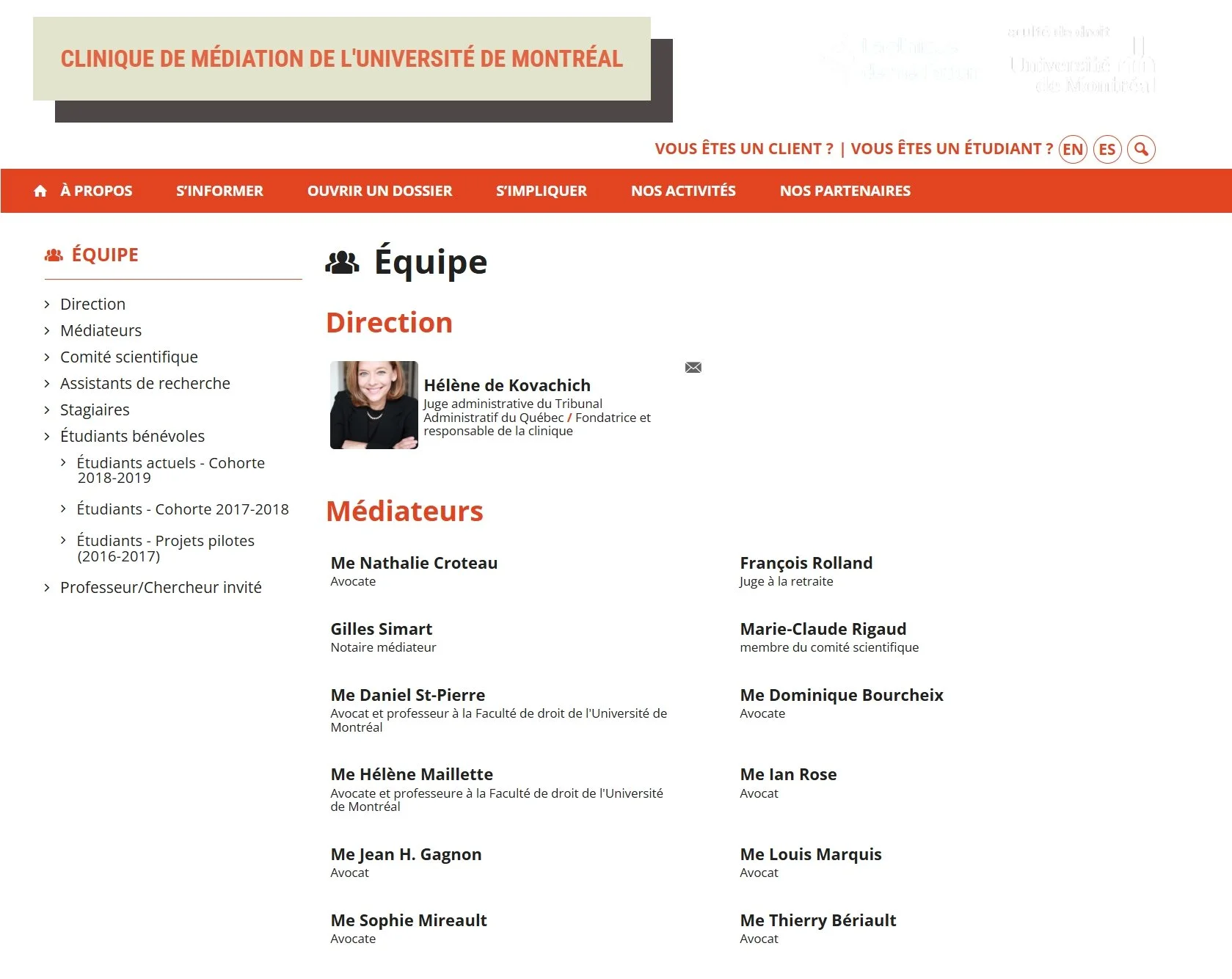
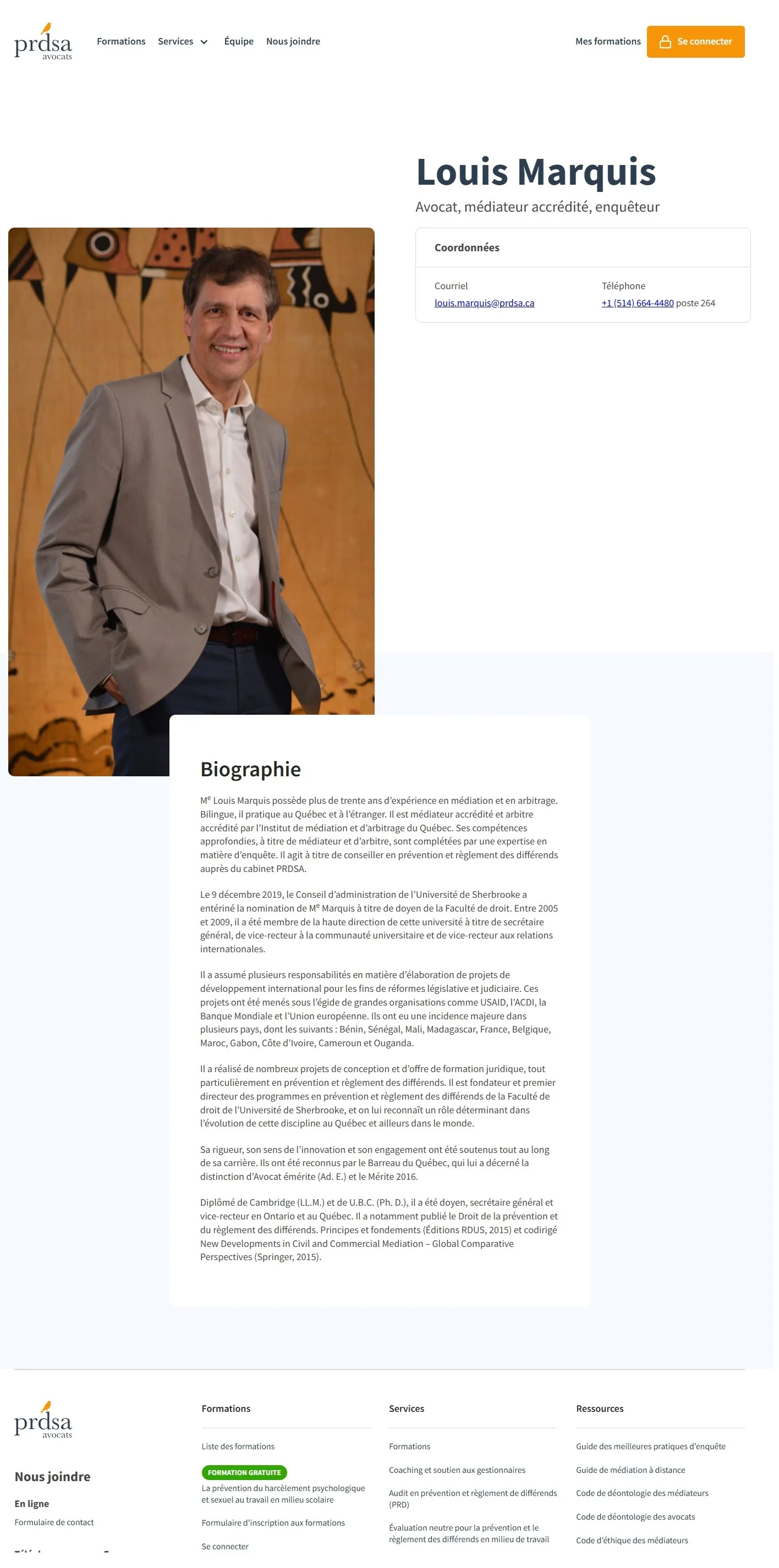

Situations that generated conflicts of interest were quick to emerge : Louis Marquis'sPRDSA firm was often mandated by the University of Montreal to investigate harassment complaints filed by its employees.
Louis Marquis therefore repeatedly found himself in the situation where he worked at the same time for the entity being investigated and for the investigating entity; for the University of Montreal and for the firm paid by this University of Montreal to investigate complaints of psychological harassment in the workplace that targeted the University of Montreal and that affected its reputation.
Masking the problem of apparent conflicts of interest, the University of Montreal hypocritically justified the choice of the PRDSA firm as follows :
"to act as an external investigator in order to give us a neutral and objective opinion on the merits of the said complaint, in light of the applicable regulatory framework and the Anti-Harassment Policy"
These investigations by LouisMarquis's PRDSA firm have often led to the dismissal of complaints filed by University of Montreal employees, under the pretext of being baseless :
Breton c. Université de Montréal, 2022 QCCAI 59 (investigation carried out by Louis Marquis's colleague, lawyer Noémie Raza);
Benoit et Larouche c. Université de Montréal, 2024 CanLII 9720 (investigation carried out by Louis Marquis's colleague, lawyer Sara Kurani);
Syndicat général des professeurs et professeures de l’Université de Montréal (SGPUM) c. Université de Montréal, 2022 CanLII 68102 (investigation carried out by Louis Marquis's colleague and friend, lawyer Jean Marois).
A system of "revolving doors", in which the common denominator of the two concerned entities was Louis Marquis.
Two examples of nepotistic appointments by Louis Marquis
A longtime friend of Louis Marquis was appointed associate professor at the Faculty of Law of the University of Sherbrooke just before the end of Louis Marquis's term as dean of the Faculty of Law of the University of Sherbrooke
Louis Marquis's boss within the PRDSA cabinet was Jean Marois.
Louis Marquis worked under Jean Marois between 2011 and 2023, including between the period 2020 and 2023, while Louis Marquis also held the position of Dean of the Faculty of Law at the University of Sherbrooke.
The close ties between Louis Marquis and Jean Marois dated back a very long time. For example, in 2008, they gave lectures together in Senegal, they travelled abroad together [24], they worked together within the Institute of Mediation and Arbitration of Quebec (IMAQ), an entity for which Jean Marois held the position of president and for which Louis Marquis held positions managerial positions and as administrator.
In 2023, a few months before Louis Marquis completed his term as Dean of the Faculty of Law at the University of Sherbrooke, Jean Marois, Louis Marquis's friend and boss at the PRDSA firm, was appointed associate professor at the Faculty of Law at the University of Sherbrooke.
Jean Marois did not miss the opportunity to thank his subordinate for the appointment he received :
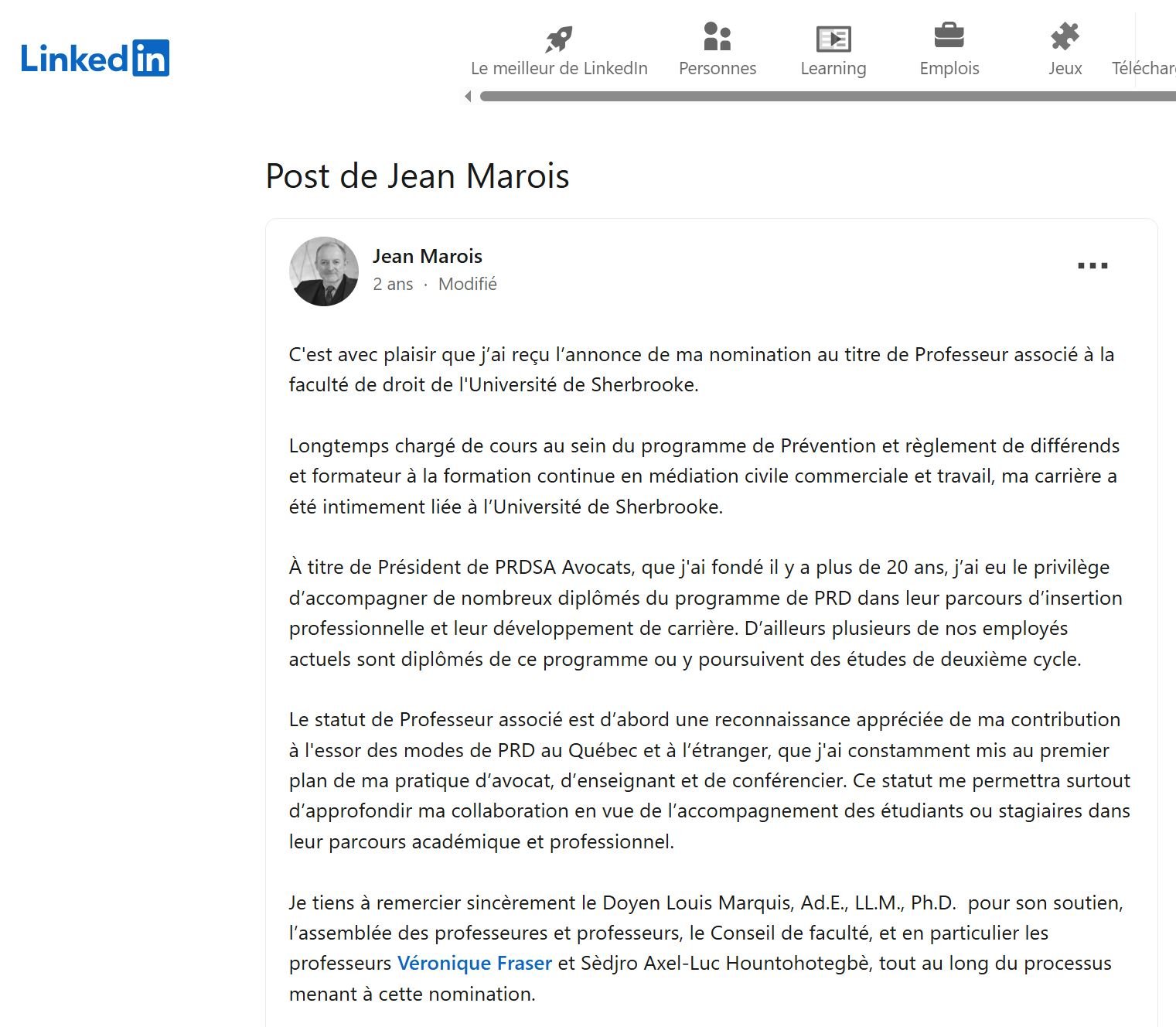
Many will have noticed that this is the same behavior reeking of nepotism and favoritism, often denounced as reprehensible and ethically questionable, as that adopted by politicians who make their most partisan appointments just before the end of their term.
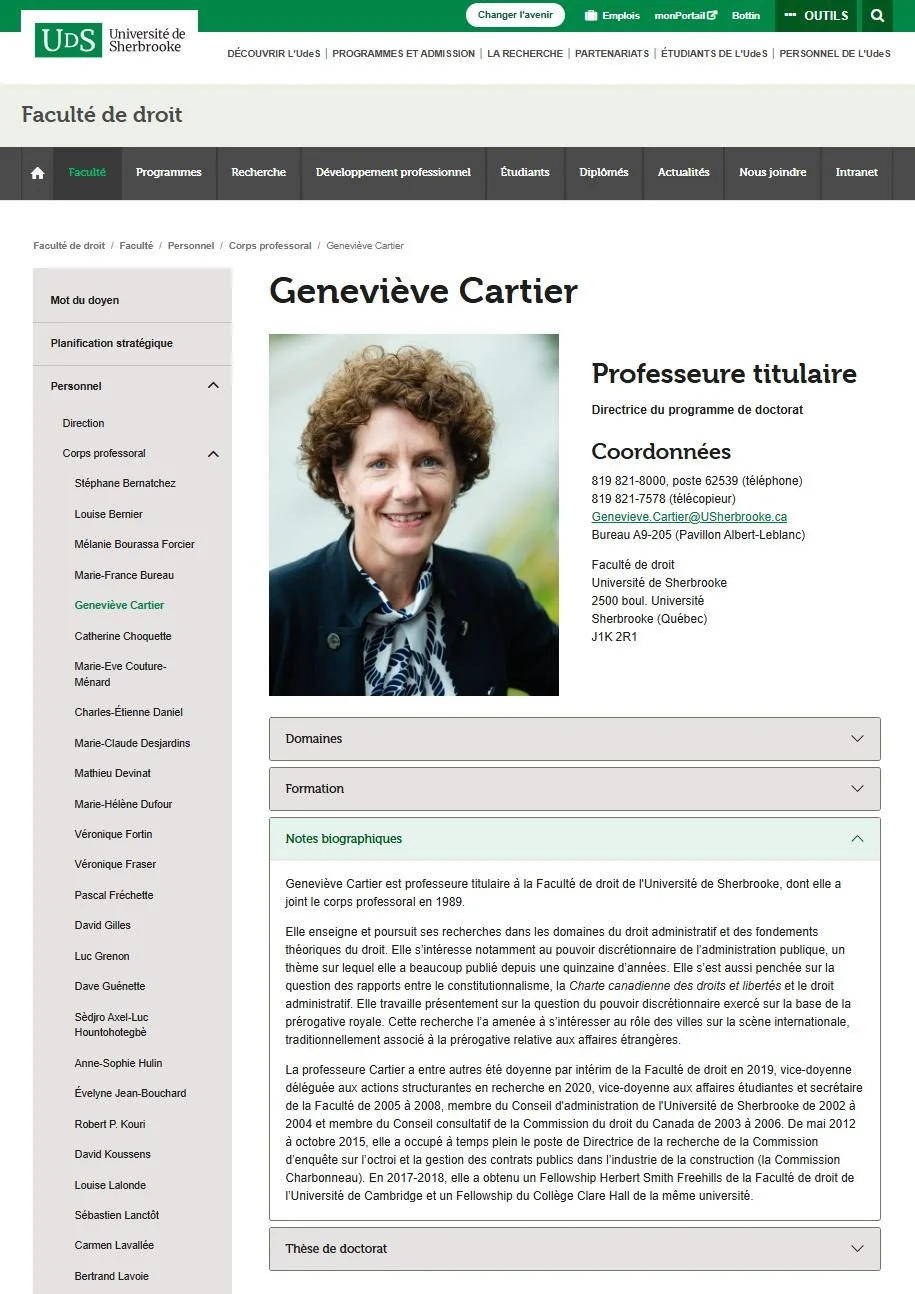
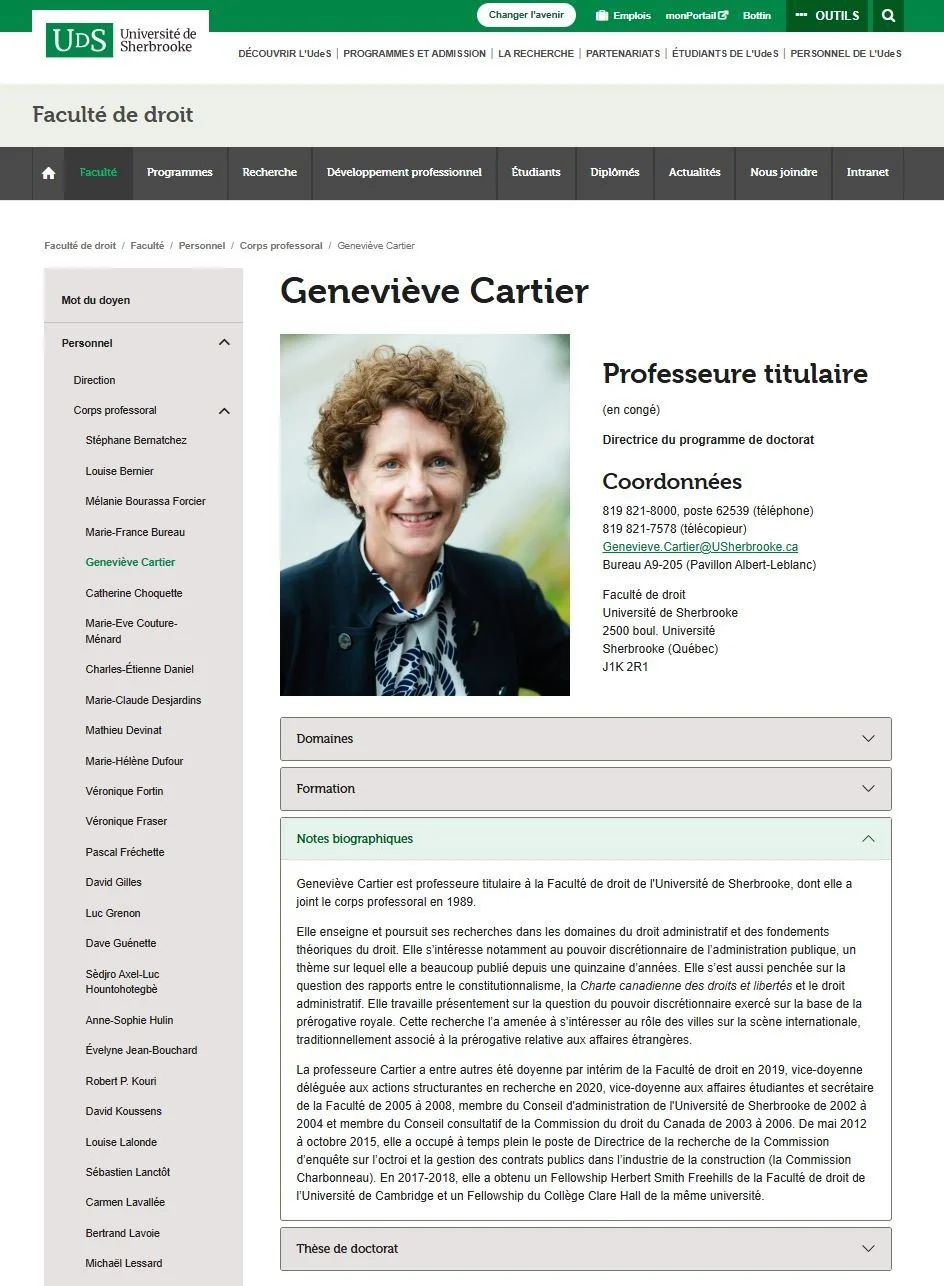
During his tenure as dean of the Faculty of Law at the University of Sherbrooke, Louis Marquis appointed his wife, Geneviève Cartier, to several leadership positions within the Faculty he directed
Like inspired by the Clinton couple model (or rather the Thénardier couple), the governance of the Faculty of Law at the University of Sherbrooke was marked between 2019 and 2023 by a concentration of power around the couple formed by then professor Louis Marquis and his wife, Geneviève Cartier, also a professor at the Faculty of Law at the University of Sherbrooke.
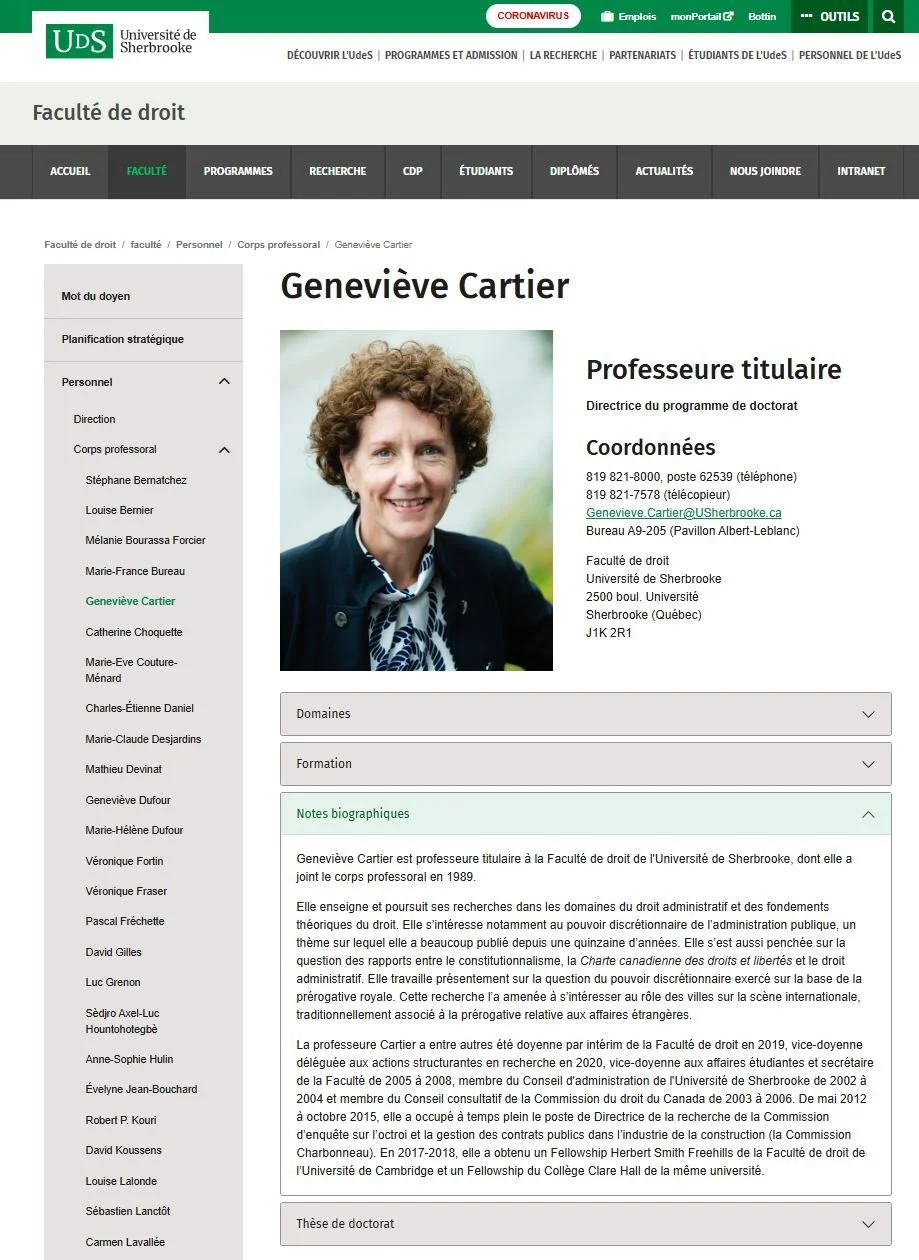
In 2019, Louis Marquis's wife held the position of interim dean [25], just before being succeeded, in 2020, by Louis Marquis.
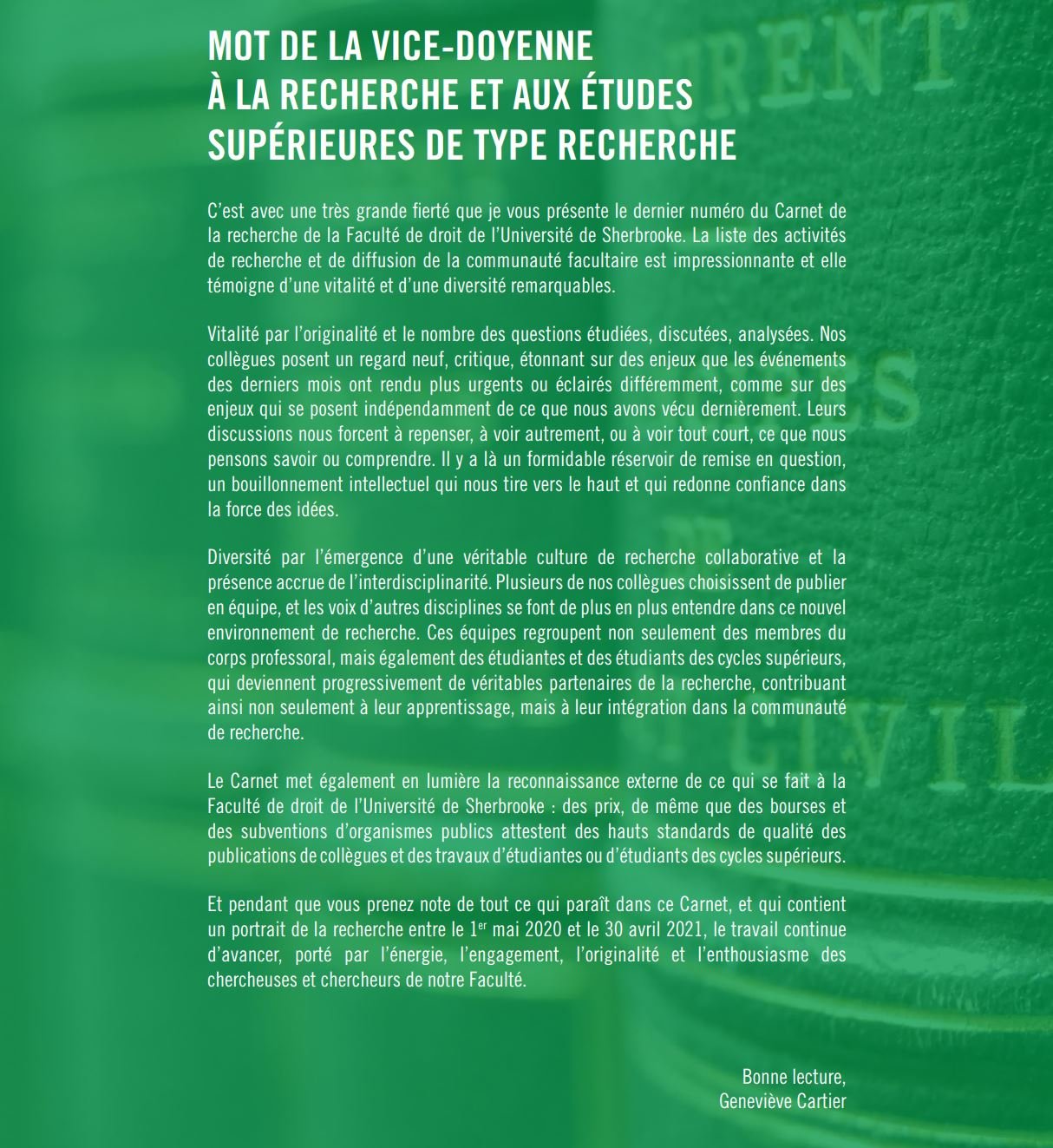
From 2020 onwards, Louis Marquis, as dean, systematically placed his wife in strategic positions of power at the Faculty of Law, in several leadership roles, including that of associate-dean in charge of structural research actions (2020-2021) [26], associate-dean of research and research-type graduate studies (2021) [27], interim co-director of the Diploma Program in Applied State Law and Policy [28] and director of the doctorate in law program (Fall 2022 - December 2023) [29].


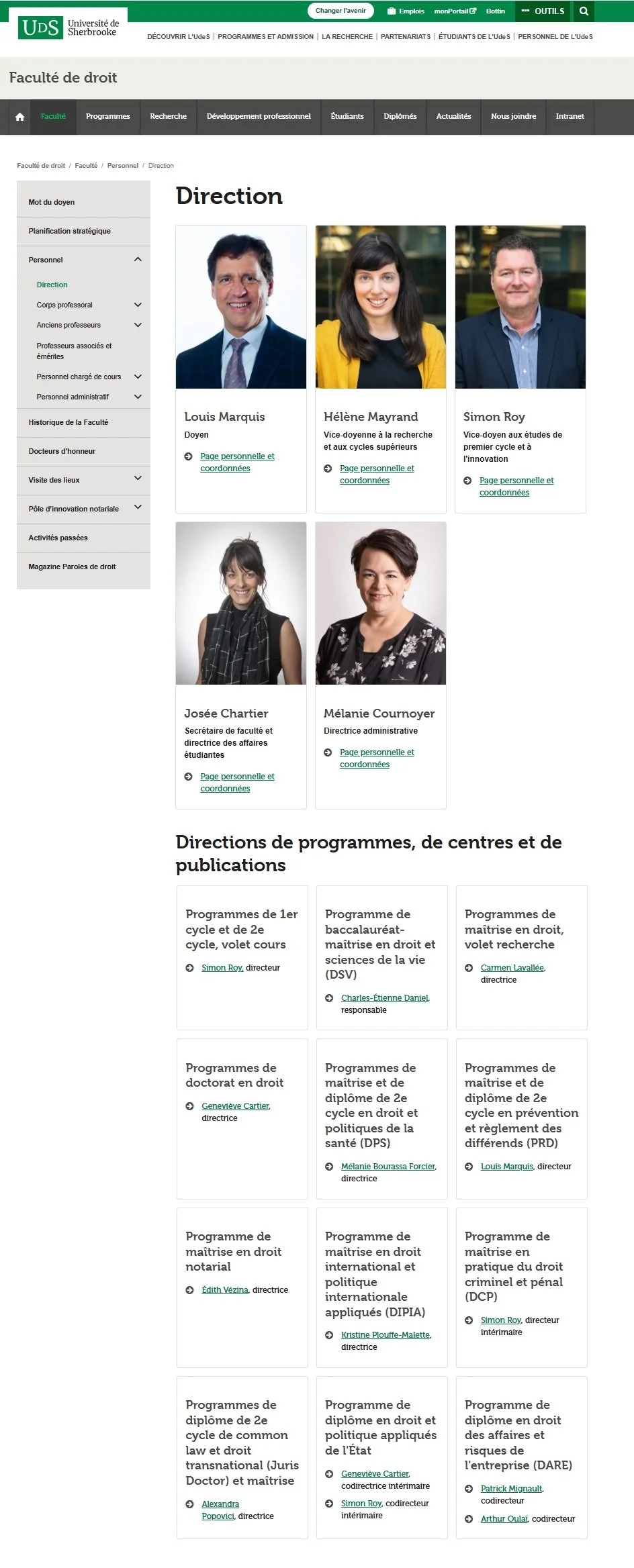
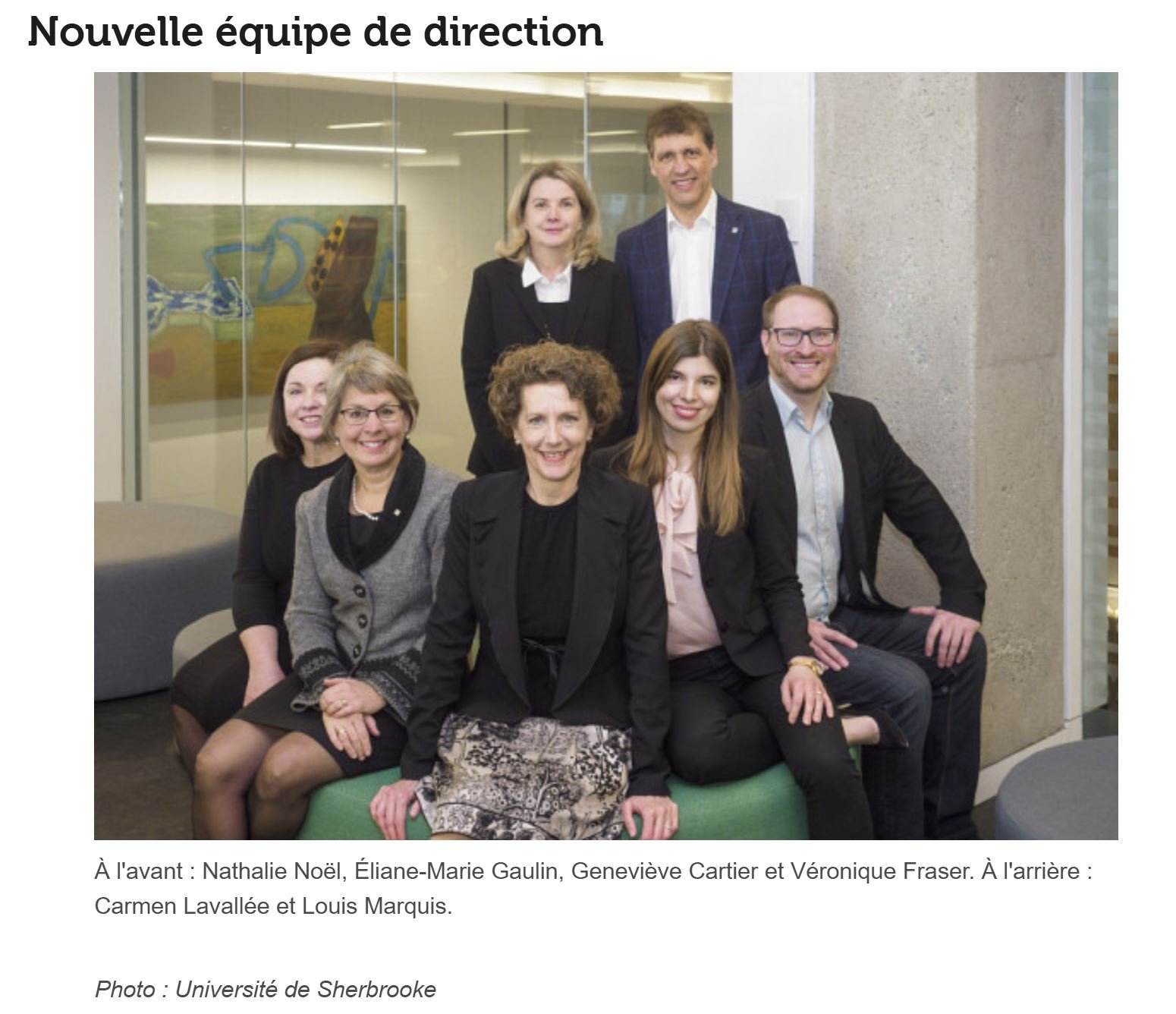


At the time, the Faculty of Law had about forty professors who could have filled these positions. By systematically placing his wife in all of these most influential positions within the Faculty of Law, Louis Marquis blocked the access to prestigious career opportunities for several of his colleagues.
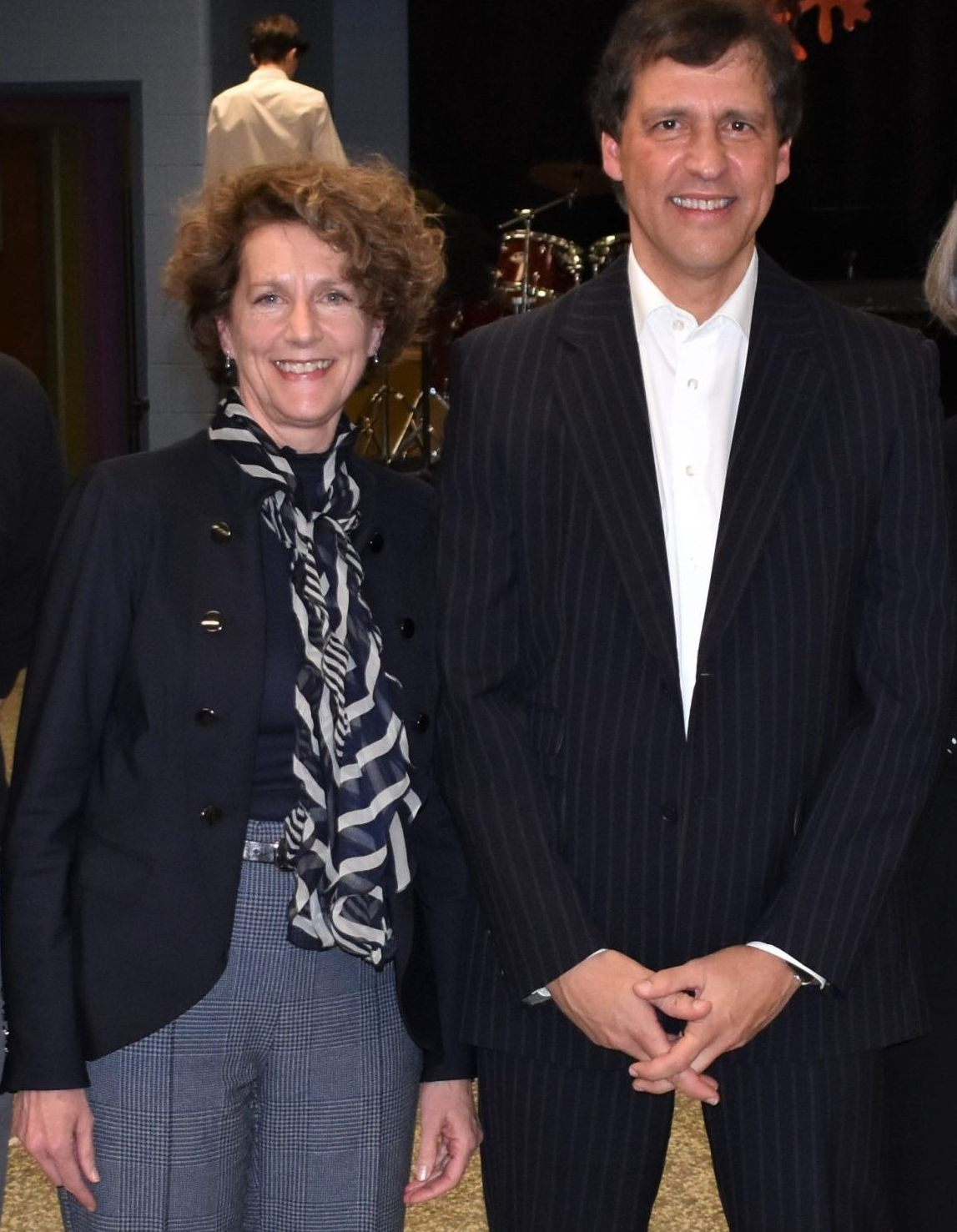
After his appointment to the judiciary, Judge Louis Marquis maintained these practices and rendered a decision in favor of his friend, instead of respecting his ethical obligations and recusing himself
In November 2024, barely five (5) months after his appointment, Judge Louis Marquis heard a case involving his long-time friend, lawyer Stéphane Reynolds, case no. 450-17-008206-212.
A friendship for over 30 years : from barbecues to the courtroom
The friendship between judge Louis Marquis and the lawyer Stéphane Reynolds spans over 30 years. This bond, which Stéphane Reynolds himself describes as "privileged," began to solidify in 1994 at the Faculty of Law of the University of Sherbrooke, following a university exchange program characterized by 24-hour cohabitation in a residence hall and social interactions with judge Louis Marquis, then a professor at the Faculty of Law, and Louis Marquis's wife, Geneviève Cartier, also a professor at the same Faculty of Law. These interactions even included private gatherings at Louis Marquis's residence. Readers of previous articles in the "UdeS Files" series are certainly familiar with Stéphane Reynolds's statement to this effect. In an interview with the University of Sherbrooke's journal Sommets in 2004, he stated :
"We even had a BBQ at Louis Marquis's residence, and Jean Charest, who was the Minister of the Environment at the time, came to eat a hot dog with us."
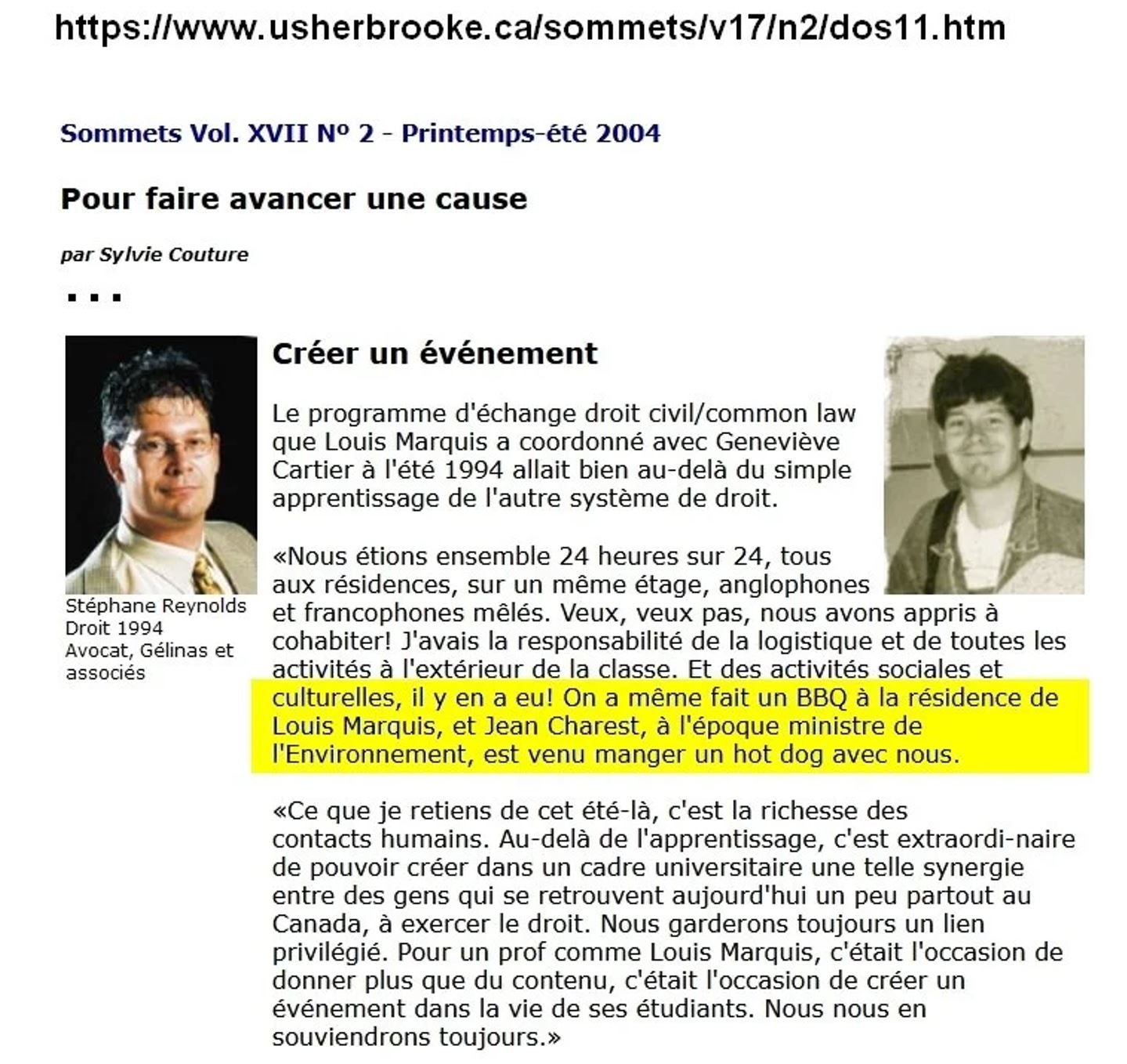
Source : University of Sherbrooke - excerpts (https://www.usherbrooke.ca/sommets/v17/n2/dos11.html)
Born on the benches of the Faculty of Law, this close relationship transformed into a constant collaboration. After the summer of 1994, Stéphane Reynolds continued to collaborate with Louis Marquis's wife, within the Faculty Council of the Faculty of Law, which dealt with the governance, strategic direction and general administration of the Faculty of Law.
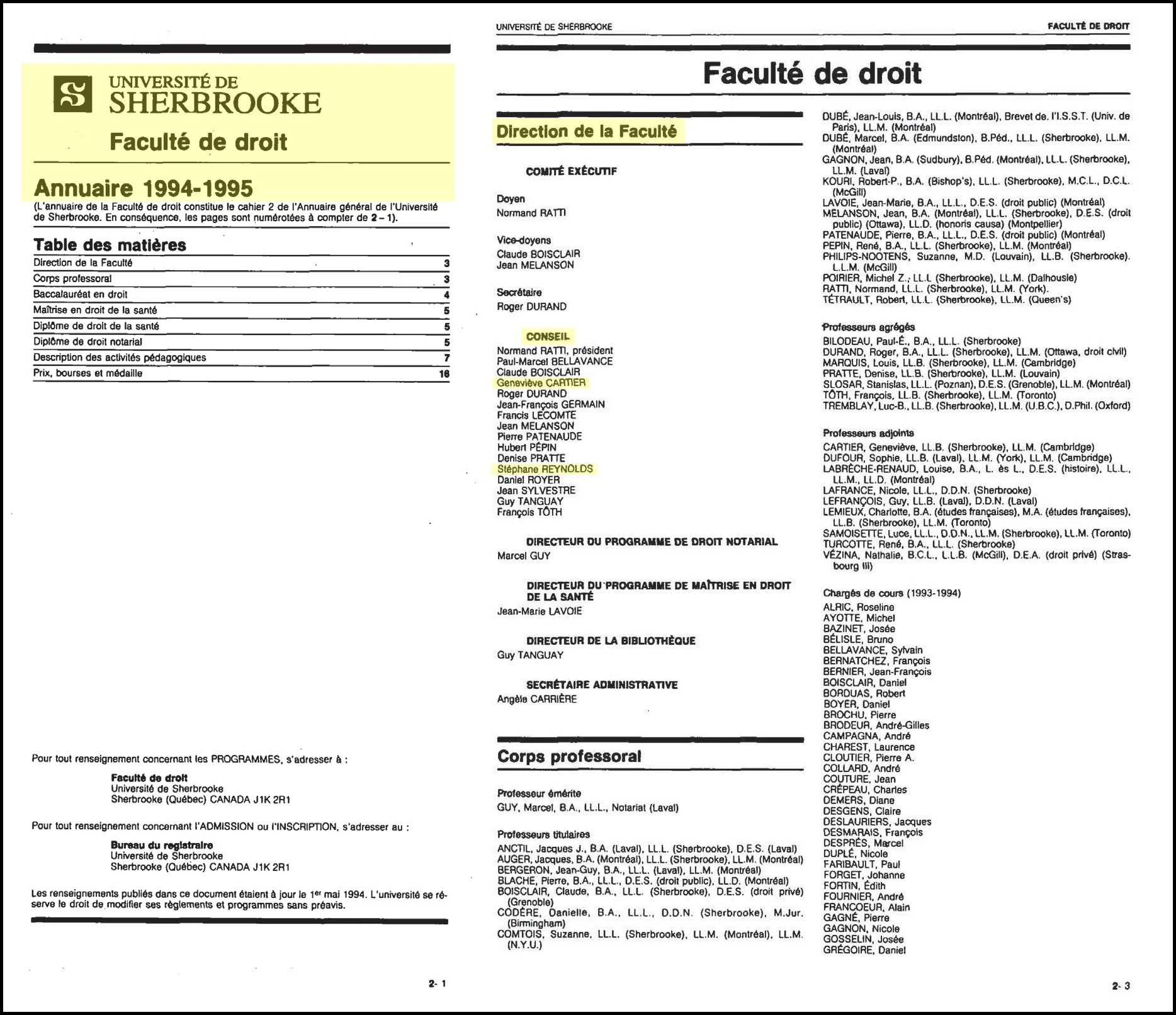
Source : University of Sherbrooke (https://www.usherbrooke.ca/registraire/fileadmin/sites/registraire/Annuaires_en_PDF/1990-2000/1994-1995_droit.PDF, p. 2-3)
Then, in 1996, while Louis Marquis held management positions at the Faculty of Law, Stéphane Reynolds benefited from a facilitated access to teaching positions less than a year after being sworn in as a lawyer – a blatant violation of the 5-year experience rule, according to his own admission for the UdeS Journal in 2008 which describes his early career :
“On October 20, 1995, Stéphane Reynolds became a member of the Bar. Having thoroughly enjoyed his first teaching experience, he expressed his interest in becoming a lecturer to several professors. They told him to send his CV, but without much hope, since the norm was that one could only obtain a teaching position five years after being called to the Bar. Determined, our leader wasn't going to let such a minor detail deter him. Less than nine months after sending his CV, his boldness paid off : the associate dean of academic affairs called him to ask if he would be willing to teach a course on civil procedure for just one year. Ultimately, he taught three courses. Then, one thing led to another, the number of courses increased, and Stéphane Reynolds has never stopped teaching.”
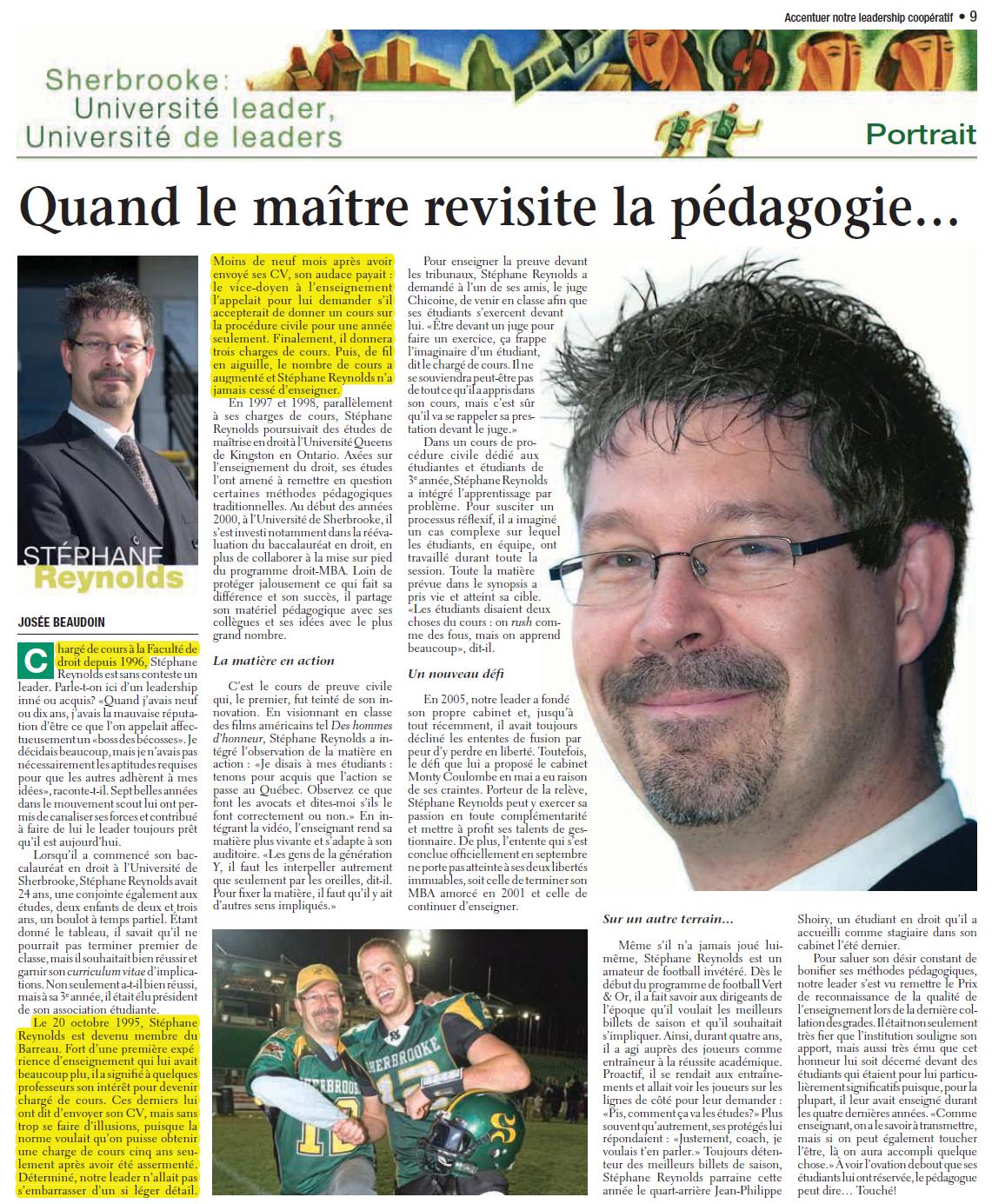
Source : University of Sherbrooke
Louis Marquis subsequently granted numerous teaching contracts to Stéphane Reynolds during his first term as dean (2000-2004), and Louis Marquis's wife also continued to collaborate with him. The Faculty of Law at the University of Sherbrooke promoted them in 2010 as being among the "individuals who contribute to the advancement of the Faculty".

Source : Faculty of Law, University of Sherbrooke (Paroles de droit, 2010, https://www.usherbrooke.ca/droit/fileadmin/sites/droit/documents/publications/PdeD-Printemps2010.pdf)
When he returned to his position as dean, from January 2020 to December 2023, Louis Marquis continued to grant teaching contracts to his longtime friend Stéphane Reynolds. Even worse, he awarded teaching contracts, paid for with taxpayer money, to Reynolds's colleagues from the firm Cain Lamarre, which did not meet the requirements provided in the contractual framework then in force (see here : https://www.claudiu-popa.com/about-the-university-environment/fraudulent-schemes-teaching-contracts-faculty-of-law-university-of-sherbrooke-3).
Once these hiring problems were discovered and the people involved were identified (Louis Marquis, Marie-Pierre Robert, and Sébastien Lebel-Grenier, another friend of Stéphane Reynolds, etc.), Stéphane Reynolds's law firm, Cain Lamarre, came in to defend the group’s interests before the courts. In very simple terms:
The University of Sherbrooke was in trouble because of the decisions that Louis Marquis took as dean of the Faculty of Law at the University of Sherbrooke;
The interests of Louis Marquis, the University of Sherbrooke and the rest of the group were represented by the firm Cain Lamarre of his friend Stéphane Reynolds;
Once Louis Marquis became a judge, while the cases concerning Louis Marquis's interests were still ongoing and the Cain Lamarre firm was still involved in these cases, Stéphane Reynolds and his Cain Lamarre firm then argued a case before Judge Marquis to request a favorable judgment.
As expected, judge Louis Marquis rendered a decision that was favorable to his friend Stéphane Reynolds (Ville de Coaticook c. Gosselin, 2024 QCCS 4446).
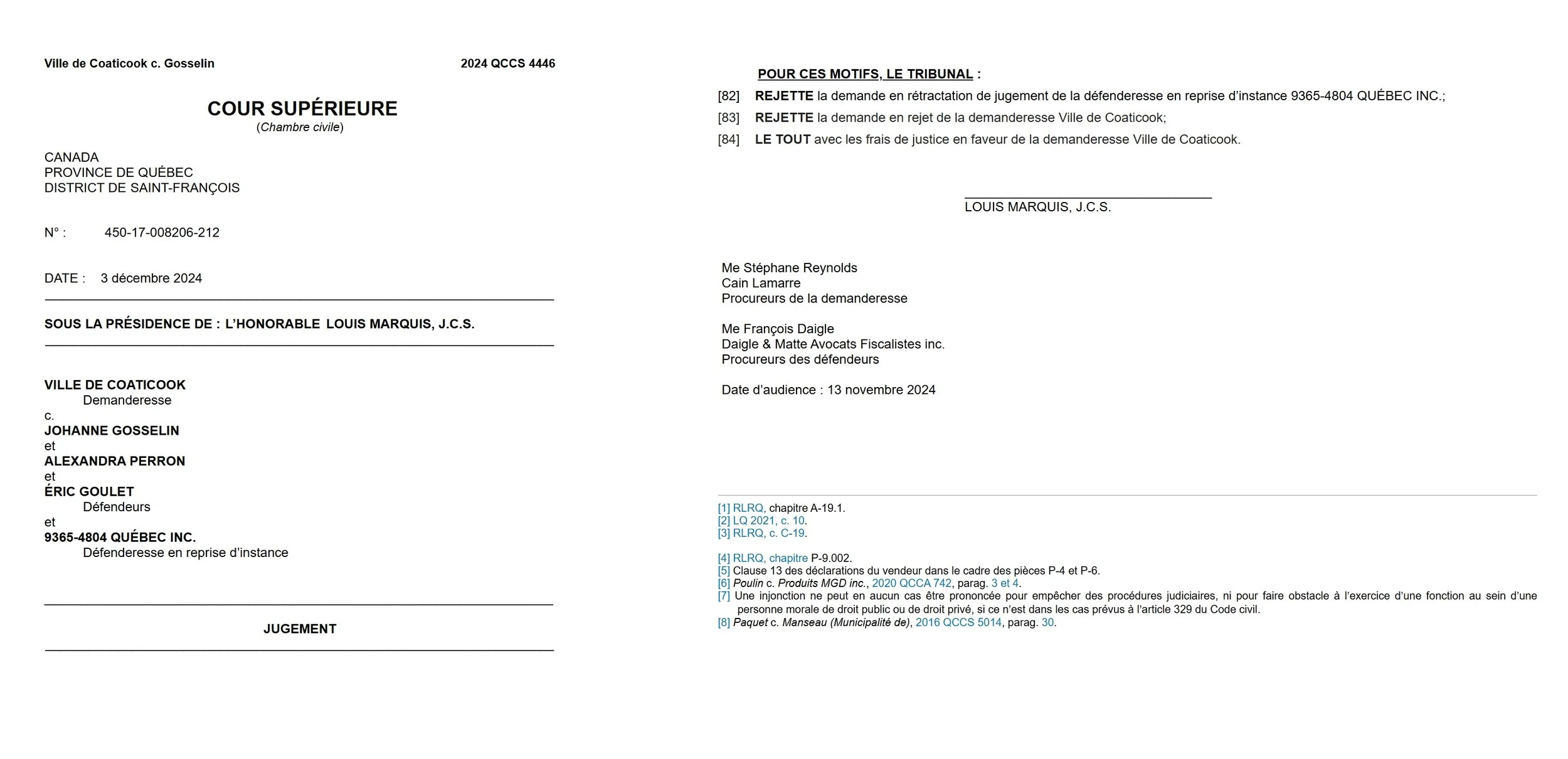
A classic case of conflict of interest where a judge rules in favor of a lawyer who is not only his friend, but whose firm also simultaneously represented the judge's interests in pending cases against him. Yet, it has long been known that a conflict of interest
"may arise from […] a close […] personal or professional relationship with a […] a counsel" [30].
and
that "it would be inappropriate for a judge to hear a case involving a […] friend" [31],
as established by the Canadian Judicial Council.
But who cares? Louis Marquis seems to believe he is above the laws that he imposes by force on others.
Judicial corruption at its finest.
However, the Supreme Court of Canada established a very high standard of conduct for judges in the landmark decision Therrien (Re) (2001 SCC 35) :
“The judge is the pillar of our entire justice system, and of the rights and freedoms which that system is designed to promote and protect”, and “the personal qualities, conduct and image that a judge projects affect those of the judicial system as a whole and, therefore, the confidence that the public places in it” [32].
“The dictates of tradition require the greatest restraint, the greatest propriety and the greatest decorum from the members of our judiciary. We expect our judges to be almost superhuman in wisdom, in propriety, in decorum and in humanity” [33].
“The public will therefore demand virtually irreproachable conduct from anyone performing a judicial function. It will at least demand that they give the appearance of that kind of conduct. They must be and must give the appearance of being an example of impartiality, independence and integrity. What is demanded of them is something far above what is demanded of their fellow citizens“ [34].
That's what they sell to the public. That's the promise. That's the social contract.
It is in exchange for these guarantees that the State asks the public for its trust, so that the public will agree to be judged by strangers. Without respecting these guarantees, this entire charade by the State is illegitimate. It amounts to nothing more than deceiving the public.
Judge Louis Marquis's conduct discredits himself. His conduct also projects a negative image on the judiciary in general. The Government of Canada, by tolerating judge Louis Marquis's conduct and by keeping him in office, would also discredit itself. The Canadian Judicial Council would also be discredited. It would be complicity to judge Louis Marquis's actions.
Questions need to be asked
Do you find that Louis Marquis's behavior can be qualified as "almost superhuman in wisdom, in propriety, in decorum and in humanity"? Is he ethically impeccable? Does he embody honesty and justice at the highest level?
To put it more simply.
If you are involved in a litigation, would you want to appear before judge Louis Marquis, with the opposing party being represented by one of Louis Marquis's friends and you not knowing it?
Judge Louis Marquis doesn't seem to have a problem ruling on his friends' cases and giving them favorable judgments. He didn't hesitate to do so for his friend Stéphane Reynolds.
Louis Marquis will potentially evaluate your personal situation, your family situation, or your professional situation. He is the one who may ultimately judge you.
What guarantees do you have, as members of the public, that judge Louis Marquis won't do exactly the same thing to you? Do you trust judge Louis Marquis?
Does he inspire common sense, a sense of ethics, and impartiality to you?
Or does he inspire the opposite?
ALL ARTICLES IN THIS SERIES :
-
-
-
-
-
-
Coming soon.
-
Coming soon.
-
-
-
English version coming soon.
French version available here : https://www.claudiu-popa.com/publications-juridiques/decoder-la-fraude
*****
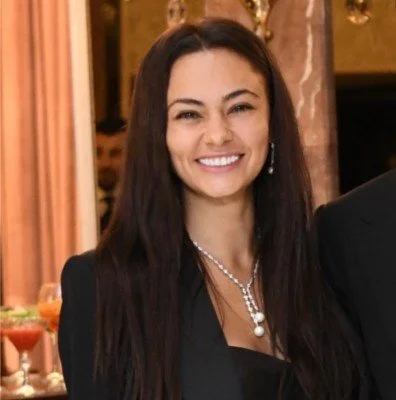
* The author, Alexandra Captariu, LL.B., is a jurist and legal researcher. She has extensive and diverse professional experience.
Holding a bachelor’s degree in law (LL.B.) from the Faculty of Law of the University of Sherbrooke (Québec, Canada), she was a lawyer in Canada from 2020 to 2026. She began her career practicing in-house law, specialising in contract law, business law, privacy law, labour law, and intellectual property law.
Trilingual and versatile, she also possesses a certificate in private international law from the University of Salzburg, Austria.
Prior to her calling to the Quebec Bar, she has worked in the legal field since 2008, namely in Europe and in Canada. She also worked as a research assistant for a university professor at the Faculty of Law of the University of Sherbrooke and held the position of editor and editor-in-chief for the student newspaper of the Faculty of Law.
She is currently the deputy director of the LEAGUE OF ACADEMIC RIGHTS AND FREEDOMS.
*****
[1] OFFICE OF THE COMMISSIONER FOR FEDERAL JUDICIAL AFFAIRS, “Guidelines for Judicial Advisory Committee Members“, Fja-cmg.gc.ca, October 2016, en ligne : https://fja-cmf.gc.ca/appointments-nominations/committees-comites/guidelines-lignes-eng.html.
[2] Id.
[3] Act respecting labour standards, ch. N-1.1, s. 81.18.
[4] Fraternité des policiers et policières de Montréal c. Montréal (Ville), 2023 CanLII 33049 (QC SAT), para. 89, 124, 163, 173.
[5] Id., para. 124.
[6] Id., para. 127 et 146.
[7] Id., para. 127
[8] Id., para. 126.
[9] Id., para. 137.
[10] Id., para. 138.
[11] Id., para. 129.
[12] Id., para. 161. (In French : « un collègue s’en est pris “à lui physiquement en lui donnant des coups de pied” »)
[13] Id., para. 157, 163. (In French : « en lui assénant une claque en arrière de la tête »)
[14] Id., para. 227.
[15] Id., para. 102, 122, 156, 165, 201.
[16] Id., para. 173.
[17] Id. (In French : des « écarts de conduite »)
[18] Id., para. 174. (In French : « Me Marquis remarque que la plupart des allégations ne sont pas supportées par une preuve prépondérante et ne peuvent donc pas être retenues dans le cadre d’une analyse globale de conduite vexatoire pouvant menée (sic) à du harcèlement psychologique »).
[19] Id. (In French : « Me Marquis ne peut statuer en une plainte de harcèlement psychologique fondée de la part d’aucun des mis en cause [les trois collègues] »).
[20] Id., para. 204. (In French : « il aura fallu plus de quatre ans avant de connaitre le dénouement de l’enquête de l’employeur laquelle s’est curieusement soldée par des reproches qualifiés de simples incivilités, et ce, malgré la gravité évidente des gestes posés »)
[21] Id., para. 233. (In French : « une comparaison déplacée avec un singe, "accompagnée d’autres écarts de conduite", sans plus de détails »)
[22] Id., para. 234. (In French : la liste des gestes était « beaucoup plus longue et accablante, comme en font foi divers témoignages entendus à l’audience, corroborant ainsi celui du plaignant, et qui correspondent en majeure partie aux notes prises par la [supérieure du plaignant] dans son rapport de décembre 2015 après qu’elle se soit entretenue avec lui »).
[23] Id., para. 237. (In French : « Il est indéniable par ailleurs sans qu’il soit nécessaire d’élaborer longuement que tous ces faits et gestes ont porté atteinte à la dignité et à l’intégrité physique et psychologique du plaignant et ont entraîné pour lui un milieu de travail néfaste au sens de la définition précitée de la LNT [Loi sur les normes du travail du Québec] »).
[24] FACULTY OF LAW OF THE UNIVERSITY OF SHERBROOKE, « L'Université de Sherbrooke forme les 60 premiers médiateurs du Sénégal », Usherbrooke.ca, April 21st, 2008, online : <https://www.usherbrooke.ca/droit/actualites/nouvelles/details/8454>.
[25] FACULTY OF LAW OF THE UNIVERSITY OF SHERBROOKE, « Une ‘répétition générale’ en vue de la rentrée universitaire », Usherbrooke.ca, August 26th, 2019, online : <https://www.usherbrooke.ca/actualites/nouvelles/facultes/droit/details/40827>; FACULTY OF LAW OF THE UNIVERSITY OF SHERBROOKE, « Geneviève Cartier », Usherbrooke.ca, July 19th, 2019, online : <https://www.usherbrooke.ca/droit/faculte/personnel/corps-professoral/genevieve-cartier/#c4697-1>.
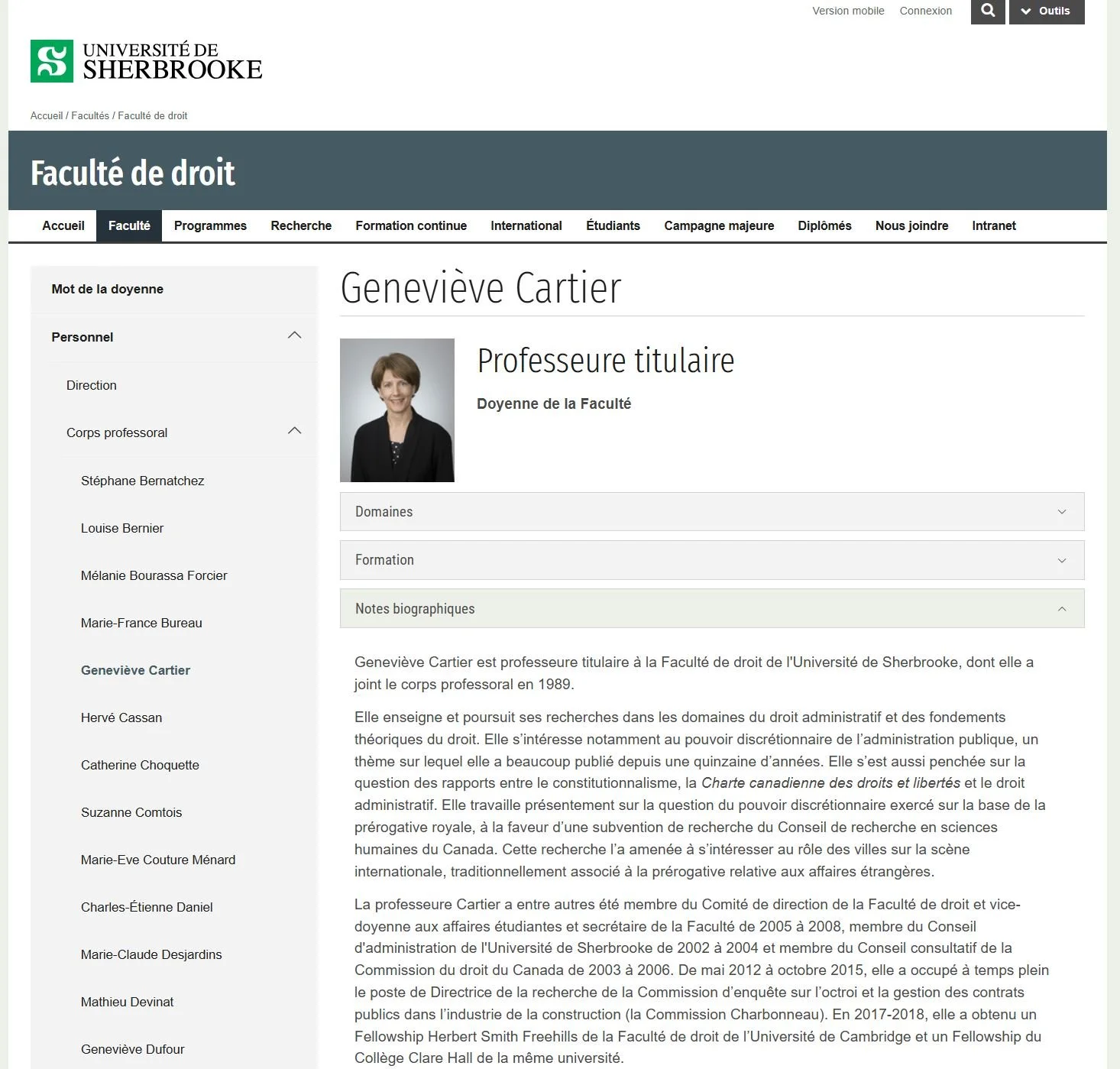
[26] UNIVERSITY OF SHERBROOKE, « Louis Marquis à la tête de la Faculté de droit », Usherbrooke.ca, December 10th, 2019, online : <https://www.usherbrooke.ca/srh/nouvelles/details/41860>; FACULTY OF LAW OF THE UNIVERSITY OF SHERBROOKE, « Direction », Usherbrooke.ca, August 11th, 2020, online : <https://www.usherbrooke.ca/droit/faculte/personnel/direction/>; FACULTY OF LAW OF THE UNIVERSITY OF SHERBROOKE, « Geneviève Cartier », Usherbrooke.ca, August 15th, 2020, online : <https://www.usherbrooke.ca/droit/faculte/personnel/corps-professoral/genevieve-cartier/#c4697-1>.
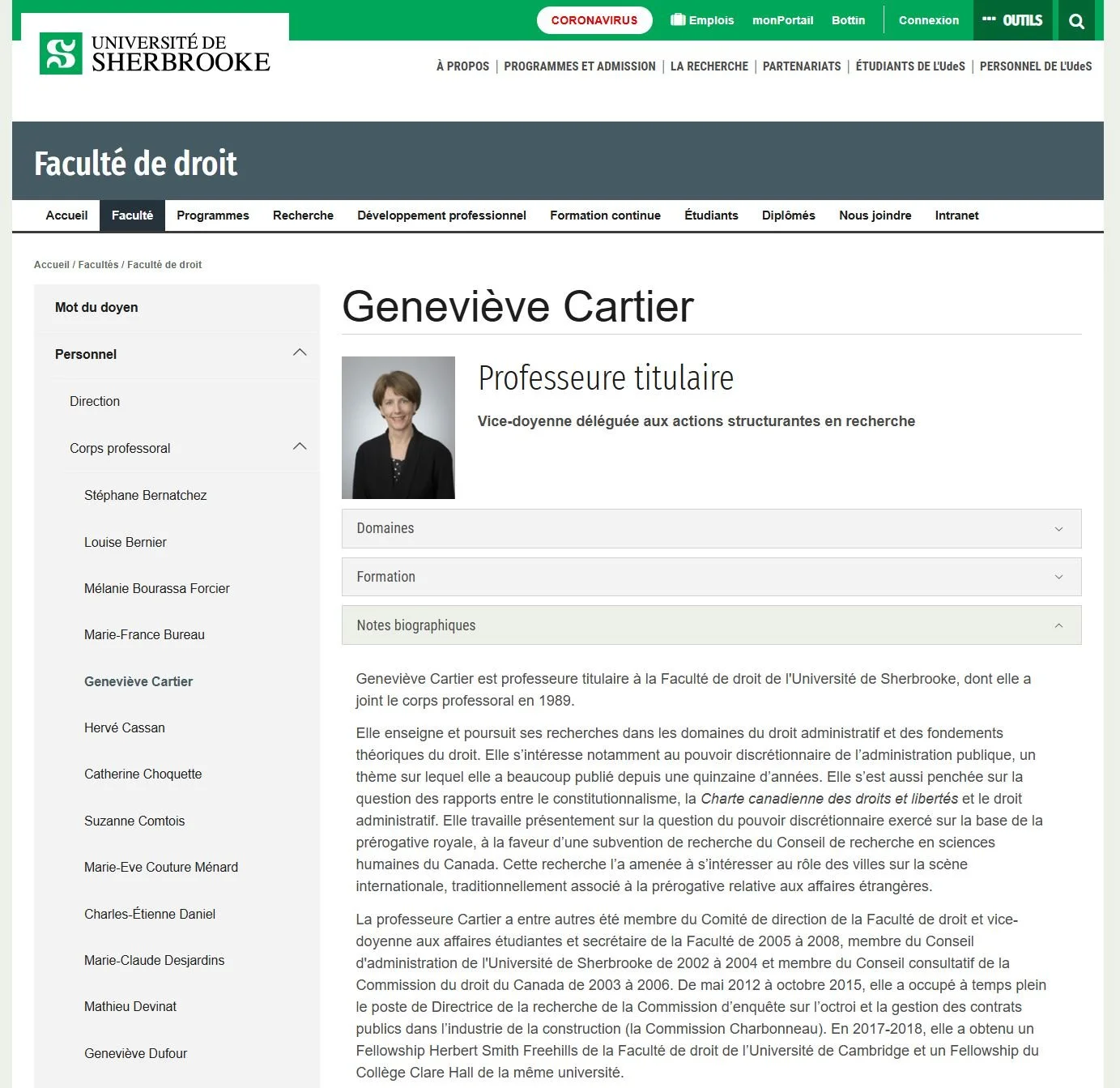
[27] FACULTY OF LAW OF THE UNIVERSITY OF SHERBROOKE, « Direction », Usherbrooke.ca, January 7th, 2022, online : <https://www.usherbrooke.ca/droit/faculte/personnel/direction/>; FACULTY OF LAW OF THE UNIVERSITY OF SHERBROOKE, « Geneviève Cartier », Usherbrooke.ca, November 1st, 2021, online : <https://www.usherbrooke.ca/droit/faculte/personnel/corps-professoral/genevieve-cartier/#c4697-1>; FACULTY OF LAW OF THE UNIVERSITY OF SHERBROOKE, Carnet de la recherche, Usherbrooke.ca, Autumn 2021, p. 1, 2 and 14, online : <https://www.usherbrooke.ca/droit/fileadmin/sites/droit/documents/publications/Carnet_de_la_recherche_2021_LR.pdf>; CONSEIL DE LA RECHERCHE DE L’UNIVERSITÉ DE SHERBROOKE, « Procès-verbal, 2e réunion », Usherbrooke.ca, September1st, 2021, online : <https://www.usherbrooke.ca/decouvrir/fileadmin/sites/decouvrir/documents/direction/proces_verbaux_cr/CR-2021-09-01.pdf>; CONSEIL DE LA RECHERCHE DE L’UNIVERSITÉ DE SHERBROOKE, « Procès-verbal, 3e réunion », Usherbrooke.ca, October 13th, 2021, online : <https://www.usherbrooke.ca/decouvrir/fileadmin/sites/decouvrir/documents/direction/proces_verbaux_cr/CR-2021-10-13.pdf>; CONSEIL DE LA RECHERCHE DE L’UNIVERSITÉ DE SHERBROOKE, « Procès-verbal, 4e réunion », Usherbrooke.ca, November 17th, 2021, online : <https://www.usherbrooke.ca/decouvrir/fileadmin/sites/decouvrir/documents/direction/proces_verbaux_cr/CR-2021-11-17.pdf>.
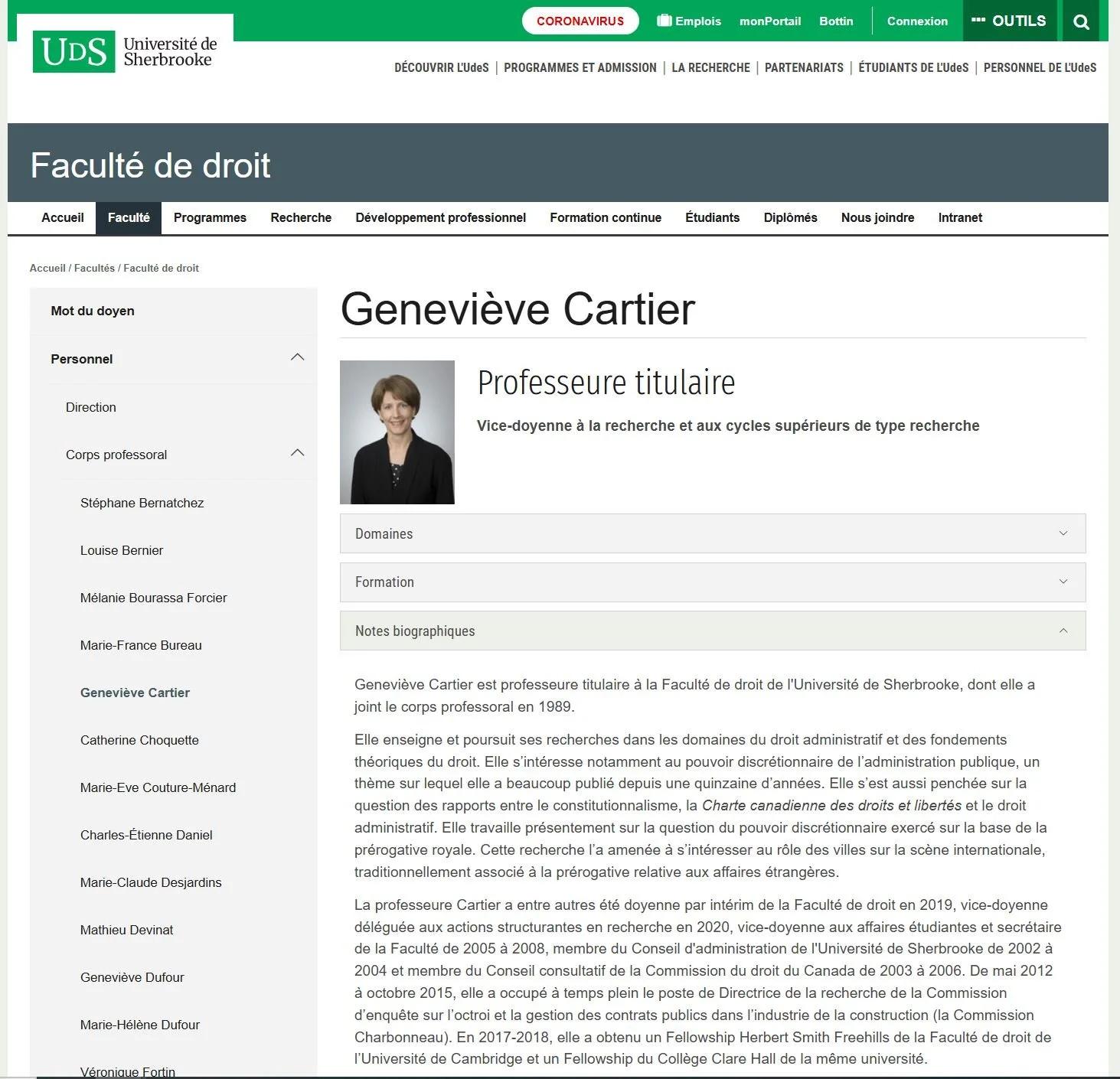
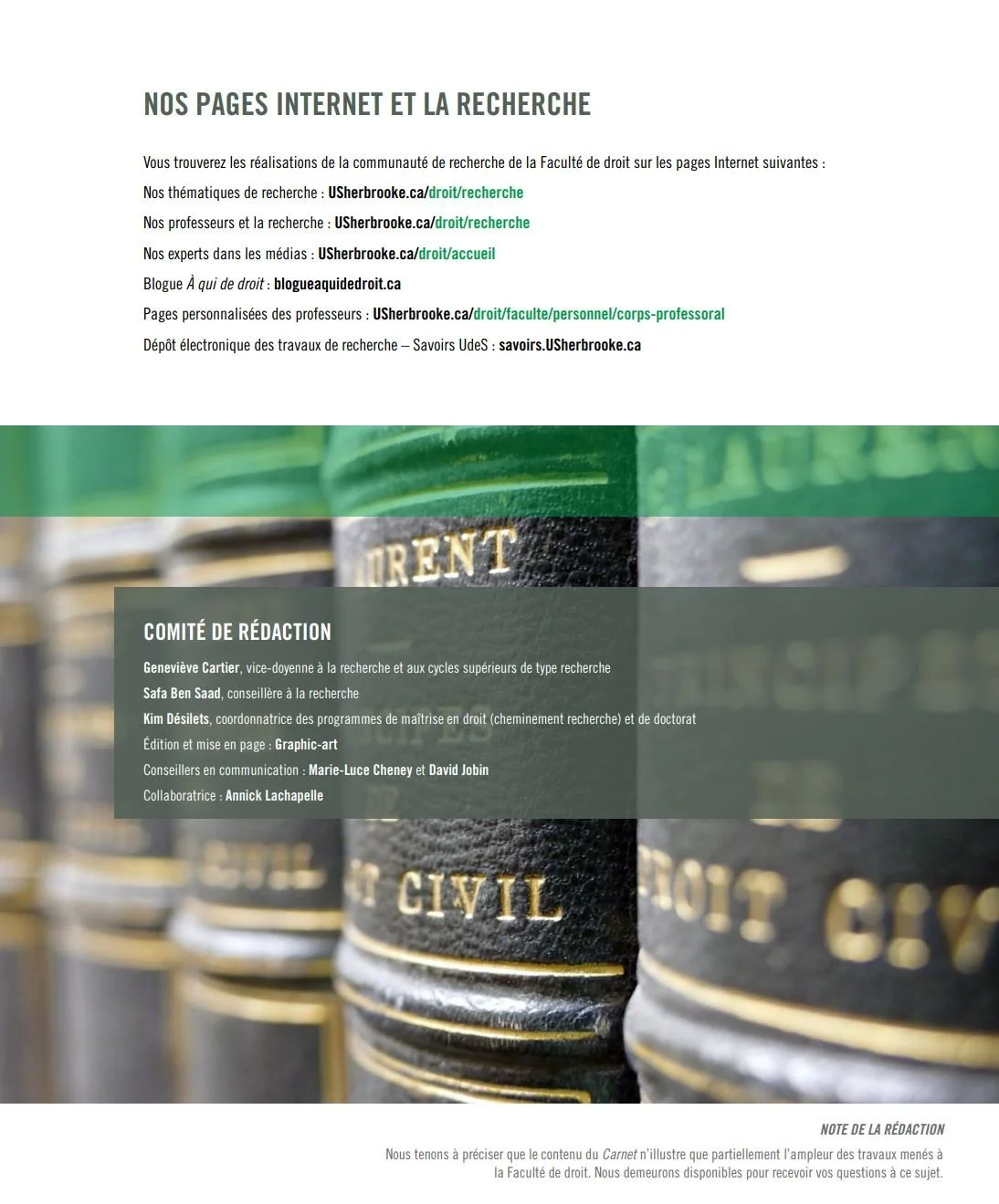

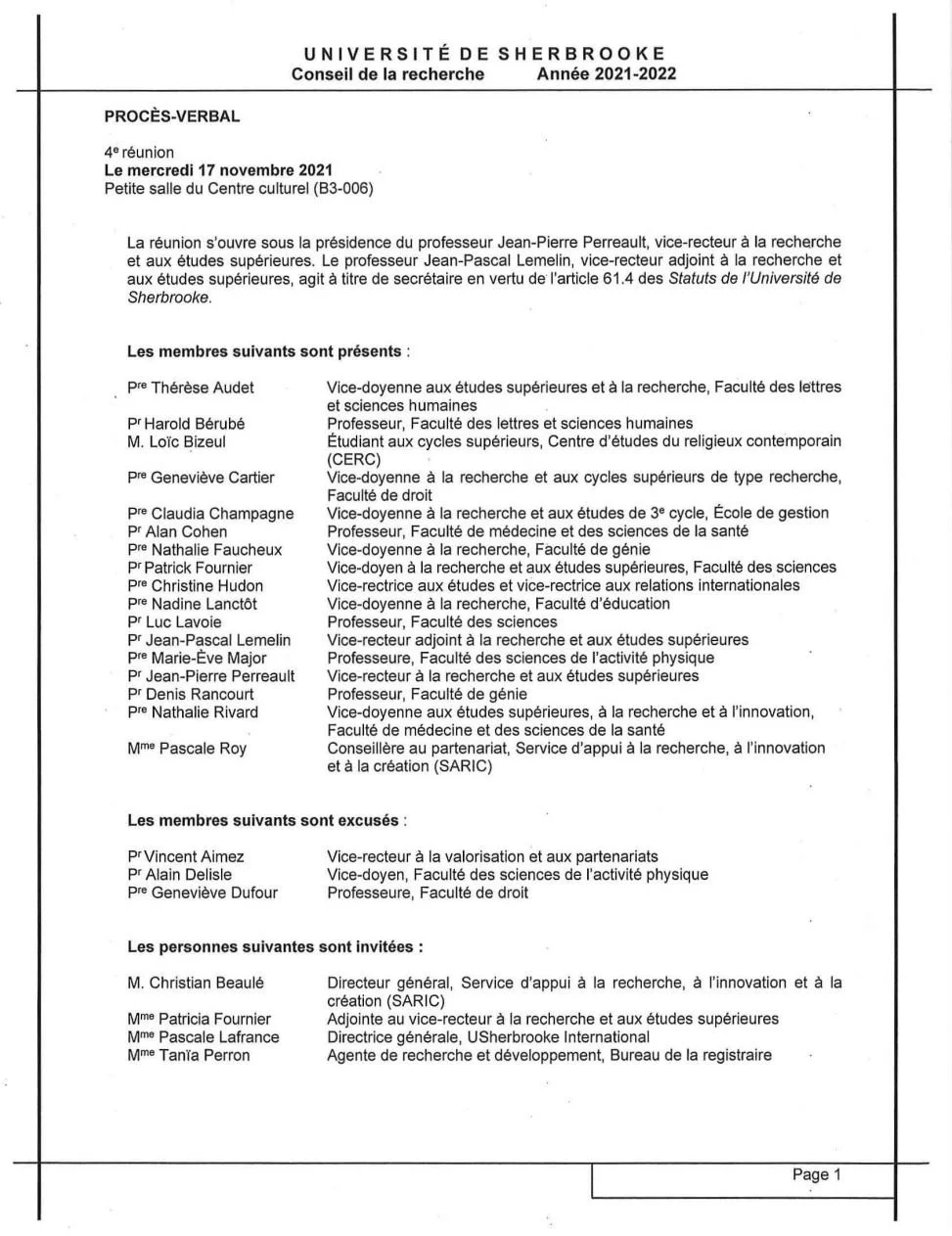

[28] FACULTY OF LAW OF THE UNIVERSITY OF SHERBROOKE, « Direction », Usherbrooke.ca, September 30th, 2023, online : <https://www.usherbrooke.ca/droit/faculte/personnel/direction/>.
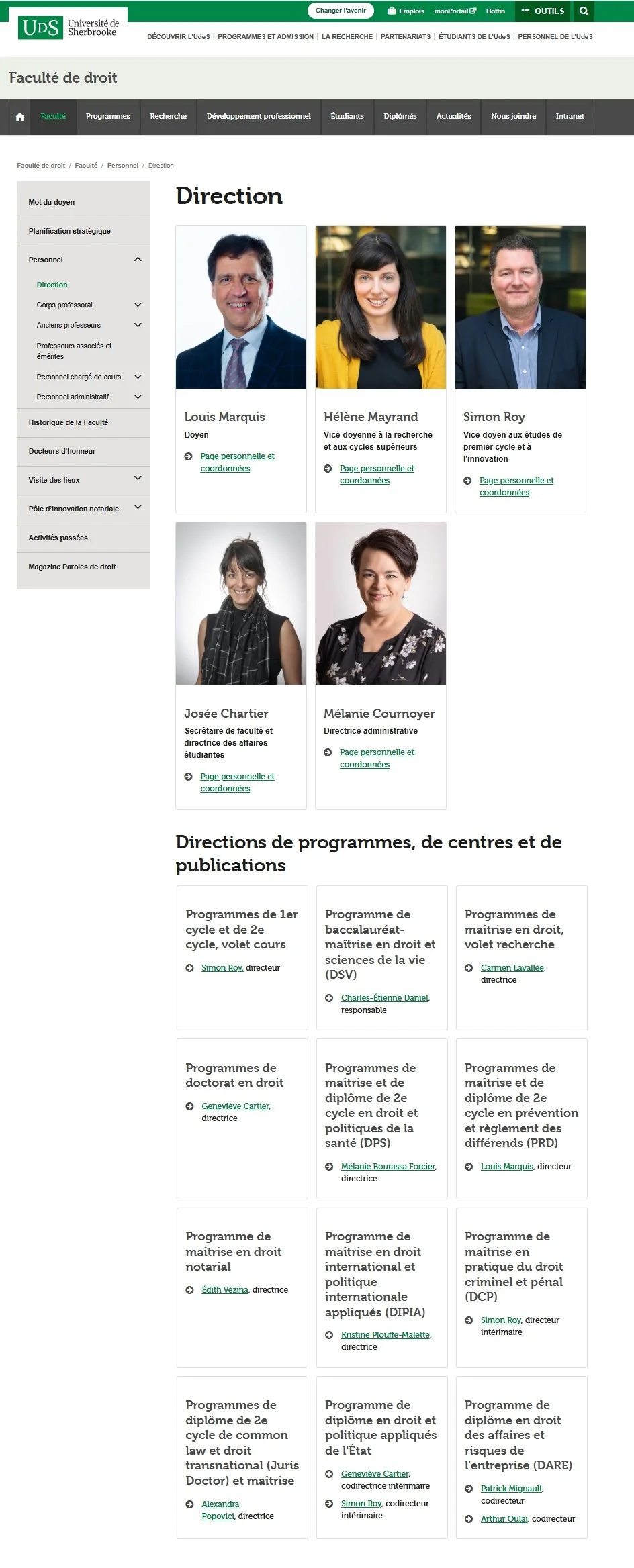
[29] FACULTY OF LAW OF THE UNIVERSITY OF SHERBROOKE, « Geneviève Cartier », Usherbrooke.ca, 4 octobre 2022, online : <https://www.usherbrooke.ca/droit/faculte/personnel/corps-professoral/genevieve-cartier/#c4697-1>; FACULTY OF LAW OF THE UNIVERSITY OF SHERBROOKE, « Direction », Usherbrooke.ca, April 16th, 2023, online : <https://www.usherbrooke.ca/droit/faculte/personnel/direction/>; FACULTY OF LAW OF THE UNIVERSITY OF SHERBROOKE, « Geneviève Cartier », Usherbrooke.ca, April 16th, 2023, online : <https://www.usherbrooke.ca/droit/faculte/personnel/corps-professoral/genevieve-cartier/#c4697-1>; FACULTY OF LAW OF THE UNIVERSITY OF SHERBROOKE, « Direction », Usherbrooke.ca, September 30th, 2023, online : <https://www.usherbrooke.ca/droit/faculte/personnel/direction/>; FACULTY OF LAW OF THE UNIVERSITY OF SHERBROOKE, « Geneviève Cartier », Usherbrooke.ca, September 30th, 2023, online : <https://www.usherbrooke.ca/droit/faculte/personnel/corps-professoral/genevieve-cartier/#c4697-1>; FACULTY OF LAW OF THE UNIVERSITY OF SHERBROOKE, « Geneviève Cartier », Usherbrooke.ca, December 3rd, 2023, online : <https://www.usherbrooke.ca/droit/faculte/personnel/corps-professoral/genevieve-cartier/#c4697-1>.

[30] CANADIAN JUDICIAL COUNCIL, Ethical Principles for Judges, Cjc-ccm.ca, 2021, Commentary 5.C.3., p. 51, online : <https://cjc-ccm.ca/sites/default/files/documents/2021/CJC_20-301_Ethical-Principles_Bilingual_Final.pdf>.
[31] Id., commentary 5.C.8., p. 54.
[32] Therrien (Re), 2001 SCC 35, para. 109 et 110.
[33] Id., para. 111.
[34] Id.