Cain Lamarre, the law firm that defended the University of Sherbrooke in the case exposing schemes in the granting of teaching contracts, was itself a beneficiary of those schemes (Pt.3)
Claudiu Popa
All publications in this series :
-
-
-
-
-
-
Coming soon
-
Coming soon
-
-
-
English version coming soon.
French version available here : https://www.claudiu-popa.com/blog-juridique/decoder-la-fraude
Beneficiaries
Among those who have benefited from fraudulent hiring schemes, used in particular to advance the careers of certain lawyers through favouritism at the expense of others, are lawyers and notaries from the law firm Cain Lamarre.
As we have seen previously, Stéphane Reynolds of the law firm Cain Lamarre had already confessed he was hired at the University of Sherbrooke as a lecturer only 9 months after being sworn in as a lawyer despite the fact that he did not meet the minimum requirement of 5 years Bar experience, a standard that Stéphane Reynolds himself invoked in his story.
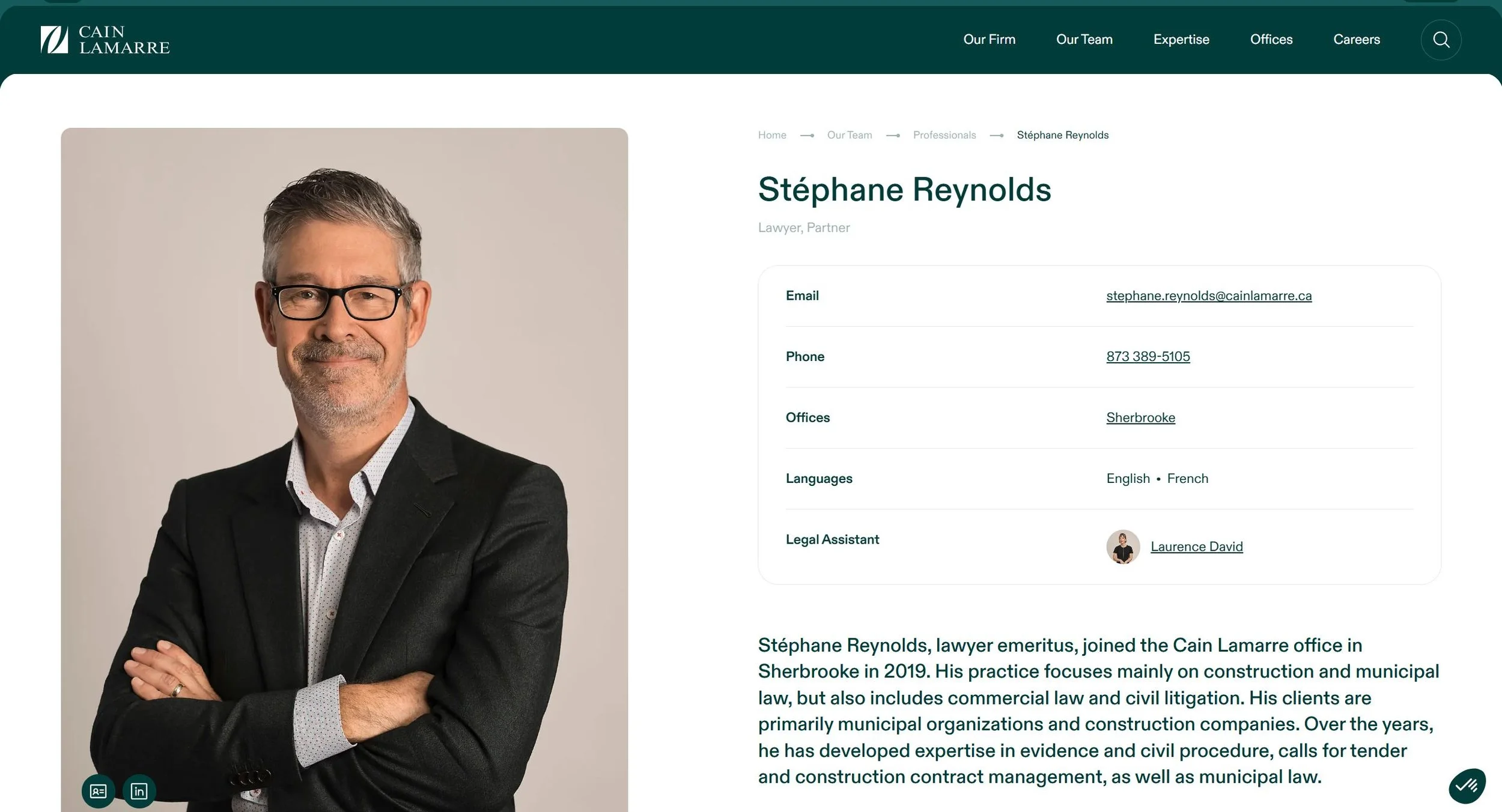
Source : Cain Lamarre
As it is often the case when such schemes are employed, a single violation of the conventional rules by the faculty’s managers was enough to create a domino effect that benefited the favoured candidate, who subsequently enjoys other financial, professional and reputational advantages : it was on the basis of this violation of the 5-year rule that Stéphane Reynolds began to accumulate institutional seniority, which then allowed him to obtain his "acknowledgment of qualification", as well as his employment priority which essentially made his teaching positions permanent and secure for him, year after year. After more than 70 teaching contracts granted to him by the University of Sherbrooke, this lawyer from Cain Lamarre had already earned an estimated sum of several hundred thousand dollars through these teaching contracts (in addition to the network of contacts and the enhancement of his professional profile, that these teaching opportunities generally offer in a university environment).
Several other lawyers and notaries from the Cain Lamarre law firm also benefited from such schemes, which have brought them advantages and benefits.
For example, Charles Guay, lawyer at the law firm Cain Lamarre, called to the Quebec Bar in 2015, was hired in 2018 at the Faculty of Law of the University of Sherbrooke by Sébastien Lebel-Grenier (dean from 2011 to 2019) and by Marie-Pierre Robert (associate-dean from 2015 to 2019), in violation of the rule of 5 years of professional and/or teaching experience relevant to the field he taught.
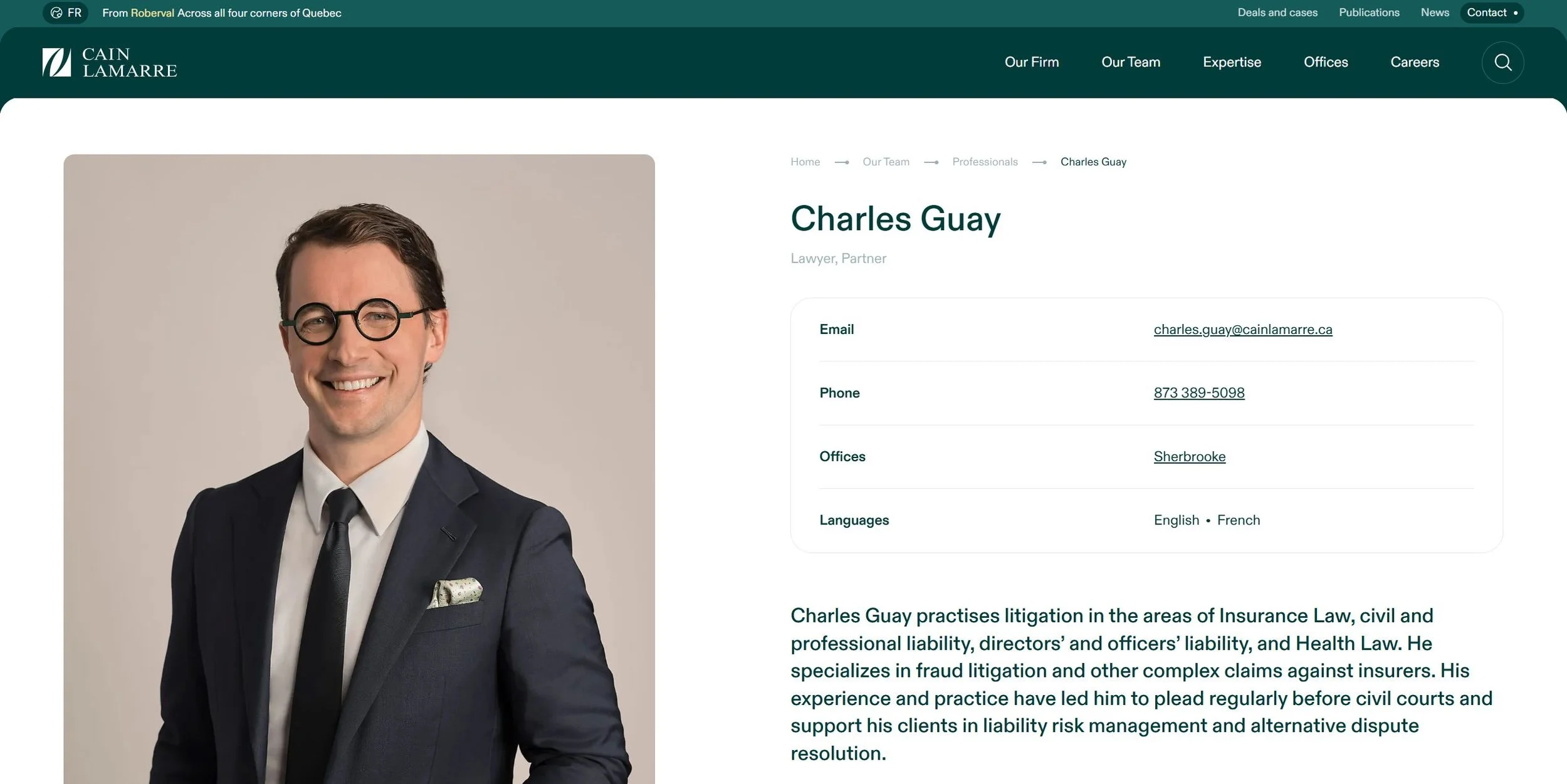
Source : Cain Lamarre
As early as 2013, Charles Guay had acted as a fundraising organiser for the benefit of the Faculty of Law at the University of Sherbrooke. The following year, the faculty’s managers integrated him into the teaching staff of the Faculty of Law that he had helped to finance.

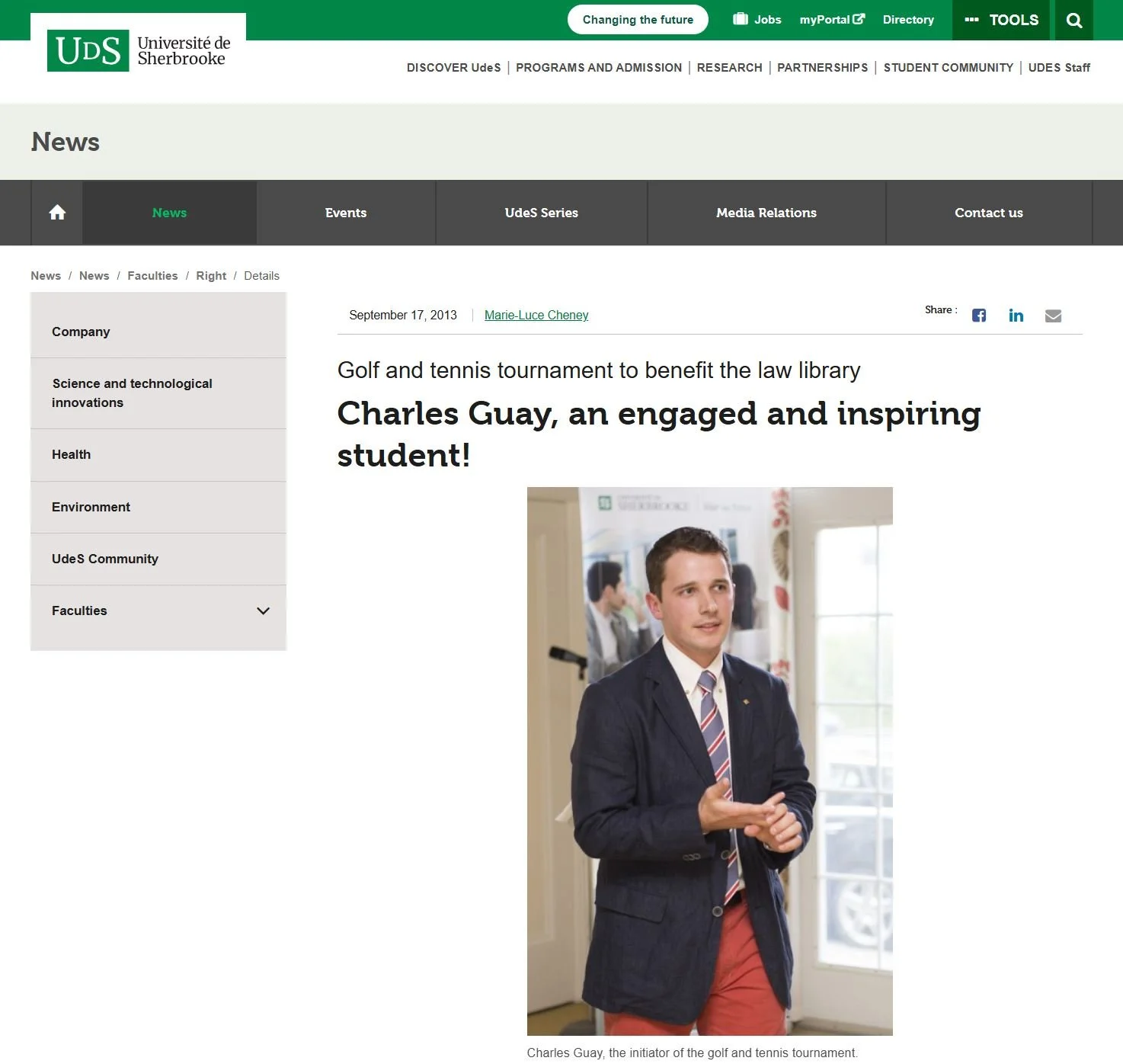
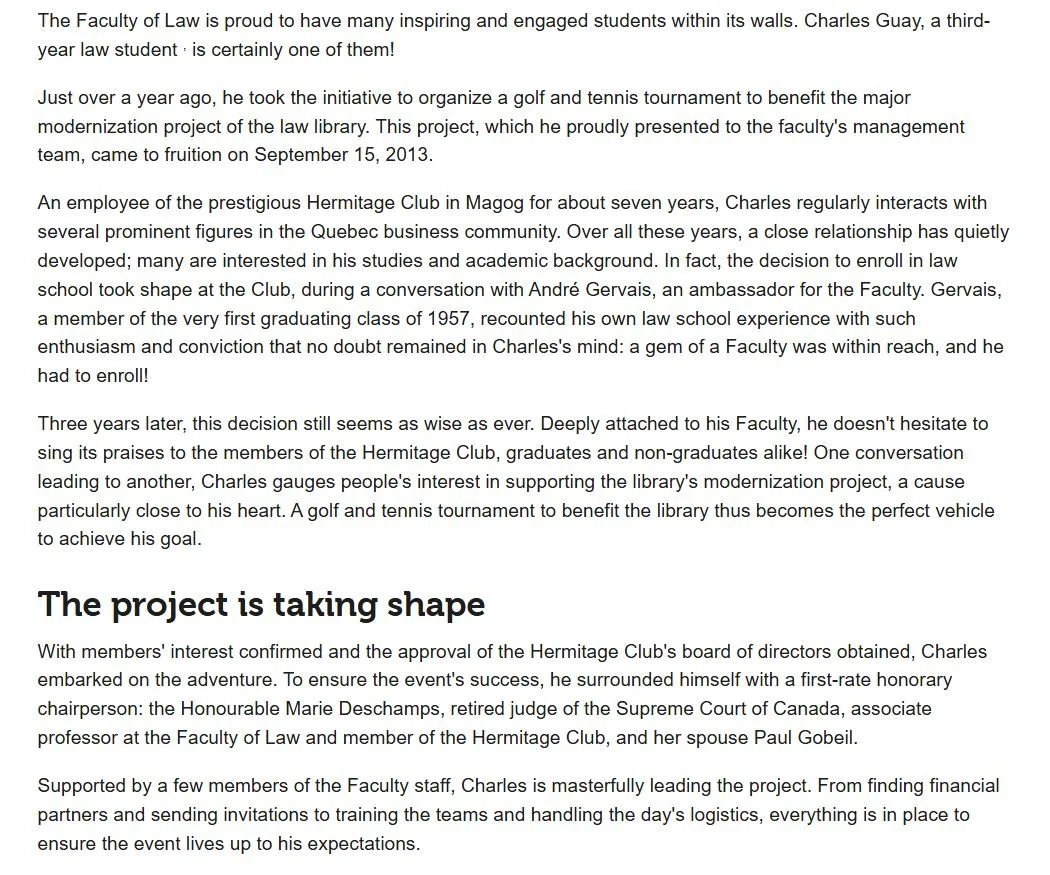
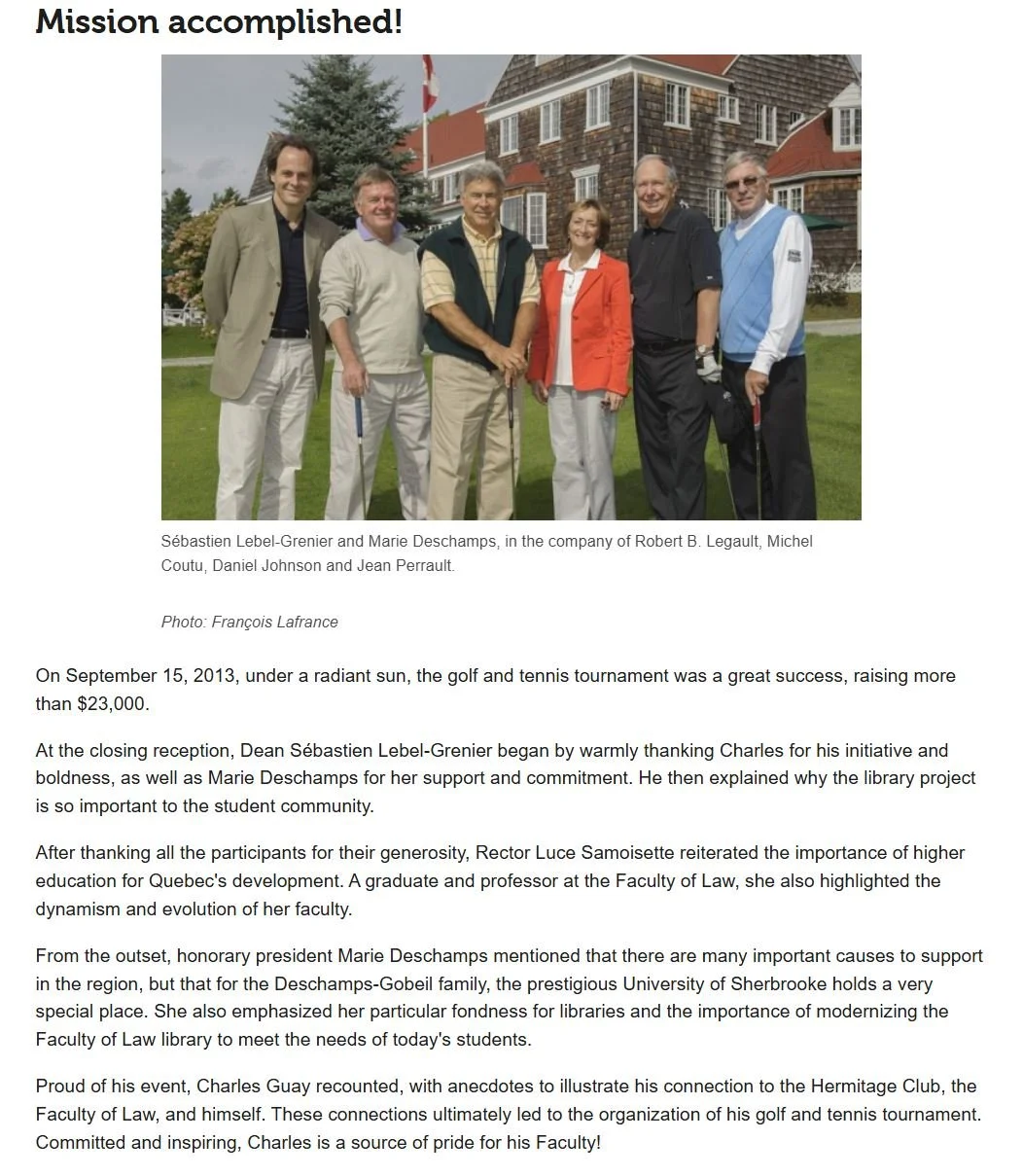
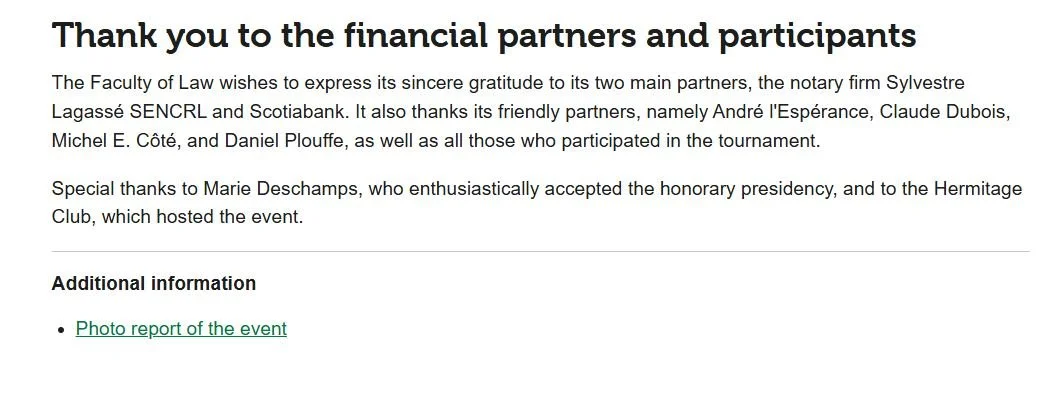
Subsequently, this lawyer from Cain Lamarre helped in organise numerous other fundraising and networking events for the benefit of the University of Sherbrooke, bringing together judges, politicians, prosecutors, lawyers, and business people. Charles Guay had also worked closely with Dean Sébastien Lebel-Grenier and later with Dean Louis Marquis within the Association of Law Alumni of the University of Sherbrooke (ADDUS) to organise these fundraising and networking events.

(More photos to come)
The faculty’s managers then hired Charles Guay as a lecturer, just 3 years after he was called to the Bar, despite the fact that this grant violated the Collective agreement, which required a lecturer to possess 5 years of experience. This lawyer from Cain Lamarre subsequently represented the University of Sherbrooke personally in certain cases that exposed the fraudulent nature of the schemes used by the very same managers who had hired him as a lecturer, using those same schemes, cases in which Charles Guay had a personal interest.
The history of violations of the legal rules regarding hiring within the Faculty of Law of the University of Sherbrooke spans over a long period of time, dating back to the early careers of the 3 deans of the Faculty of Law : Sébastien Lebel-Grenier, Louis Marquis and Marie-Pierre Robert, to whom the grievance reproached preferential hiring practices, among other things.
These 3 deans personally benefited from these fraudulent practices and subsequently perpetuated them in their turn for the benefit of those they chose as lawyers to represent them before the courts :
In his early days, just like his friend Stéphane Reynolds, Dean Louis Marquis was hired as a lecturer in 1989 at the Faculty of Law of the University of Sherbrooke only one (1) year after being called to the Quebec Bar in 1988;
Similarly for Dean Sébastien Lebel-Grenier, who was also hired as a lecturer in 1997 at the Faculty of Law of the University of Sherbrooke after only one (1) year of practice as a lawyer at Stikeman Elliott (1993-1994), while Louis Marquis was Associate-Dean of the Faculty of Law of the University of Sherbrooke;
Dean Marie-Pierre Robert was also hired early in her career as a lecturer at the Faculty of Law of the University of Sherbrooke in 2001 (according to her CV) by the then Dean Louis Marquis (Dean from 2000 to 2004), one (1) year before being sworn in as a lawyer at the Quebec Bar in 2002 and while she had not yet obtained her Master’s degree in law (degree obtained in 2002 according to the same CV that she sent us in 2023 to elect her as dean, excerpt below).
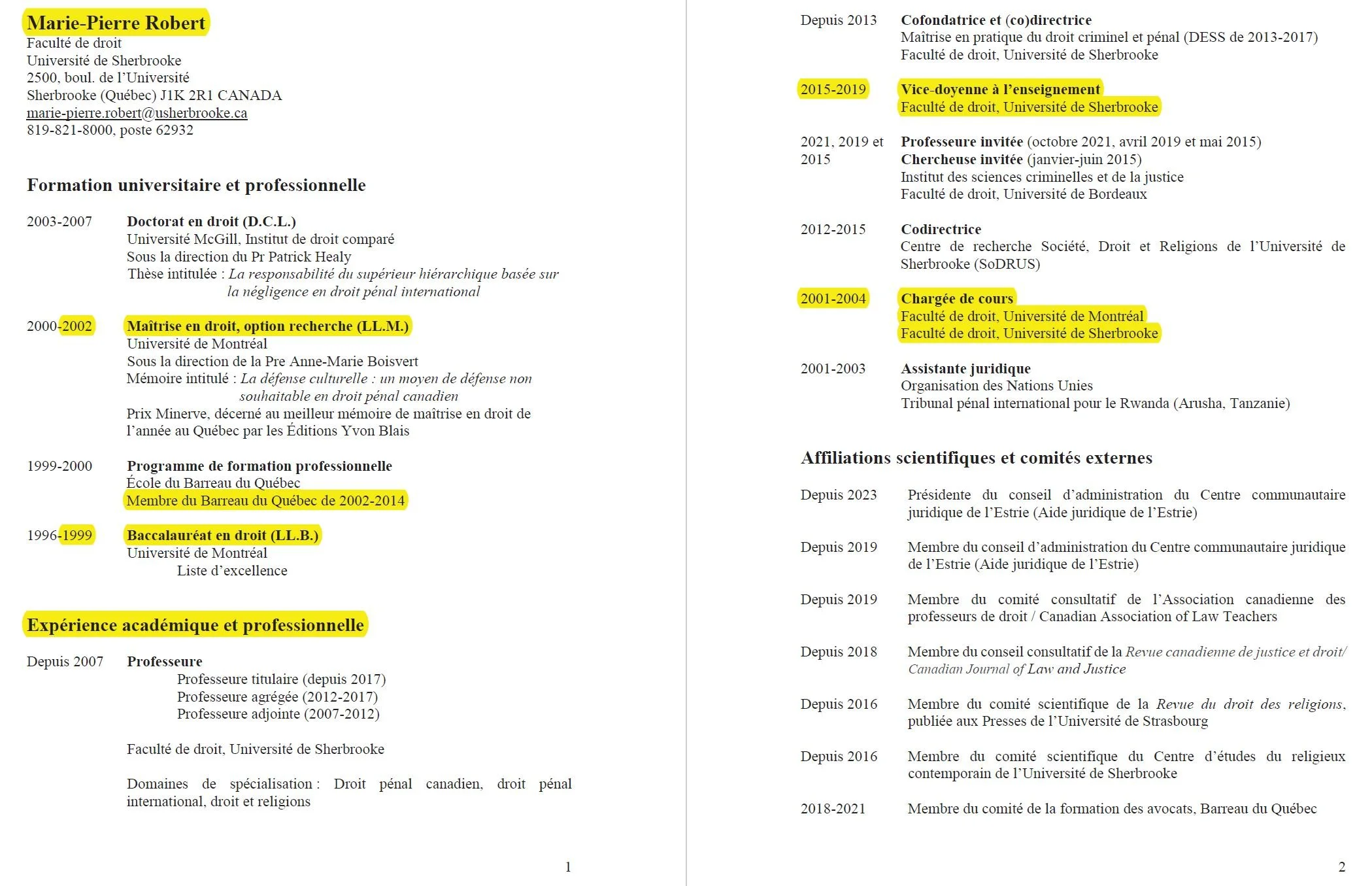
Note : In 2001, according to this same CV, Marie-Pierre Robert claims to have been simultaneously in Tanzania (1. legal assistant at the United Nations) and in Quebec (2. master's student and 3. lecturer)... activities which were all carried out full time... at a time when technology did not allow for remote work.
It is therefore not surprising that Marie-Pierre Robert and Sébastien Lebel-Grenier subsequently hired Charles Guay of Cain Lamarre as a lecturer at the Faculty of Law in 2018, only three (3) years after being called to the Quebec Bar (again, the reason why this conduct is reprehensible is, on the one hand, the fact that these managers have violated the rules of the Collective Agreement and, on the other hand, that they claimed not to have violated these same rules, in addition to the fact that the faculty’s managers violated these rules in favour of some and to the detriment of others - without applying an equal treatment to all).
In addition to Stéphane Reynolds and Charles Guay, there are other examples of lawyers and notaries from the Cain Lamarre law firm who have benefited from similar granting of teaching contracts :
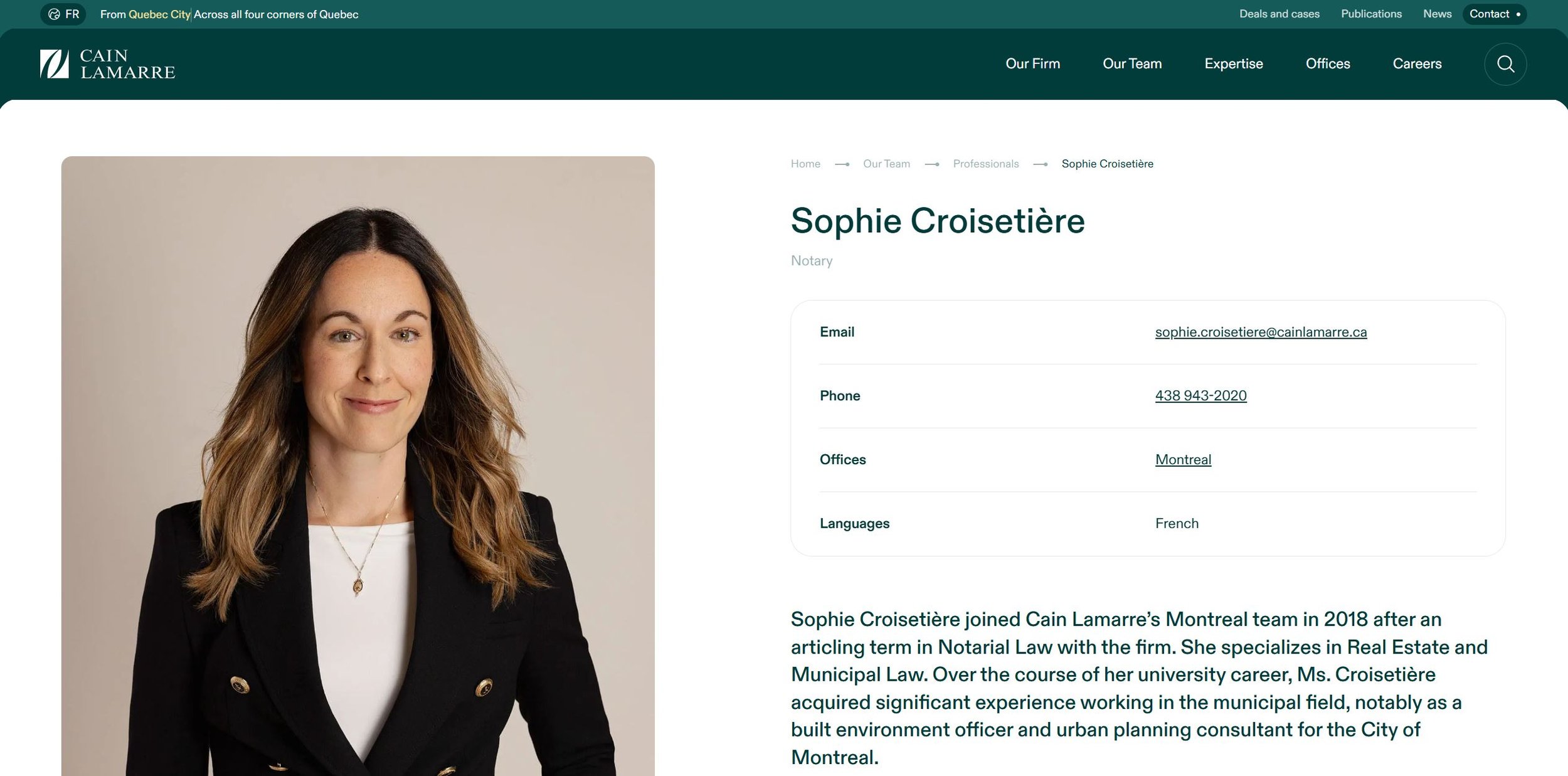
Sophie Croisetière from Cain Lamarre, a member of the Chamber of Notaries since 2019, was hired in 2022 by Louis Marquis (dean January 2020 to December 2023), in violation of the 5-year rule. She was rehired in 2023.
Catherine Beaumier-Dupont from Cain Lamarre was hired in 2020 by Louis Marquis based on the Faculty of Law's "internal hiring procedure," which did not exist. She was rehired in 2021, 2022, and 2023.
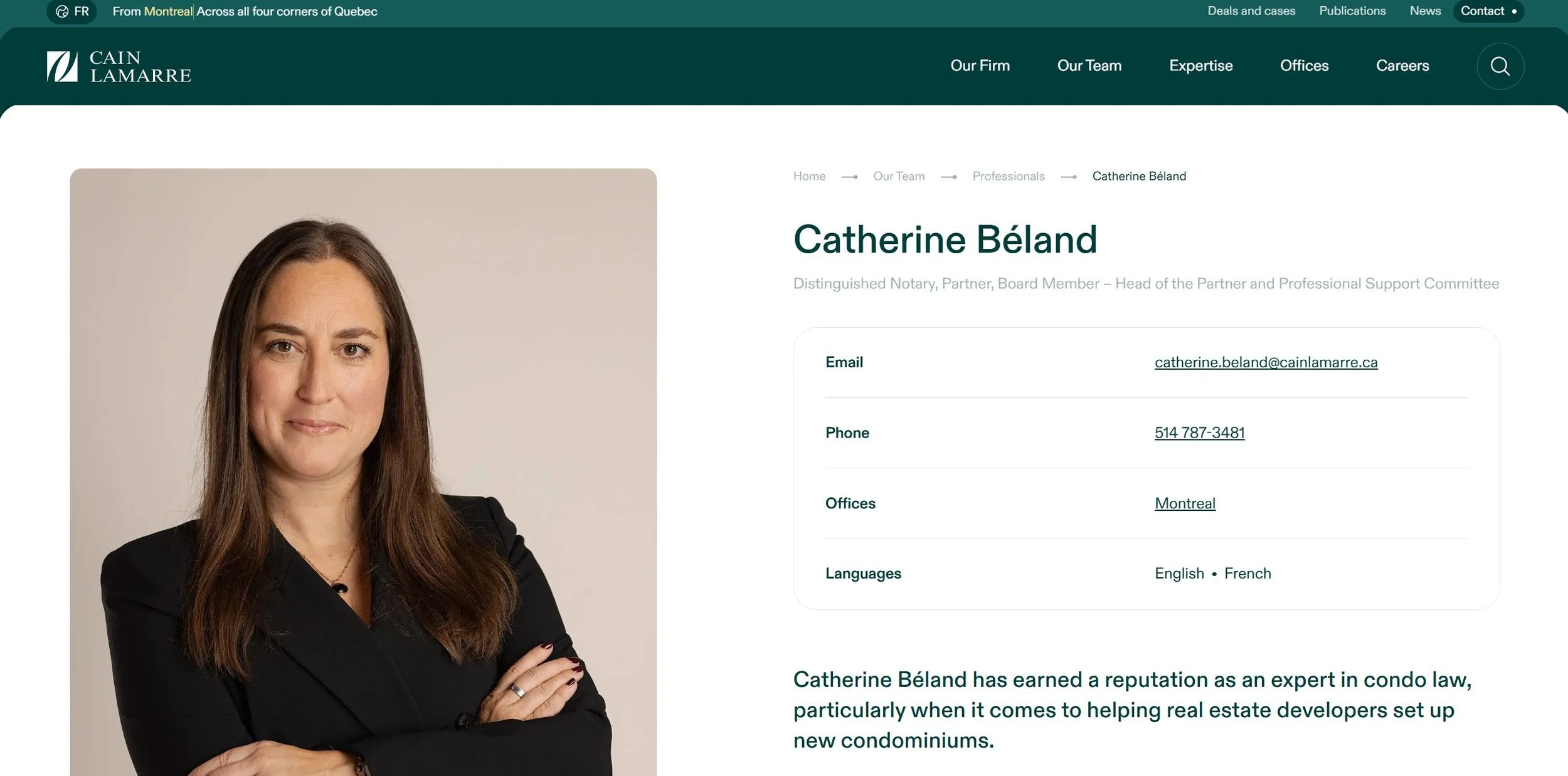
Catherine Béland from Cain Lamarre was hired in 2019 by Sébastien Lebel-Grenier and Marie-Pierre Robert based on the Faculty of Law's "internal hiring procedure," which did not exist. She was rehired in 2020, 2021, 2022, and 2023.
Rosemarie Bouchard from Cain Lamarre was hired in 2018 by Sébastien Lebel-Grenier and Marie-Pierre Robert based on the Faculty of Law's "internal hiring procedure," which did not exist. Subsequently, Rosemarie Bouchard was hired permanently by the University of Sherbrooke as legal counsel.
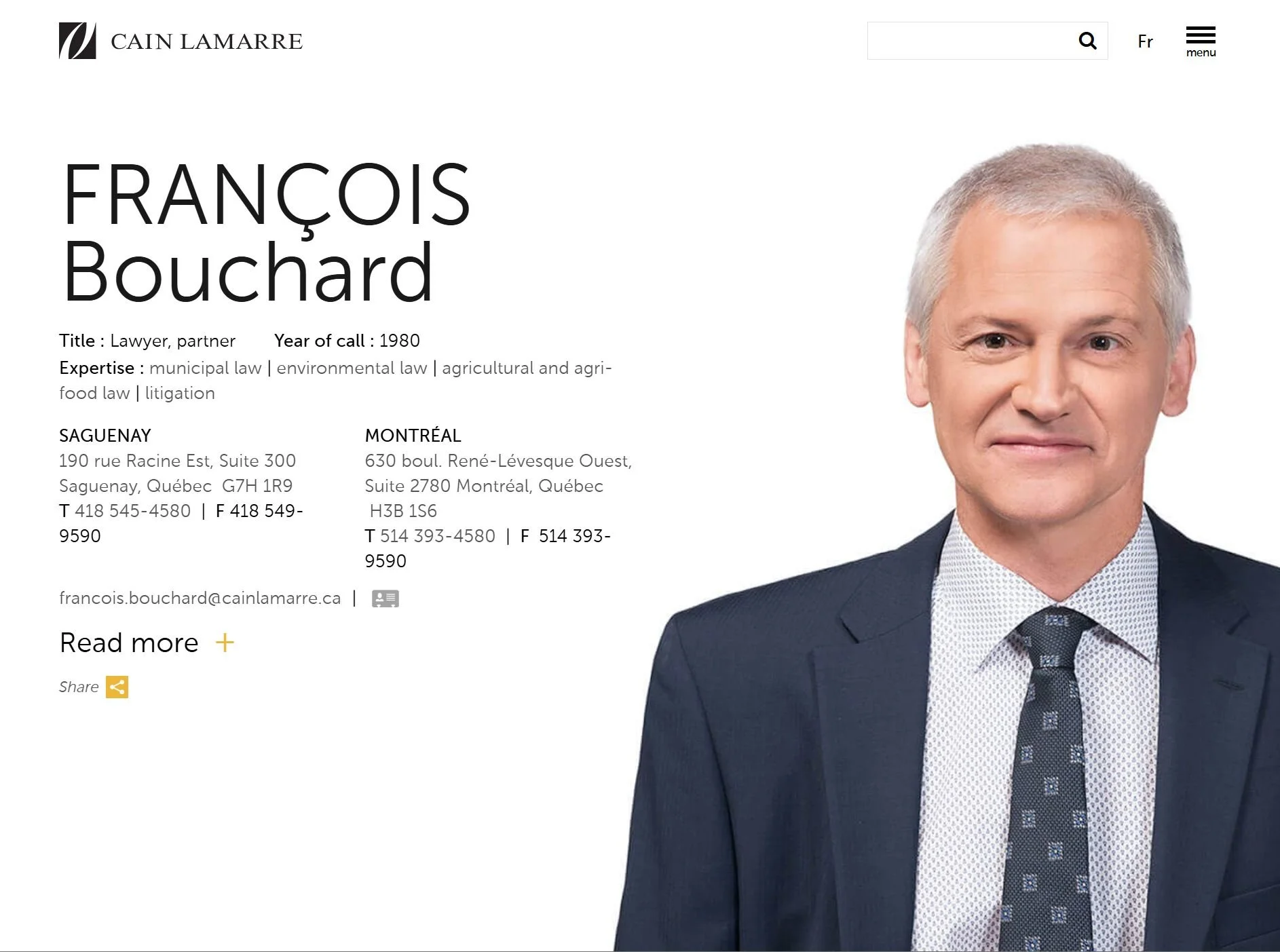
François Bouchard from Cain Lamarre, Rosemarie Bouchard’s father, was hired in 2017 by Sébastien Lebel-Grenier and Marie-Pierre Robert on the basis of the Faculty of Law's "internal hiring procedure" which did not exist.
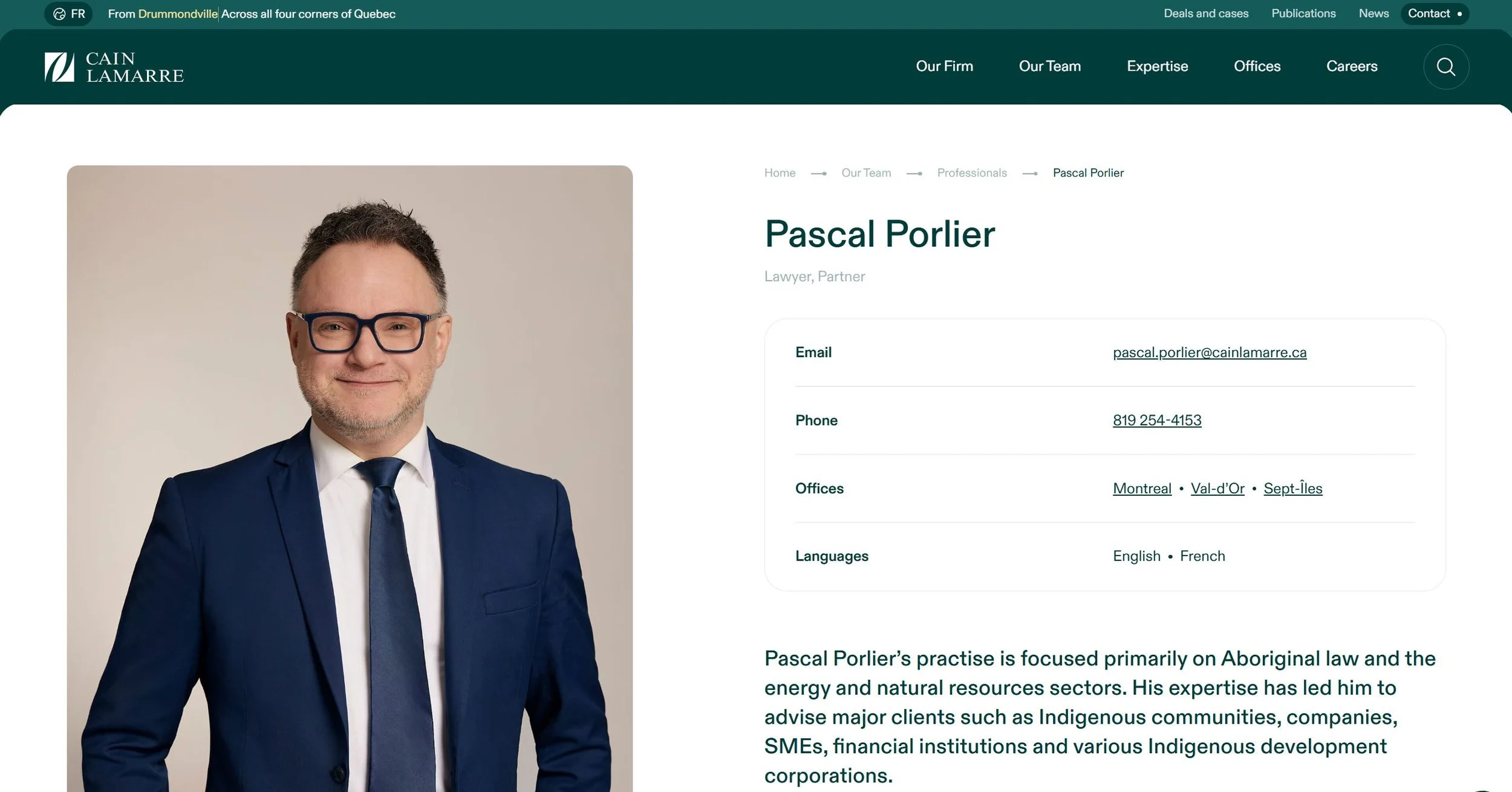
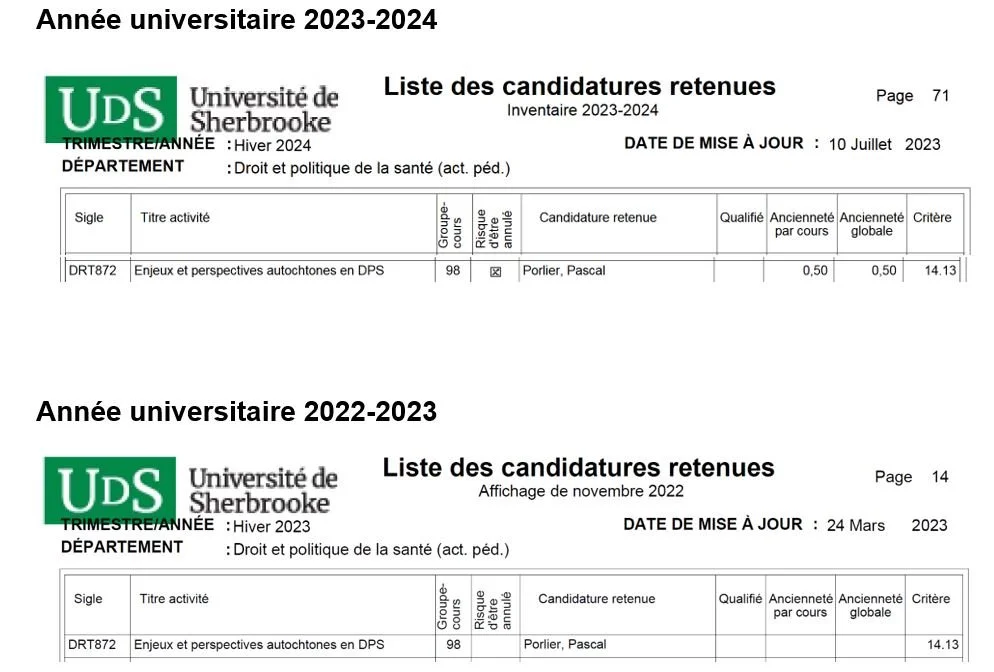
Pascal Porlier from Cain Lamarre was hired in 2022 by Louis Marquis based on the Faculty of Law's "internal hiring procedure," which did not exist. He was rehired in 2023 and 2024.








A law firm that benefited from fraudulent schemes, which defended the schemes of those who had enabled the law firm to profit from those schemes
Lawyers and notaries from the law firm Cain Lamarre had benefited for years from the schemes of these managers of the Faculty of Law of the University of Sherbrooke (schemes described here : https://www.claudiu-popa.com/about-the-university-environment/fraudulent-schemes-teaching-contracts-faculty-of-law-university-of-sherbrooke-1-marie-pierre-robert-louis-marquis-sebastien-lebel-grenier, and here : https://www.claudiu-popa.com/about-the-university-environment/fraudulent-schemes-teaching-contracts-faculty-of-law-university-of-sherbrooke-2-marie-pierre-robert-louis-marquis-sebastien-lebel-grenier) and continued to benefit from them while the law firm Cain Lamarre defended these managers and their schemes in the granting of teaching contracts in cases that exposed their fraudulent nature.
The personal interest of the Cain Lamarre law firm in the grievance case of its client, the University of Sherbrooke, was manifest since it was essentially defending the hiring of its own lawyers and notaries at the Faculty of Law of the University of Sherbrooke, thus defending its own interests in the legal case of its client.
However, section 20 of the Code of Professional Conduct of Lawyers imposes a duty of impartiality (“désintéressement” in French - which translates to disinterestedness) towards one's client, which obliges the lawyer and his firm to be detached from any personal interest in their client :
Section 20 : The lawyer has, towards the client, duties […] of impartiality […].
Cain Lamarre also had other personal interests in its client's case : (1) to maintain the employment relationship between its lawyers and notaries and its client, the University of Sherbrooke, (2) to confirm the legality of the hiring process and, consequently, the hiring of its lawyers and notaries, (3) to prevent the hiring of its lawyers and notaries from being associated with the perception of nepotism, favouritism, or faculty cronyism, and (4) to prevent the future hiring of its lawyers and notaries from being negatively impacted by the outcome of the litigation. However, the rule of law and the case law expressly prohibited Cain Lamarre from representing its client, the University of Sherbrooke, under such circumstances.
The rule of law also imposed an obligation to safeguard one's professional independence (section 13 of the Code of Professional Conduct of Lawyers), an obligation which lies at the heart of the integrity of the judicial system, as established by the courts :
“Even when acting as a representative of a party, [the lawyer] must fulfill this role in such a way that all parties may benefit from an impartial trial within the meaning of section 23 of the Quebec Charter of Human Rights and Freedoms […]. The lawyer’s role in the judicial process is a delicate one. They must act effectively in their representative function. […] This function must be equally loyal to both the opposing party and the court in order to preserve the quality and integrity of the civil or criminal trial. The full execution of this role requires a certain degree of detachment on the part of the lawyer from their client and the case they are defending. It entails upholding the value of independence in their relationship with their client and the court” [1].
- Fédération des médecins spécialistes du Québec v. Association des médecins hématologistes-oncologistes, 1988 CanLII 856 (QC CA)
The Cain Lamarre law firm was therefore also under an obligation to maintain a degree of distance from its client's case and the cause it was defending [2]. The courts describe this obligation as maintaining "a distance that allows it not to confuse its own interests with those of the party it represents" [3]. However, the interests of the law firm Cain Lamarre were inseparable from those of its client, the University of Sherbrooke, because its case concerned fraudulent schemes from which lawyers and notaries from Cain Lamarre had benefited. In practice, this distance did not exist. Furthermore, at the time the case was being handled by Cain Lamarre, 86% of the lawyers and notaries at the Sherbrooke-based law firm Cain Lamarre were graduates of the firm's client and members of the Association of Law Alumni of the University of Sherbrooke University (ADDUS), where their Cain Lamarre colleague, Charles Guay, had been vice-president for nearly a decade. The Sherbrooke-based law firm Cain Lamarre gave the impression of being the University of Sherbrooke "disguised as a law firm," and the situation screamed a lack of professional distance.
“Almost all of us studied at Sherbrooke, it’s our alma mater. We have a special attachment to the Faculty.” [4]
(Stéphane Reynolds, describing the strong sense of belonging felt by lawyers that graduated from the Faculty of Law of the University of Sherbrooke towards the Faculty of Law of the University of Sherbrooke).
Adding to this context of professional inbreeding between client and law firm was the fact that the faculty’s managers involved in the litigation were also friends, close collaborators, or long-time acquaintances of the lawyers from the Cain Lamarre firm (see the application below). However, the courts have previously disqualified a lawyer who displayed (as in the case of Cain Lamarre and their client) “a very close relationship between [the lawyer] and their client, of such a nature as to compromise the independence with which they must, in the best interests of justice, perform their duties before the Court” [5].
The Application for a Declaration of Disqualification
An application for disqualification was filed against this law firm in September 2023, in particular on the grounds that the protection of the integrity of the judicial system "underpins the idea that the courts must remain vigilant regarding the compliance with the rules of professional conduct and ethical principles" of lawyers, as taught by the Court of Appeal of Quebec [6]. Such an application was intended to protect the integrity of the judicial system, given the law firm's personal interest in its client's case (contrary to the professional obligation of detachment, objectivity, and disinterestedness) and the personal and professional ties that extended beyond the lawyer-client relationship.


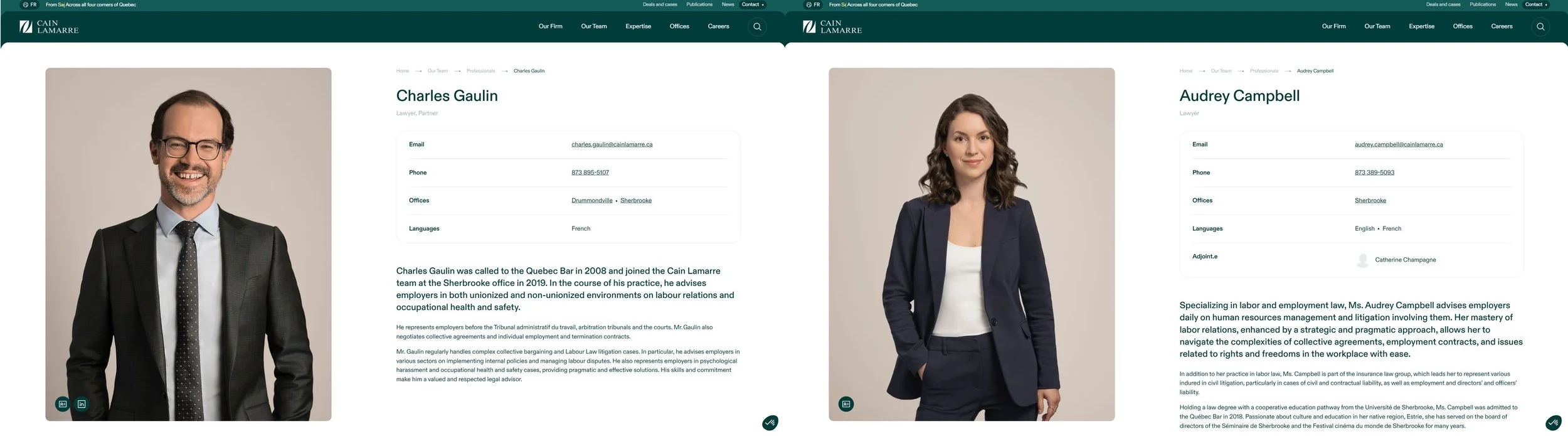
When issues of disqualification are raised (and before the judge declares the law firm disqualified), the law firm in question has the option to withdraw from the case and allow another law firm to take its place.
These issues were raised in relation to Cain Lamarre, but the law firm refused to withdraw from the case and clung to it at all costs.
Although unacceptable, this move was not entirely surprising given Cain Lamarre’s "track record" regarding disqualifications. Cain Lamarre's history of disqualifications was well known, relating not only to the University of Sherbrooke case, but also to other legal cases involving different clients.
Cain Lamarre's history of disqualification and breaches of professional conduct
This is a law firm that is constantly the subject of applications for disqualification, of which more than thirty applications can easily be listed, for a wide range of reasons [7], including : placing itself in a conflict of interest by representing divergent or opposing interests, acting in a manner that brings the administration of justice into disrepute and demonstrates a lack of detachment, using legal proceedings to harm one of the parties, uniting two parties against another, actions taken by the law firm that could constitute fraud against one of the parties in litigation, breaches of the duty to ensure the appearance of justice, lack of transparency, collusion with its client that harmed the other party, failure to respect the integrity of the judicial system, accepting a mandate where there was a connection between a mandate the firm had previously handled and the current mandate, which was in opposition to its former client’s interests, failure of the law firm's internal system to detect conflicts of interest when opening a new file, projected testimony of some of these lawyers in their client's case, breach of confidentiality regarding information obtained in the course of practising law, failure to put in place a "Chinese wall", failure to uphold the duty of loyalty towards a client, etc.
Charles Guay of Cain Lamarre (who acted in the University of Sherbrooke's cases concerning the rules for hiring lecturers, from which he himself had benefited) was the subject of an application for a declaration of disqualification [8] and a notice of intention to file such an application in two separate cases, by two separate litigants. In the case of the application intended against Charles Guay, he was a lawyer at Cain Lamarre and the case was assigned to a judge who was a former lawyer at Cain Lamarre (Charles Ouellet of the Superior Court of Quebec in Sherbrooke) [9], whom Charles Guay described as "the founder of the Cain Lamarre office in the Eastern Townships" where Charles Guay had worked for years and before whom Charles Guay appeared.
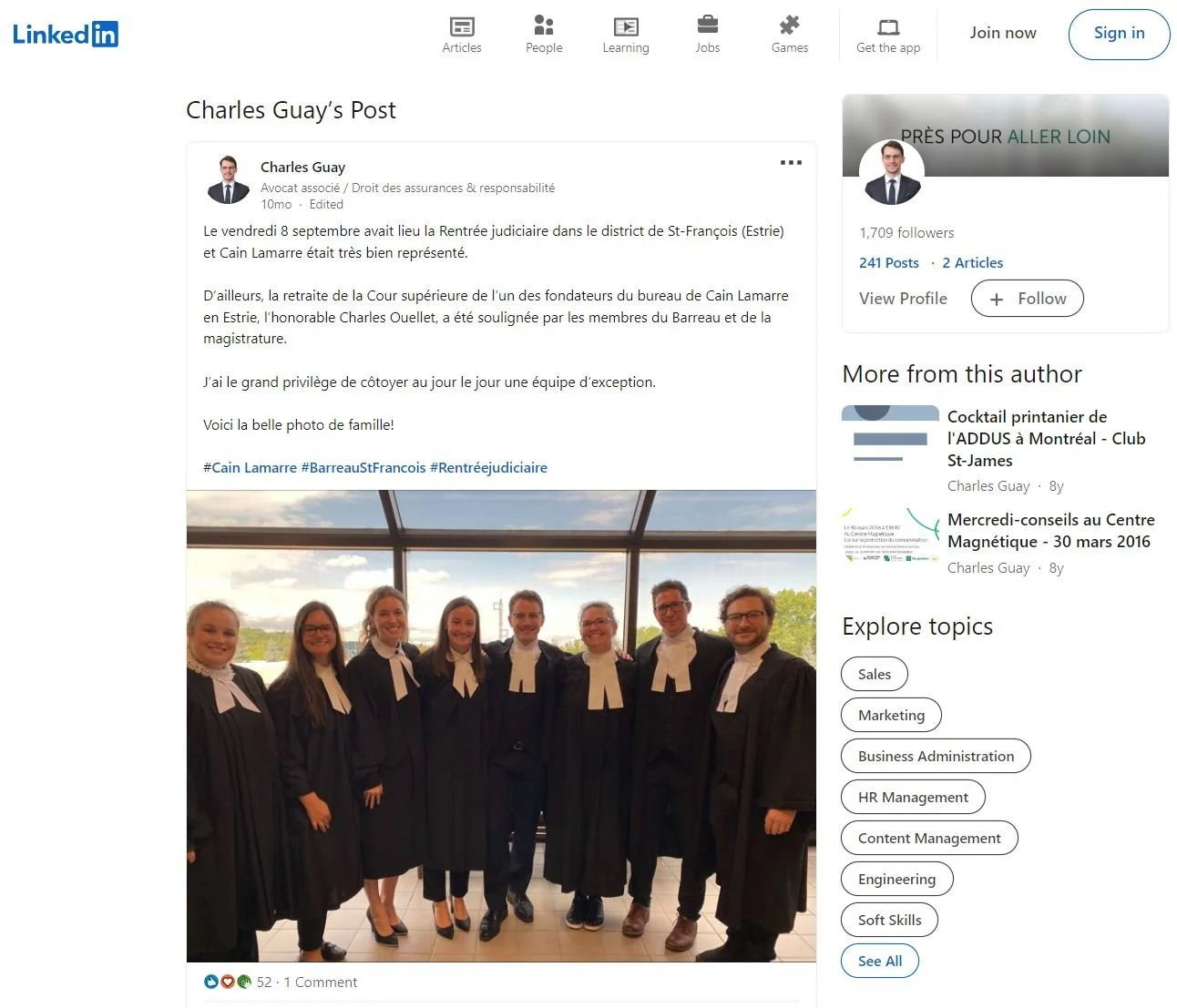
Source : Charles Guay, LinkedIn (2023)
The Cain Lamarre law firm has been declared disqualified on several occasions by the courts for reasons similar to those for which its disqualification was requested in the University of Sherbrooke case : lack of distance, lack of objectivity and conflicts of interests.
Most recently, in 2024, the Superior Court of Quebec’s Judge Nathalie Pelletier was asked to rule on an application for a declaration of disqualification against the firm Cain Lamarre [10] due to the existence of a connection between the law firm's past mandate (drafting a contract) and its current mandate (representing one of the parties to the contract in litigation arising from the interpretation of that contract), which involved the risk of disclosing confidential information or gave the appearance of a conflict of interest. Considering that the law firm had failed to take measures to avoid any appearance of conflict, the judge declared Cain Lamarre disqualified from representing their client.
“The Court reiterates that the test is that of the appearance, not the certainty, of the existence of a conflict of interest, this is why it is said that a lawyer must not accept a mandate where there is a connection between the mandate he executed in the past and the mandate he would now be undertaking against his former client. […] [Cain Lamarre’s lawyer] confirms that no safeguard had been put in place at the time the proceedings were initiated. He offered, however, to put one in place immediately. With all due respect to [the Cain Lamarre’s lawyer], the safeguard must be put in place before accepting the mandate, not after the mandate has been accepted. The Court concludes that the connections between the past and current mandates executed by Cain Lamarre and the confidential information exchanged during the drafting of said contract may be known to the firm. Considering that no reasonable measures were taken prior to accepting the mandate to ensure that confidential information was not to be disclosed from one lawyer to another, the Court considers that the firm must also be declared disqualified to act in this case.”
(translated from French)
In the decision Centre commercial Rimouski inc. v. Ville de Rimouski, 2017 QCCS 6259, the Superior Court of Quebec’s Judge Suzanne Ouellet declared the law firm Cain Lamarre disqualified after finding a clear conflict of interest and the failure on the part of the law firm to maintain sufficient distance in the handling of the case, which compromised the integrity of the judicial process : the law firm had initially represented the petitioner and then withdrew from its client's case midway through in order to represent the opposing party against its former client. The judge condemned the coordinated strategy that Cain Lamarre had orchestrated in order to harm a third party to the litigation and protect its new client. The judge also condemned Cain Lamarre for its involvement in strategies aimed at undermining the claims of this third party, in order to prevent or delay its demands. The judge had determined that this conduct by the Cain Lamarre law firm brought the administration of justice into disrepute and demonstrated a lack of detachment :
“The law firm Cain Lamarre, which represented BSL as the petitioner, is now representing the City as the defendant following the third-party claim filed by CCR, the main defendant. […] This is a case where a client petitioner (BSL) whose former lawyer is now representing another client (the City) which is in the position of a defendant against them. This “musical chairs” situation is perplexing. […] The fact that the Cain Lamarre law firm responded for the City (defendant in warranty) immediately after being replaced (in demand) demonstrates that the law firm is handling the case as part of a unified strategy (suppliers-City) against CCR. The context falls within the definition of a conflict of interest as set out in sections 71 and 72 of the Code of Professional Conduct of Lawyers […] two of the contractors then represented by Cain Lamarre used bankruptcy proceedings to thwart the claims and conclusions sought by CCR against the City […]. The same tactic was, moreover, used by the Cain Lamarre law firm as counsel for BSL against CCR. […] This approach discredits the administration of justice and demonstrates a lack of objectivity.
(translated from French)
In the decision Dallaire v. Parent, 2003 CanLII 34925 (QC CS), the Superior Court of Quebec’s Judge Jean Bouchard declared the law firm Cain Lamarre disqualified due to a conflict of interest and a breach of its duty of loyalty to its clients, which compromised the integrity of the judicial process. The law firm initially represented the defendants in a transaction concerning the purchase of a property and subsequently represented the petitioners in a lawsuit brought against the defendants concerning the same property.
“When [the defendant] first spoke to [Cain Lamarre’s lawyer, who represented the petitioner], he informed the latter [that another colleague from Cain Lamarre] had previously represented him in a litigation against his vendor concerning hidden defects. In the Court’s opinion, [Cain Lamarre’s lawyer] should have withdrawn from the case immediately or, at the very least, put in place the mandatory isolation measures and procedures in place at Cain Lamarre. As mentioned, these measures were only taken a month later […]. This is a breach that undermines public confidence and may give rise to the belief that confidential information has been disclosed. […] even if this incongruous situation can be explained, it defies common sense and, in the Court’s opinion, casts doubt on the lawyer’s duty of loyalty and, by extension, on the integrity of our justice system.”
(translated from French)
In the decision Lafond v. Morin, 2016 QCCS 9, the Superior Court of Quebec’s Judge Christian J. Brossard declared the law firm Cain Lamarre disqualified, as the law firm risked breaching its duties of neutrality, disinterestedness, and detachment, thereby compromising the integrity of the judicial system. In this case, the firm was accused of having, through its recommendations and misrepresentations, encouraged one of the two shareholders of a company to accept the appointment of the other shareholder as sole director, while that shareholder was in a vulnerable position, and the advice provided by Cain Lamarre was biased. While Cain Lamarre was representing the company, it had deliberately taken sides with one shareholder to the detriment of the other. According to the judge, Cain Lamarre may have breached its ethical obligations by participating in a transaction that could constitute fraud against the aggrieved shareholder :
“What is at issue here, and what is indeed problematic, is the serious risk, or the appearance of risk, of a lack of neutrality, of disinterestedness [on the part of the Cain Lamarre law firm], in short, of the detachment described by Judge Lebel in the Fédération des médecins spécialistes decision. […] according to the claims […], [Cain Lamarre] played a direct role, through its recommendations and misrepresentations to Ms. Lafond, in her consent […]. [Cain Lamarre] is alleged to have acted wrongfully towards her and to have participated in a fraud of which she was the victim. The fact remains that [Cain Lamarre] must defend the interests of the Society […] in interventions which, if proven, could possibly be wrongful and constitute fraud.” […] In these circumstances, a reasonable member of the public would likely conclude that [Cain Lamarre] lacks the necessary distance to challenge, on behalf of the Company, Ms. Lafond's proceedings, thereby jeopardising, at the very least in appearance, the integrity of the judicial system. [Cain Lamarre] cannot therefore continue to act in these proceedings.”
(translated from French)
In the decision Longpré (Syndic de), 2013 QCCS 6524, the Superior Court of Quebec’s Judge Jean-Yves Lalonde declared the law firm Cain Lamarre disqualified because it represented both the trustee and one of the administrators involved in the litigation. According to the judge, this dual representation created a serious risk that the firm would favour the interests of one party to the detriment of the other. The very nature of the litigation heightened the danger of this situation, as each party sought to maximize its share, and Cain Lamarre could be tempted to favour one client over the other, or to make arbitrary choices regarding its legal strategy. By acting for two clients whose interests were potentially opposed or divergent, Cain Lamarre found itself in a position where its duties of loyalty and independence were compromised.
“The application alleges the impact of diverging interests, or even the existence of a conflict of interest, arising from the fact that [Cain Lamarre’s lawyer] is already representing [in defence, one of the directors of two companies involved in the litigation] in the liquidation proceedings, whereas, in acting for the trustee, he finds himself representing, to a certain extent, the interests of the bankrupt […]. [The bankrupt] anticipates a conflict of interest. He fears that [Cain Lamarre’s lawyer] may favour the interests of [the administrator of the two companies involved in the litigation] in carrying out the mandate entrusted to him by the trustee. He does not accept that the trustee, represented by [Cain Lamarre’s lawyer], conduct one or more examinations (section 163 of the Bankruptcy Act) of himself and other parties or third parties to further his client’s [the administrator] case to the detriment of the body of creditors or the bankrupt debtor.” […] [Cain Lamarre's lawyer], acting for the trustee in the bankrupt's estate, might be tempted to favour his client [the administrator]. If, on the other hand, he favours the body of creditors, it will necessarily be [his client, the administrator] who will be disadvantaged. Clearly, the interests of the two clients that [the Cain Lamarre law firm] wishes to represent diverge ostensibly. […] Such an exercise would surely be risky, arbitrary, and likely to bring the administration of justice into disrepute, at least in appearance. The risk [for Cain Lamarre] of favouring one client over the other is too serious here. It is even unreasonable and runs against the proper administration of justice.
(translated from French)
In appeal, Judge Jacques A. Léger of the Court of Appeal of Quebec upheld the trial court’s decision [11] to remove Cain Lamarre from the case.
In the decision Municipality of the Township of Stratford v. Marcoux, 2020 QCCS 3467, the Superior Court of Quebec’s Judge Claudia P. Prémont, former President of the Quebec Bar, declared the law firm Cain Lamarre disqualified due to a lack of diligence in managing conflicts of interest. In this case, Cain Lamarre found itself representing the defendants against the petitioner and then, a few years later, representing the petitioner against the defendants. The judge condemned the clear conflict of interest in which Cain Lamarre found itself, a conflict it failed to avoid :
“The defendants […] are shocked to find that the law firm that represented them before the Municipal Court is now suing them in this case. […] Cain Lamarre represented the defendants in a case before the Municipal Court challenging the tickets issued by the petitioner […]. Cain Lamarre is now representing the petitioner against the defendants. Both cases involve the same parties, the same facts, and related legal issues, including, among other things, the interpretation and application of the municipal by-law applicable in this instance. The connection between the mandates is obvious. […] No alert from the law firm’s internal system detected the conflict of interest when the case us was opened [by Cain Lamarre]. […] This demonstrates a deficiency in the institutional system [of Cain Lamarre].”
(translated from French)
In the decision Tremblay v. Savard, 2013 QCCS 6052, the Superior Court of Quebec’s Judge Sandra Bouchard declared the law firm Cain Lamarre disqualified to represent its client (the petitioner), in another case of conflict of interest and failure to protect confidential information. The case concerned an initial relationship between the firm and the defendants, in which the latter had consulted Cain Lamarre on a specific matter. A few months later, the same law firm was called upon to act for the petitioner against the defendants in proceedings concerning the very issue for which the firm had been consulted by the defendents. Clearly, Cain Lamarre exhibits loyalty issues (being a mercenary, in appearance) towards its former clients and prioritises money (even if that money comes from the former opposing party). The judge considered that allowing the law firm to continue acting in this litigation could undermine the integrity of the judicial system and the appearance of justice, and removed Cain Lamarre from the case :
“Although the petitioners’ [lawyers of the law firm Cain Lamarre], are attempting to convince the Court that no confidential information was disclosed, the Court is not convinced that a reasonably informed member of the public would be persuaded of this, as taught by the Supreme Court. Prosecuting a client whom they met only a few months earlier regarding a matter related to the proceedings does not respect the spirit of the Code of Professional Conduct and the appearance of justice. In these particular circumstances, the preservation of the integrity of the judicial system justifies declaring the law firm Cain Lamarre Casgrain Wells disqualified to represent the petitioner in this case.”
(translated from French)
In the decision Protection de la jeunesse — 245029, 2024 QCCQ 4892, the Judge Lucie Godin of the Court of Quebec declared the law firm Cain Lamarre disqualified due to its deplorable handling of a blatant conflict of interest. By simultaneously representing the Director of Youth Protection (DPJ) and the child's foster family, the law firm seriously breached its ethical obligations, placing itself in a position where the interests of both clients were inherently opposed and incompatible. The judge also found that Cain Lamarre knowingly ignored this obvious conflict of interest, taking no steps to manage or report it, and continued to act contrary to the best interests of the child. The judge criticised the conduct of the lawyers from the Cain Lamarre law firm for their blatant lack of transparency, the presentation of incomplete evidence in court, their refusal to acknowledge the seriousness of the situation, as well as their lack of objectivity and complicity with their clients, which demonstrated ethical infractions that compromised the integrity of the judicial system :
“Cain Lamarre and his lawyers represent conflicting interests in this case : those of the Director of Youth Protection, who is a party to the proceedings, and those of the child’s foster family, who is a third party. Since the Director and the foster father are the same person [referred to as ‘C’], these interests are inseparable, even though they are opposed and incompatible. C cannot be separated from his role as Director of Youth Protection, just as he cannot be separated from his status as a foster parent; he is one and the same person. […] C, as Director of Youth Protection, has interests that are opposed to those of C, to whom the child is entrusted, and vice versa. C, the foster father, qualifies himself for his role as a foster family, and as Director, he has all the confidential information about the child’s situation, which he is not entitled to have. As a DPJ, he receives information about the child's situation that originates from him, information which must remain confidential. As a DPJ, he also possesses information that he must not share with the foster family, but moreover, it is he who, in his capacity as DPJ, recommends himself to act as a foster family and declares himself suitable to serve the child's best interests until the child reaches the age of majority. […] It is important to understand that the problem stems from the fact that C is one and the same person fulfilling two roles and functions that are incompatible with one another. Cain Lamarre and its lawyers therefore find themselves in what is, for them, a dead-end situation, since representing opposing interests in this case not only creates a conflict of interest but also raises serious questions regarding the appearance of justice and the prejudice caused to the other parties, namely, the child and his parents, in terms of respecting their rights, as well as the court. Such a situation also raises concerns regarding the respect of the integrity of the judicial system. Cain Lamarre’s lawyers exercised their mandate while disregarding the obvious conflict of interest in representing the DPJ A, which was at the same time the child's foster family. The lawyers from this law firm carried out their mandate by presenting incomplete evidence to the court, even though the relevant documents existed and were in their client's possession. These documents were filed only after the child's lawyer made numerous requests for their release and was forced to file an application with the court to that effect. [...] The report was preceded by progress notes [...]. These notes should have been forwarded to the parties and filed with the court. Their content is informative and reflects the concerns of several interveners, particularly following C's interference in the unilateral agreements made between C and the child's mother, without informing the authorised social worker assigned to the case. [...] The Court should have been informed of this situation, which was characterised by interference and confusion. Cain Lamarre failed to fulfill its obligation to the Court in a timely manner. [...] Cain Lamarre’s lawyers carried out their mandate from the outset without paying any attention to the conflict of interest that already existed. [...] They should have [...] ensured that this conflict of interest ceased. Instead, they chose to turn a blind eye and endorse the director's decisions, even though these decisions were incompatible from the beginning, and are now irreconcilable. [...] The duties of independence, objectivity, and integrity of lawyers are essential. A lack of distance from a client or a specific case creates a risk of inadequate representation. The need for caution should have prevailed. The conflict of interest is blatant. Cain Lamarre and its lawyers lacked transparency towards the Court and the other parties, and they did not prioritise the child's best interests and rights in this case. One might even go so far as to say that they [Cain Lamarre and its lawyers] have, through their actions in recent months in particular, become complicit in the decisions of the director and his principals. As it is essential to maintain public confidence in the administration of justice, the conflict of interest that has come to light renders the law firm Cain Lamarre and its lawyers disqualified to act in the case of the child in question.”
(translated from French)
Even worse, Charles Gaulin, Cain Lamarre's lead lawyer in the cases involving the University of Sherbrooke, was also forcibly removed by the Court following an application for a declaration of disqualification from a case in which Charles Gaulin and his law firm at the time were representing another employer, as recently as July 2019.
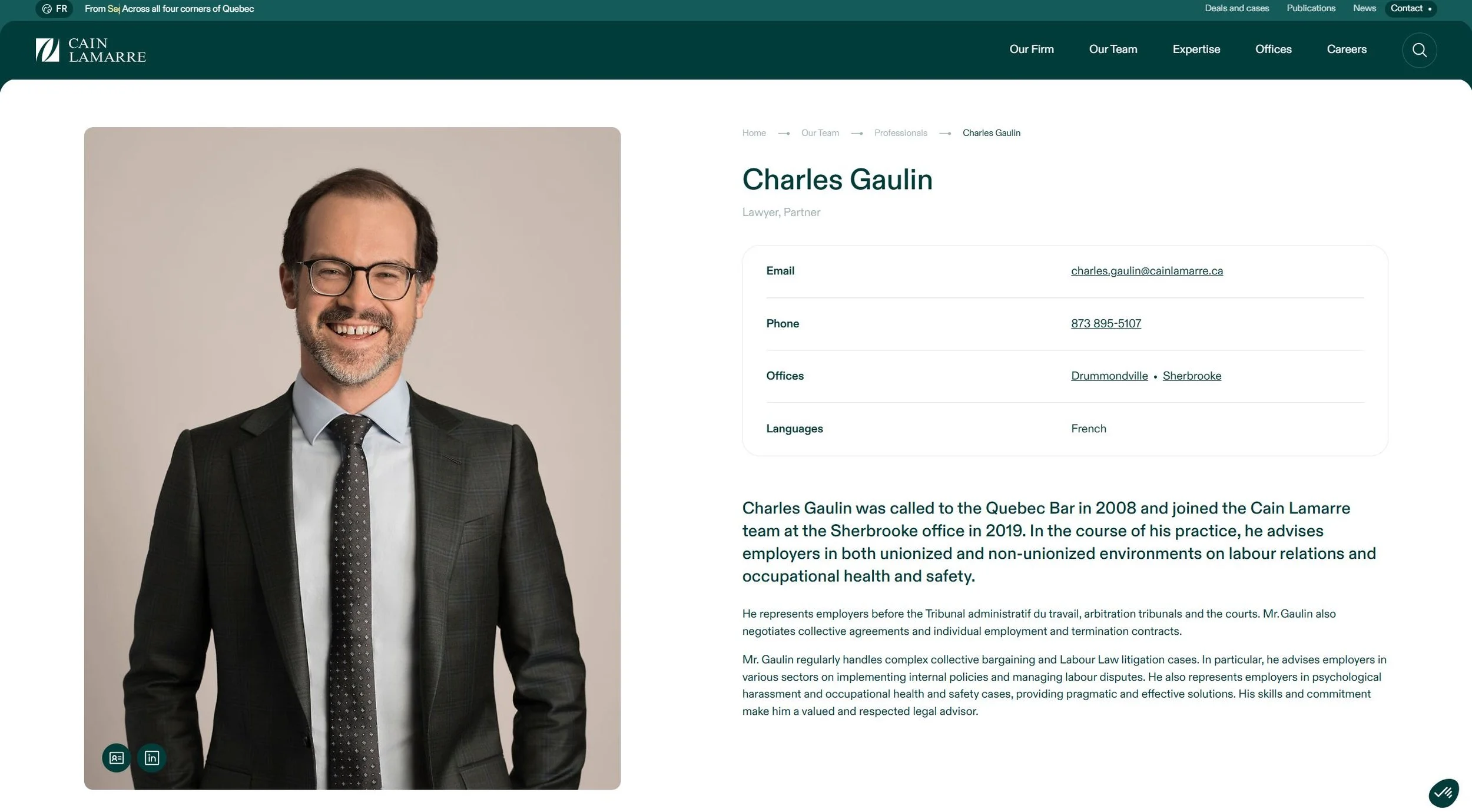
Source : Cain Lamarre
The judge had severely criticised Charles Gaulin for having been involved in the process that led to the plaintiff's disguised dismissal and because he was, at the same time, the lawyer defending the plaintiff's dismissal, based on his own investigation and legal opinion. While Charles Gaulin's interest was "aligned" with that of his client, the judge ruled that this "alignment of interests" constituted a potential conflict of interest and that it was unacceptable for a lawyer to have a personal interest "aligned" with that of his client :
“Mr. Gaulin played an active role in several key stages of the case. He appears to have been closely involved in the process that gave rise to the litigation. How could his colleagues possibly have ‘the necessary distance to debate’ these issues, particularly given that some of these discussions took place in the law firm’s offices and several members of the law firm have been involved in the case over time? […] the specific circumstances of this case preclude the distance necessary for the professional independence required before a court. Both Mr. Gaulin and the law firm are, at least in appearance, stakeholders in the investigation and the decisions that gave rise to the litigation. In this sense, they have a vested interests in the case.” [12]
(translated from French)
This situation was similar to that of the University of Sherbrooke case, where the lawyers and notaries of the Cain Lamarre law firm had "a vested interest in the case", stakeholders having benefited from their client's fraudulent schemes to get hired as lecturers there, and the law firm then advised their client on how to "defend" itself against the allegations of fraudulent schemes, while "defending" the hiring of its own lawyers and notaries in their client's case.
Despite his track record, Charles Gaulin had not learnt his lesson. Neither has he, nor Cain Lamarre. On the contrary, their stubborn insistence on remaining on the case demonstrated a pattern of repeated misconduct by the law firm and its lawyers, who repeatedly disregarded ethical rules and court rulings — a reprehensible modus operandi perpetrated over a long period of time that could have easily constituted an aggravating factor in the assessment of the application for a declaration of disqualification brought against them in this case.
"Schemings" sold as an asset
Even more surprising is that Cain Lamarre’s modus operandi was marketed to potential clients, publicly, on the law firm's website, as a remarkable asset (despite the fact that is violates professional ethics and the rule of law).
Cain Lamarre boasted of having an "impressive network of contacts" which it consciously cultivated in order to later use it to the benefit of its clients to resolve their "legal problems". This network even included judges. This was evident from the statement of Gina Doucet, lawyer and head of professional practice at the Cain Lamarre law firm :

“Our legal experts […] include eminent lawyers respected by the highest courts, influential legal advisors, bar presidents […] Such is the distinguished makeup of our firm, some of whose members have been named to the bench.”
“Over the years, we have forged an impressive network of contacts we can tap into to serve our clientele. Our legal professionals cultivate and maintain strategic relationships with municipal, provincial and federal politicians and elected officials, lawyers from other national and international firms, members of the media across Québec and around the world, and leading economic stakeholders.”
“Used wisely, this web of contacts can be helpful in finding legal solutions. It also enhances efficiency and serves as a powerful economic lever for many of our clients.” “The network is further strengthened by the active role our lawyers play in the social and economic life of the communities where the firm has roots and continues to develop today.”
- Gina Doucet, Lawyer and Executive Director of Professional Practice, Cain Lamarre, 2023-2024 [13]
When the public reads between the lines of this sort of statement, it might conclude that Cain Lamarre would offer clients a shady and perfidious "way" to find "solutions" to their "problems" through the backchannels of the judiciary, using influential figures of the judicial system (judges, bar presidents, people in power, media) who are part of its multi-tentacular network of contacts and who would act in the benefit of "their own."
The first time I read this statement on Cain Lamarre's website, my immediate reaction was to wonder whether it was possible to market corruption within the judicial system more openly without arousing the authorities’ suspicions and triggering police investigations. Moreover, Cain Lamarre’s remarks proved to be "prophetic" of what was to follow.
Although the University of Sherbrooke has frequently been represented in court by other law firms such as McCarthy Tétrault [14], Lavery [15], Heenan Blaikie [16] (an infamous law firm that collapsed, where some of the University of Sherbrooke's associates worked, including the University of Sherbrooke’s former lawyer Claude Villeneuve, the ambassador of the Faculty of Law of the University of Sherbrooke Marie-Josée Hogue, Dean Marie-Pierre Robert's husband Sébastien Pierre-Roy, and the daughter of University of Sherbrooke's great ambassador Jean Charest, Amélie Dionne-Charest, in addition to some other political friends like Pierre Marc Johnson and Jean Chrétien, not to mention Pierre Elliott Trudeau whose Trudeau Foundation financed Marie-Pierre Robert's law studies) or Monty Sylvestre (Monty Coulombe) [17]), here, in these cases specifically, the University of Sherbrooke was keen to be represented by the law firm Cain Lamarre, and, consequently, for Cain Lamarre to remain on the case.
So, the University of Sherbrooke needed an “accommodating” judge, who would keep Cain Lamarre on the case.
Former University of Sherbrooke’s lawyer Claude Villeneuve (the coordinating judge of the Superior Court of Quebec at the Sherbrooke Courthouse) and Marie-Anne Paquette (the Chief Justice of the Superior Court of Quebec from the law firm McCarthy Tétrault, appointed to this position in 2022 by the David Lametti - Justin Trudeau regime 2019-2023), assigned the disqualification case to Judge Martin F. Sheehan, a lawyer from Fasken, appointed as a judge in 2019 by the same David Lametti of Justin Trudeau's Liberal government (after being removed from his position as Minister of Justice, David Lametti was hired by Fasken in January 2024; Judge Martin F. Sheehan heard the application in February 2024).

Just like Cain Lamarre, Judge Martin F. Sheehan also had a history of disqualifications on his record dating back to his time as a lawyer.
The lawyer Martin F. Sheehan and his law firm Fasken were the subject of applications for a declaration of disqualification which were granted by the courts, once in 1999 [18] and again in 2016 [19], shortly before his appointment to the bench in 2019. In the first decision, the judge declared Martin F. Sheehan and Fasken disqualified, precisely for reasons of lack of distance and lack of objectivity, as raised in the application for a declaration of disqualification against Cain Lamarre which Judge Martin F. Sheehan was going to rule on.
In short, things did not bode well.
ALL ARTICLES IN THIS SERIES :
-
-
-
-
-
-
Coming soon
-
Coming soon
-
-
-
English version coming soon.
French version available here : https://www.claudiu-popa.com/blog-juridique/decoder-la-fraude
*****
[1] Fédération des médecins spécialistes du Québec v. Association des médecins hématologistes-oncologistes, 1988 CanLII 856 (QC CA).
[2] Gattuso Bouchard Mazzone v. Chartier, 2023 QCCS 3178, para. 12; Lessard and Coopérative de solidarité du Centre de la petite enfance Le Bilboquet, 2019 QCTAT 3255, para. 24; Centre commercial Rimouski inc. v. Ville de Rimouski, 2017 QCCS 6259, para. 89.
[3] Locas v. Boileau, 2000 CanLII 18232 (QC CQ), para. 38.
[4] Marie-Luce CHENEY, “The Faculty of Law highlights the generosity of Monty Coulombe”, University of Sherbrooke, April 8, 2014, online : ‹https://www.usherbrooke.ca/lafondation/nouvelles/details/25248›.
[5] Commission des droits de la personne et des droits de la jeunesse (Beaudoin et autres) v. Gaz métropolitain inc., 2005 CanLII 35792 (QC TDP), para. 40.
[ 6] R. c. Harrison, 2017 QCCA 263, para. 47.
[7] David Boyer, Residential Real Estate Broker Inc. v. Lambert, 2024 QCCS 2421; Youth Protection — 245029, 2024 QCCQ 4892; Rimouski Shopping Centre Inc. v. City of Rimouski, 2017 QCCS 6259; Dallaire v. Parent, 2003 CanLII 34925 (QC CS); Lafond v. Morin, 2016 QCCS 9; Longpré (Trustee of), 2013 QCCS 6524; Lemieux Nolet Inc. v. Longpré, 2014 QCCA 336; Municipality of the Township of Stratford v. Marcoux , 2020 QCCS 3467; Tremblay v. Savard , 2013 QCCS 6052; Bio-Bon Inc. v. Aliments Inpack inc., 2021 QCCS 62; Vézina v. Centre d'initiative en agriculture de la région de Coaticook (CIARC), 2019 QCCS 4007; AD and AD, 2017 QCCS 6021; Amqui (Ville d') v. Lévesque, 2006 QCCS 6659; Auger v. Roy, 2018 QCCS 3058; Blackburn v. Blackburn, 2024 QCCS 559; Commission des normes du travail v. Centre de santé et de services sociaux du Lac-St-Jean Est, 2008 QCCQ 168; Dentistes (Ordre professionnel des) v. Gaudet, 2023 QCCDODQ 20; Droit de la famille — 13154, 2013 QCCS 287; Family Law — 221297, 2022 QCCS 2806; Équipements Yves Landry inc. v. Gaspé (City of), 2016 QCCA 288; FS v. Syndicat de l'enseignement de l'Estrie, 2008 QCCAI 72; Gagnon v. Bolduc, 2009 QCCS 2361; Genest-Makdessi v. Genest, 2007 QCCS 1362; Industries Remac inc. v. Constructions CLD (1985) inc., 2007 QCCS 6493; Isacco (Estate of Isacco) v. Spencer, 2019 QCCS 4368; Milunovic v. Huard and Lepage, 2018 QCCDBQ 29; Rioux & Beaulieu inc. v. Sun Life of Canada, Life Assurance Company, 1997 CanLII 10694 (QC CA); Robidoux v. JCR Constructions et rénovations inc., 2021 QCCS 2058; Rousseau v.RER Enterprises Inc. (Universal Parts Inc.), 2003 CanLII 54503; Sexologists (Professional Order of) v. Gariépy, 2024 QCCDSEXO 4; Estate of Blouin, 2023 QCCS 4999; Sun Life of Canada v. Tremblay, 1998 CanLII 11708.
[8] Bio-Bon inc . c. Aliments Inpack inc., 2021 QCCS 62.
[9] Vézina v. Centre d'initiative en agriculture de la région de Coaticook (CIARC), 2019 QCCS 4007, para. 53.
[10] David Boyer, residential real estate broker inc. v. Lambert, 2024 QCCS 2421.
[11] Lemieux Nolet inc. v. Longpré, 2014 QCCA 336.
[12] Lessard and Coopérative de solidarité du Centre de la petite enfance Le Bilboquet, 2019 QCTAT 3255.
[13] Gina DOUCET, “Our firm. Here to get you there”, Cain Lamarre, December 2023, online : ‹https://cainlamarre.ca/en/our-firm/›.
[14] Association of Professors of the Faculty of Medicine of the University of Sherbrooke (APPFMUS) v. University of Sherbrooke, 2025 CanLII 91164 (QC SAT); Association of Professors of the Faculty of Medicine of the University of Sherbrooke (APPFMUS) v. Professor Guay, 2025 CanLII 47479 (QC SAT); Association of Professors of the Faculty of Medicine of the University of Sherbrooke (APPFMUS) v. Guay, 2024 CanLII 42207 (QC SAT); Association of Professors of the Faculty of Medicine of the University of Sherbrooke (APPFMUS) v. Guay, 2024 CanLII 505 (QC SAT); Guay v. Association of Professors of the Faculty of Medicine of Sherbrooke (APPFMUS), 2022 QCCQ 5098; Rhnima v. Union of Professors of the University of Sherbrooke, 2021 QCTAT 6070; Union of Professors of the University of Sherbrooke (SPPUS) v. University of Sherbrooke, 2020 CanLII 62493 (QC SAT).
[15] Syndicat des employés et employés de soutien de l'Université de Sherbrooke (CUPE 7498) v. Université de Sherbrooke, 2015 CanLII 13304 (QC SAT); Obaid v. Université de Sherbrooke, 2022 QCCS 1325; Cloutier v. Université de Sherbrooke, 2023 QCCS 458; Adjo v. Université de Sherbrooke, 2024 QCCS 1177.
[16] Université de Sherbrooke v. Commission des droits de la personne et des droits de la jeunesse, 2013 QCCA 1449; Commission des droits de la personne et des droits de la jeunesse (Lemieux et autres) v. Université de Sherbrooke, 2013 QCTDP 15; Commission des droits de la personne et des droits de la jeunesse (Lemieux et autres) v. Université de Sherbrooke, 2012 QCTDP 18; Université de Sherbrooke v. Pratte, 2011 QCCQ 15974.
[17] Pozy-Audette and University of Sherbrooke, 2017 QCTAT 933 ; Rachidi v. University of Sherbrooke, 2014 QCCS 6398; Drouin and University of Sherbrooke, 2014 QCCRT 335; GD v. University of Sherbrooke, 2014 QCCAI 95; Beaudoin and University of Sherbrooke, 2014 QCCRT 222; Rachidi v. University of Sherbrooke, 2013 QCCS 6982; Ménard and University of Sherbrooke, 2013 QCCLP 4754; Langlois and University of Sherbrooke, 2013 QCCLP 2768; University of Sherbrooke v. Association of Administrative and Professional Staff of the University of Sherbrooke (APAPUS), 2013 QCCA 553; Langlois and University of Sherbrooke, 2012 QCCLP 7113; University of Sherbrooke v. Union of Support Staff of the University of Sherbrooke (CUPE, Local 7498), 2012 QCCRT 218; Tôth v. University of Sherbrooke, 2012 QCCS 2921; Carrier v. University of Sherbrooke, 2012 QCCS 1665; Rhazi v. Marcheterre, 2012 QCCS 409.
[18] 9010-0066 Québec inc. v. Bouthillier, 1999 CanLII 11659 (QC CS).
[19] Personnel Unique Canada inc . v. Day & RossInc., 2016 QCCS 1521.