The case of the disqualification of the law firm Cain Lamarre to defend the University of Sherbrooke, judged by a judge in conflict of interests : Martin F. Sheehan (Superior Court of Quebec) (Pt.4)
Claudiu Popa
All publications in this series :
-
-
-
-
-
-
Coming soon
-
Coming soon
-
-
-
English version coming soon.
French version available here : https://www.claudiu-popa.com/publications-juridiques/decoder-la-fraude
To paraphrase the psychoanalyst Sigmund Freud,
"hungry talks about food, a person who has no money - about money",
a corrupt person talks about integrity, and the Chief Justice of the Superior Court of Quebec, Marie-Anne Paquette, talks about the independence and impartiality of judges.
- Chief Justice of the Superior Court of Quebec, Marie-Anne Paquette (2024)
Set to soothing music and employing an angelic, hypnotic voice, combined with the classic display of judicial virtue, the Chief Justice of the Superior Court of Quebec, Marie-Anne Paquette, endeavours in her promotional video to portray herself and her colleagues as true incarnations of justice, the personification of all moral qualities past and present - saints, in other words.
They must not allow the slightest shadow of doubt to fall on this aspect, nor must they allow any room for critical thinking, nor let the public suspect that all this staging, this public relations campaign, could be a diversion from a more sinister reality :
that these judges are in fact former lawyers (with their background…), who have strong ties with their former law firm colleagues (who subsequently plead “successfully” before them), that they continue to see each other, network together and meet at Christmas, New Year's and at other events at their home or elsewhere, without the knowledge of the public;
that some of these judges are former university professors who actively maintain and nurture their ties with the academic community, who are simultaneously judges and associate professors at universities, who have vested interests in the academic community and who subsequently judge cases concerning these very same universities or their former fellow professors, their interests or the interests of their past or present collaborators;
that the favouritism and judicial protectionism offered to universities by these judges over the years are evident;
that some of these judges are former politicians or come from families of politicians, and that members of their families have an interest in these judges or their colleagues being able to “help” them at some point with a “good” decision (whether (1) the decision is in their favour or (2) it is against them but not as unfavourable as if it would have been had it been rendered by a truly independent and impartial judge);
that these judges have “private lives” which, for some, means that their spouse is, for example, a Crown prosecutor and that she may have one or two friends who are Crown prosecutors who need to win a case for the State and, as if by magic, there they are, pleading “successfully” before their friend’s spouse without anyone knowing (because… private life);
that these judges have personal beliefs, political convictions or biases that may colour their decisions;
that some have become judges precisely so that they can impose their views on others (“delusions of grandeur”, inferiority complex, narcissism and a thirst for power are not uncommon among certain judges) whilst giving the impression of acting objectively and legitimately (hypocrisy is not uncommon either);
that these judges, in turn, have children, nephews or nieces who have personal or professional needs, as much for the children/nephews/nieces who wish to practice law as a family tradition (whom these judges wish to place strategically within influential law firms), but also for those having other interests (politics, medicine, business, etc.);
that family members or acquaintances of these judges may have interests unknown to the public in cases that are strategically “assigned” to some of these judges (and not to others) to judge; and that they judge (oh, surprise!) in favour of the interests of their circles or networks of contacts, acquaintances or interests;
that these judges may receive benefits, advantages, honours, gifts or other favours, in various forms or under various pretexts, from the parties to the legal proceedings (whom they are judging, have just judged or will judge shortly), from their former law firms or from lawyers, all whom are interested in obtaining at one time or another some advantage in return (because “there is no such thing as a free lunch”);
that these judges have ties with the political world, to whom these judges actually owe their position, because whilst there are many competent lawyers, only a few are appointed by the ruling political party, and not always the most competent "of the competent" (several of these judges are financial contributors to the coffers of the political party that appointed them or to the election campaigns of various ministers who subsequently play a part in their appointment, friends of ministers or former colleagues, etc. [1]);
that the intelligence services or the political establishment (to which the intelligence services are subordinate) may have “files” on these judges, a detailed knowledge of their skeletons in the closet (real or fabricated) that can be used as leverage for persuasion or coercion if necessary, and that these judges are not always as independent or as beyond reproach as they claim;
and so forth.
Let us return to Chief Justice Marie-Anne Paquette's promotional clip.
How does Judge Marie-Anne Paquette guarantee the veracity of her statements? Does she have any evidence to support this?
How can Chief Justice Marie-Anne Paquette know that in every single case, in absolutely every case heard by all (more than) 200 judges of the Superior Court of Quebec, every day of every week, and without exception, all the judges would always be as perfectly impartial as she claims?
Without ever harbouring any prejudices?
Without ever letting themselves get carried away?
Without ever being biased?
Without ever placing themselves in a position of conflict of interest and judge whilst being in such a position?
Without anyone ever intervening with them?
Without ever letting themselves be influenced?
Could it be that Chief Justice Marie-Anne Paquette's claims might have exceptions?
Could it be that what Judge Marie-Anne Paquette claims, without nuance, are not always entirely and completely true?

In the photo above : Marie-Anne Paquette, the Chief Justice of the Superior Court of Quebec (seated on the right), dined and feasted in 2024, at the University of Montreal’s expense, with Jean Charest's (the grand ambassador of the University of Sherbrooke) Minister of Finance, the lawyer Raymond Bachand of Norton Rose Fulbright (seated on the left), and a colleague in the same law firm with the daughter of the Chief Justice of the Supreme Court of Canada, Richard Wagner (Catherine Wagner, director at Norton Rose Fulbright [2]),

whilst Raymond Bachand's daughter, the lawyer Stéphanie Bachand [3], ex- Norton Rose Fulbright, former diplomat with Global Affairs Canada, the Canadian Department of Foreign Affairs, which used its diplomats as spies, who then passed on the information they gathered to the Canadian Security Intelligence Service (CSIS) [4], was the Executive Legal Officer to the Supreme Court of Canada and Chief of Staff to Chief Justice Richard Wagner, before she was moved to the Canadian Judicial Council as Director and General Counsel, a Council headed by the same Richard Wagner.
Judge Marie-Anne Paquette is pictured here surrounded by some of the rest of Raymond Bachand's political and legal family, including his brother Jean-Claude Bachand (senior advisor at Dentons [5]) and Frédéric Bachand, a judge at the Court of Appeal of Quebec (former lawyer at Norton Rose Fulbright and a university professor [6]). Frédéric Bachand hears appeals of decisions rendered by Marie-Anne Paquette and her subordinates’ first instance court at the Quebec Superior Court, appeal cases assigned by Manon Savard (the Chief Justice of the Court of Appeal of Quebec, former lawyer at Norton Rose Fulbright [7]), who is the wife of Daniel Jutras, Rector of the University of Montreal [8], the university that serves as their meeting place and which organised this feast. A (very, very) small world, tightly knit.
Note : 1) Marie-Anne Paquette is a graduate of the University of Montreal, Manon Savard is a graduate of the University of Montreal, her husband Daniel Jutras is a graduate of the University of Montreal, Raymond Bachand is a graduate of the University of Montreal, his daughter Stéphanie Bachand is a graduate of the University of Montreal, his brother Jean-Claude Bachand is a graduate of the University of Montreal, and Frédéric Bachand is also a graduate of the University of Montreal. Marie-Pierre Robert (the Dean of the Faculty of Law of the University of Sherbrooke) and her husband, Sébastien Pierre-Roy, are also graduates of the University of Montreal.
2) Raymond Bachand wears on his lapel the pin of the Order of Canada, an award given in 2019 by a committee chaired since 2017 by (oh, surprise!) his daughter's boss, Chief Justice of the Supreme Court of Canada, Richard Wagner (just as Judge Wagner had done for Judge Manon Savard’s husband).
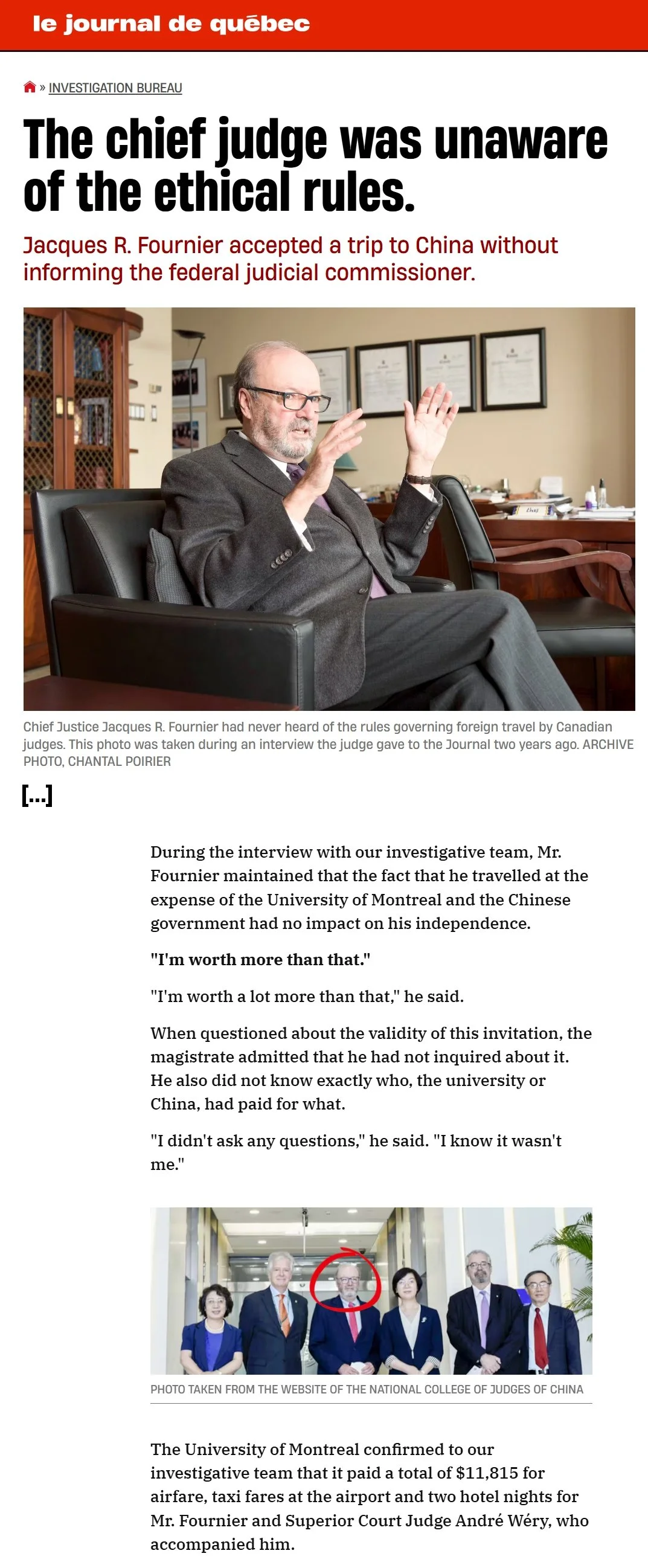
Let us not forget that judge Marie-Anne Paquette's predecessor, Chief Justice Jacques R. Fournier (a graduate of the University of Montreal, like Justice Paquette), who served as Chief Justice of the Superior Court of Quebec from 2015 to 2022, also benefited from the University of Montreal’s funds through favours granted to him by the university whilst he held the position of Chief Justice of the Superior Court of Quebec. This ultimately led to a scandal for him. He was subsequently replaced with judge Marie-Anne Paquette.
(Original in French. English version provided by Google Chrome Browser.)
Judges have a legal, social, and moral duty to be and to behave as described in Judge Marie-Anne Paquette's promotional video. That is what we, as members of the public, are being sold. That is the promise, the commitment, the social contract. But judges do not always live up to this; one only needs to read the disciplinary inquiry reports of the judicial councils [9] to be convinced of this.
It also happens that some judges behave in an even more reprehensible manner when the cases involve their relatives, their acquaintances, when the cases involve sensitive interests or parts of the system that “should not” be touched, questioned or criticised.
*** The term “system” is used here in a broad sense, including, but not limited to, the justice system, the state’s “security” and espionage apparatus, actors within the judicial system, and universities — universities that serve as meeting places for actors from the political, judicial, and espionage spheres, where networking and cronyism take place between the three supposedly separate branches of government, universities through which many of these actors reduce their taxes on their exorbitant incomes by making “donations” to the universities, whilst these same “donating/contributing actors” are supposed to “objectively” investigate or judge these universities, etc. ***
Source : Daniel Rogers, Director of the Canadian Security Intelligence Service (CSIS), November 2025 (he essentially acknowledged, albeit reluctantly, that intelligence services have an "interest" – are very much present – in universities. This fact has been well known in academic circles for a long time; some professors engage in propaganda and publish articles for the benefit or in the interest of the intelligence services, and are paid to do so through grants).
This is what will be addressed in the rest of this series of articles : the reality of the judicial system when the cases heard by judges touch upon the system’s “house of cards”, which risk exposing what the public is not meant to know, in particular that the heads of universities or faculties are not as “clean” as they present themselves to be, and that judges are not as “fair, independent and impartial” as they claim to be.
More specifically, we will see that regardless of the Court where the cases involving the University of Sherbrooke were heard — the Arbitration Tribunal, the Administrative Labour Tribunal, the Superior Court of Quebec, the Court of Appeal of Quebec, the Supreme Court of Canada — these cases were systematically “assigned” to judges who had ties to the heads of the Faculty of Law of the University of Sherbrooke who were involved in these cases, who had interests in the University of Sherbrooke or in the case itself (even though there were many other judges in Quebec who had no ties to the University of Sherbrooke and who could have heard these cases fairly). But as the cases involving the University of Sherbrooke and the managers of its Faculty of Law were so clearly and obviously against them to such extent that a truly objective, independent, and impartial judge would have had to rule against them, these cases could not be assigned to judges who were not part of their networks of acquaintances or influence. And considering that these cases went beyond the scope of labour law and could have had subsequent repercussions in criminal law, this need to have “friendly” judges and to stifle the civil legal cases was all the more pressing.
The next three articles are essentially case studies relating to what can be affectionately termed “judicial corruption, practised discreetly and subtly enough to slip under the radar” (which some judges describe as “judicial discretion” or “an outcome that falls within the range of possible acceptable outcomes”) or what Sébastien Lebel-Grenier would call the “soft touch” :
article 4 (this article) will address how the courts dealt with the application for a declaration of disqualification against the law firm Cain Lamarre to represent the University of Sherbrooke, contrary to the law and case law;
article 5 will examine the quasi-judicial and judicial treatment of the qualification aknowledgment file (the ruse described in article 2);
article 6 will address the grievances file revealing the fraudulent schemes in the granting of teaching contracts discussed in the first two articles of this series.
Let us therefore move on from the general discussion about judges to a more specific discussion on how judges have handled the cases involving the University of Sherbrooke, starting with the case concerning the disqualification of the law firm Cain Lamarre.
*****
The judicial treatment regarding the application for a declaration of disqualification against the law firm Cain Lamarre, an application filed within the broader context of the case exposing fraudulent schemes in the granting of teaching contracts at the Faculty of Law of the University of Sherbrooke
Article 3 of this series (here : https://www.claudiu-popa.com/about-the-university-environment/cain-lamarre-law-firm-university-of-sherbrooke-disqualification-misconduct) revealed how lawyers and notaries from the law firm Cain Lamarre, several of whom were friends with the managers of the Faculty of Law of the University of Sherbrooke involved in the case concerning teaching contract granting schemes, had benefited for years from the schemes operated by these same managers of the Faculty of Law of the University of Sherbrooke (schemes described in the first two articles, here : https://www.claudiu-popa.com/about-the-university-environment/fraudulent-schemes-teaching-contracts-faculty-of-law-university-of-sherbrooke-1-marie-pierre-robert-louis-marquis-sebastien-lebel-grenier and here : https://www.claudiu-popa.com/about-the-university-environment/fraudulent-schemes-teaching-contracts-faculty-of-law-university-of-sherbrooke-2-marie-pierre-robert-louis-marquis-sebastien-lebel-grenier) and continued to benefit from them, whilst the law firm Cain Lamarre defended these managers and their schemes in the case that exposed their fraudulent nature.
Article 3 listed several serious reasons explaining why the rule of law did not allow the Cain Lamarre law firm to defend the University of Sherbrooke and explaining why an Application for a Declaration of Disqualification had been filed with the Superior Court of Quebec in September 2023, seeking a judge’s order to prohibit this law firm from continuing to represent the University and to order the University to find another law firm.
What happened with this Application?
The coordinating judge of the Superior Court of Quebec in Sherbrooke (the former lawyer of the University of Sherbrooke), Claude Villeneuve [9.1], had initially “assigned” the Application for a Declaration of Disqualification of the lawyers of the University of Sherbrooke to Judge Line Samoisette (the cousin of the former rector of the University of Sherbrooke, Luce Samoisette, who is the mentor of Dean Sébastien Lebel-Grenier).

Photo on the left : The dean of the Faculty of Law of the University of Sherbrooke from 2011 to 2019, Sébastien Lebel-Grenier (left) involved in the case revealing fraudulent schemes in the granting of teaching contracts, and the coordinating judge of the Superior Court of Quebec of the Sherbrooke Courthouse, Claude Villeneuve (former lawyer of the University of Sherbrooke, right)
Photo on the right : Sébastien Lebel-Grenier (left) and Judge Line Samoisette of the Superior Court of Quebec (Sherbrooke).

On the left, Superior Court of Quebec Judge Line Samoisette (Sherbrooke) with her cousin, Luce Samoisette (then Rector of the University of Sherbrooke) in the centre of the photo.

From left to right : Louis Marquis (Dean of the Faculty of Law of the University of Sherbrooke from January 2020 to December 2023), Sébastien Lebel-Grenier (Dean of the Faculty of Law of the University of Sherbrooke from 2011 to 2019), both involved in the case revealing fraudulent schemes in the granting of teaching contracts, and Luce Samoisette, the former Rector of the University of Sherbrooke, also a former Vice-Dean of the Faculty of Law of the University of Sherbrooke responsible for granting teaching contracts to lecturers).
Thus, having been assigned to the case by the coordinating Judge Claude Villeneuve, Judge Line Samoisette (the cousin of the former rector of the University of Sherbrooke and mentor of the dean of the Faculty of Law Sébastien Lebel-Grenier) was supposed to rule on this case involving the University of Sherbrooke and the managers of its Faculty of Law.
The hearing date for the Application for a Declaration of Disqualification had been set since October 2023, for January 2024.
One (1) day before this hearing, Judge Claude Villeneuve decided to cancel it (a gesture that showed contempt for the preparatory work, and the human and financial resources that had been invested in preparing such an application), and I was offered to reschedule it more than a year later, around June 2025.
The catch?
This allowed the Cain Lamarre law firm, through the back door, to remain involved in the case until the Superior Court of Quebec ruled on the case revealing fraudulent schemes in the granting of teaching contracts in which the law firm had a personal interest, a case that Judge Claude Villeneuve had already set for hearing in May 2024, at the unilateral request of Cain Lamarre.
This rescheduling also had another effect : it rendered the question of Cain Lamarre’s disqualification moot, theoretical and irrelevant; the main case would have been concluded by that time and the Court would not have held the rescheduled hearing.
However, Judge Claude Villeneuve knew that applications for a Declaration of disqualification must be heard on an emergency basis, as a priority. Once I reminded him of this rule, Judge Claude Villeneuve eventually rescheduled the hearing promptly, for February 27th, 2024.
He tried, but it didn't work out. "We'll find something else."
A week before the hearing on disqualification, the judge/cousin of the former rector of the University of Sherbrooke was replaced by another judge, this one from the judicial district of Chief Justice Marie-Anne Paquette, brought in from Montreal to Sherbrooke, specifically for this case : Martin F. Sheehan (a former lawyer at the Fasken law firm, a colleague of the son of Chief Justice Richard Wagner of the Supreme Court of Canada, lawyer Charles Wagner [10], still a lawyer at Fasken). Judge Sheehan had also worked with Wagner's father, having co-directed the CAIJ with Judge Richard Wagner [11].

Martin F. Sheehan, another judge in conflict of interests
One of the most important rules of law in Quebec, which aims to ensure the objectivity, impartiality, and integrity of the judicial system, as referred to by Marie-Anne Paquette, Manon Savard, and Richard Wagner, is set out in section 203 of the Code of Civil Procedure. This rule prohibits a judge from ruling on a case in which they or their spouse have an interest :
Section 203 of the Code of Civil Procedure of Quebec : "A judge who has an interest or whose spouse has an interest in a case is disqualified and cannot hear the case."
However, Judge Martin F. Sheehan found himself in such a situation prohibited by law, as both he and his spouse had interests in the matter :
Judge Martin F. Sheehan's daughter was a student at the University of Sherbrooke while Judge Sheehan was hearing the University of Sherbrooke’s case;
Judge Martin F. Sheehan's wife had and continued to have business relationships with both the University of Sherbrooke and the Cain Lamarre law firm;
Judge Martin F. Sheehan's father had ties to the University of Sherbrooke;
(Not to mention, amongst other things, because one has to draw the line somewhere, the fact that Judge Martin F. Sheehan was a friend of Dean Sébastien Lebel-Grenier’s wife, the lawyer Nadia Martel [12], and a work colleague of Dean Marie-Pierre Robert’s husband, Judge Sébastien Pierre-Roy).
Judge Martin F. Sheehan's family interests in the University of Sherbrooke
Judge Martin F. Sheehan and his wife, the lawyer Kim Lachapelle [13], a senior executive at the Autorité des marchés financiers of Quebec, both had a personal interest, a long-term investment, in the University of Sherbrooke : their daughter's professional future depended on the University of Sherbrooke (the other party to the dispute), a university to which the Sheehan family had been paying thousands of dollars since 2023.
Judge Martin F. Sheehan's daughter had a contractual relationship with the institution her father was to judge, as she was a student at the University of Sherbrooke. In 2023, she was accepted by the University of Sherbrooke in the highly competitive, quota-restricted medical program whilst her father was judging the University of Sherbrooke’s case, moths later. The rector of the University of Sherbrooke at the time, Pierre Cossette [14], was the former dean of the Faculty of Medicine and a professor at that same Faculty. After his term as rector ended, Pierre Cossette returned to teach at the Faculty of Medicine [15], where Judge Martin F. Sheehan's daughter was studying. He was succeeded as rector by another professor from the Faculty of Medicine, Jean-Pierre Perreault [16].
An unfavourable decision rendered by Sheehan father against the University of Sherbrooke risked having negative consequences for the Sheehan daughter, who could have faced persecution by the University of Sherbrooke at the Faculty of Medicine (the same way that this university treated me, other professionals and other students, the list is long. I will return to this subject in another publication), suffering reprisals disguised as negative evaluations, undesirable internships or to be excluded from the medical program under various pretexts.
Conversely, a favourable decision rendered by Sheehan father in favour of the University of Sherbrooke had the potential to help his daughter's medical studies, to benefit from better treatment, "understanding and accommodating" internship supervisors, key contacts, better grades, better internship evaluations, better internships or residency, and so on.
Furthermore, Judge Martin F. Sheehan had another incentive to please Cain Lamarre. This firm, which openly discussed on its webpage the effectiveness of its “network of contacts” in pulling strings (see article 3 in this series), had well “cultivated and maintained” contacts within the University of Sherbrooke Health Center, where medical students complete their internships and residencies.


Whilst a judge has an obligation to be completely independent of the parties to litigation, the situation of dependence between Judge Martin F. Sheehan and the party University of Sherbrooke, was manifest here : just as the fate of Judge Sheehan's daughter's medical career laid in the hands of the University of Sherbrooke, the fate of the careers of the University of Sherbrooke's faculty managers and their lawyers laid equally and simultaneously in the hands of Judge Sheehan.
Judge Martin F. Sheehan did not disclose his conflicts of interest or his situation of dependence. He chose to remain silent and did not recuse himself from the case.
On the contrary, this case was so important to the judge that he chose to violate the law (section 203 of the Code of Civil Procedure of Quebec) rather than to withdraw from the case.
Furthermore, other members of Judge Sheehan's family had ties to the law firm Cain Lamarre or to its client, the University of Sherbrooke.
A business relationship between the wife of Judge Martin F. Sheehan and the University of Sherbrooke
Judge Martin F. Sheehan's wife’s employer, the Autorité des marchés financiers (AMF - Financial Markets Authority), where she has been a member of the senior management since 2018 [17], had a long-standing business relationship with the University of Sherbrooke, a party to the litigation that Judge Sheehan was to judge : granting of scholarships, subsidies, collaboration on research projects and on financial product development projects, the development of a master's program in collaboration with the Faculty of Law of the University of Sherbrooke, are just a few examples of existing business ties between the organisation directed by the judge's wife and the party her husband was about to judge [18].
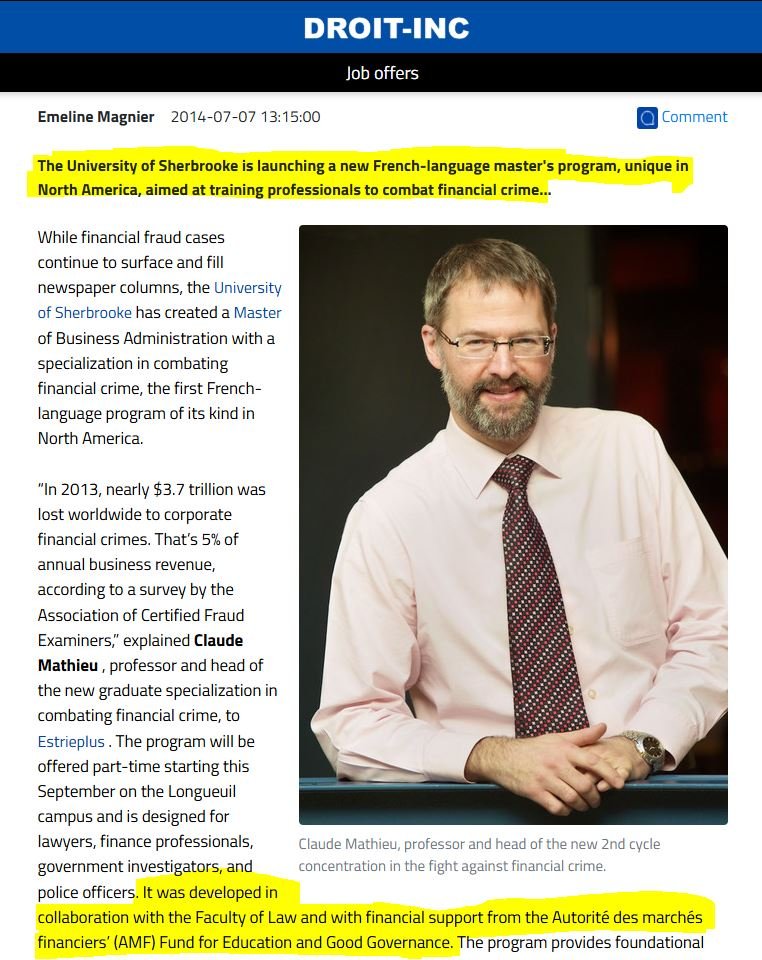
Original in French. English version provided by Google Chrome Browser.
Their business relationship continues to this day. In 2025, the public organisation directed by Judge Martin F. Sheehan's wife entered into a partnership with the University of Sherbrooke for a research project on which the two institutions had already been working together since 2022 [19].

Original in French. English version provided by Google Chrome Browser.
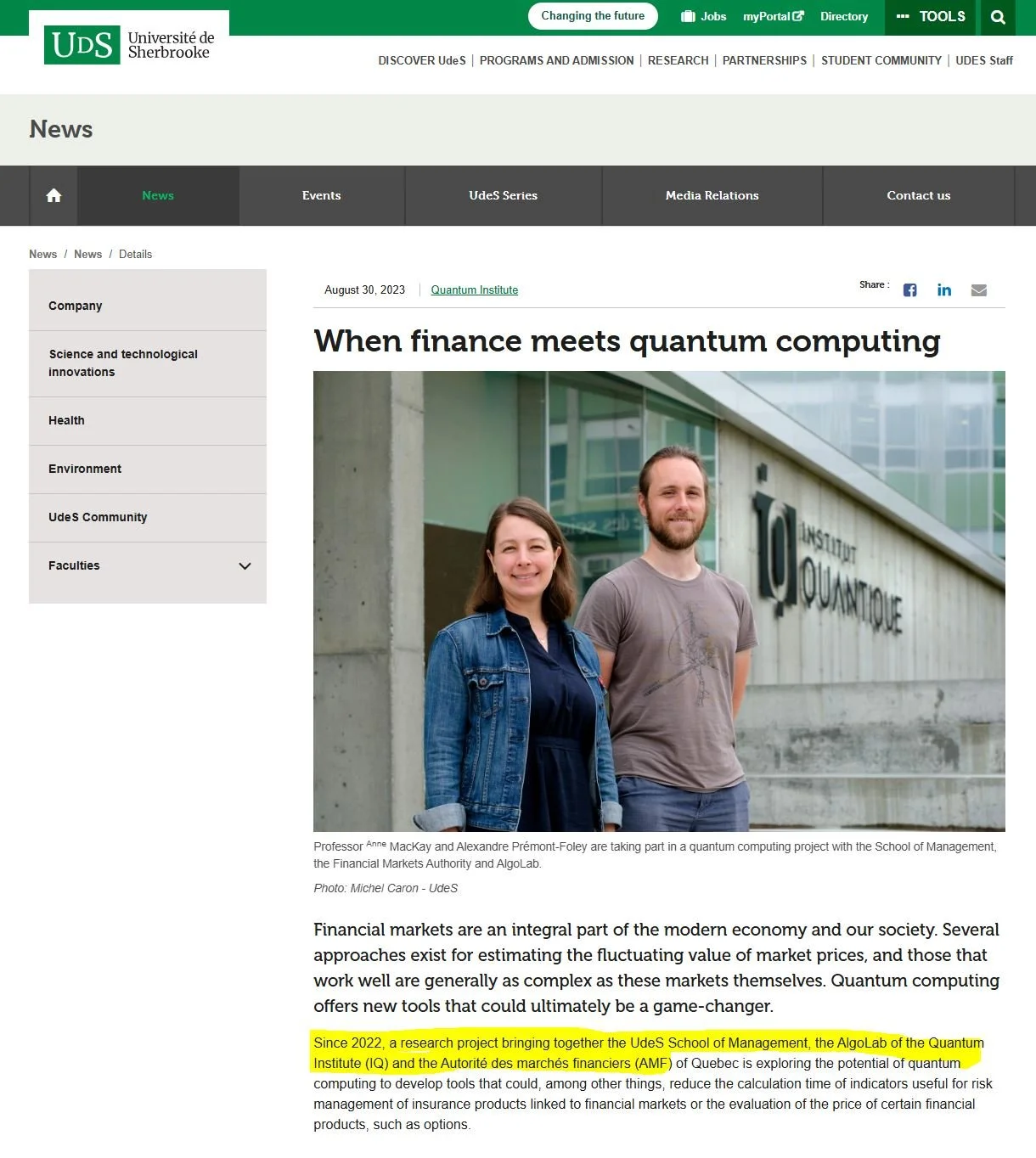
Original in French. English version provided by Google Chrome Browser.
When she was chair of the board of directors of another organisation known in the Quebec legal community, the Centre for Access to Legal Information (CAIJ), Judge Sheehan’s wife forged closer ties with the University of Sherbrooke by entering into another partnership with this university, more specifically with the Faculty of Law of the University of Sherbrooke, under the direction of Dean Sébastien Lebel-Grenier, to promote the University of Sherbrooke Law Review [20].

Another business relationship, this time between the wife of Judge Martin F. Sheehan and the law firm Cain Lamarre, which was representing the University of Sherbrooke
As for the law firm Cain Lamarre, which was defending the University of Sherbrooke, whilst Judge Sheehan's wife was on the board of directors of the Centre for Access to Legal Information (CAIJ), her organisation entered into partnerships to promote and extend the professional visibility of the Cain Lamarre law firm [21] :


There's more.
Whilst the Cain Lamarre law firm represented the University of Sherbrooke and Judge Martin F. Sheehan was judging on its disqualification from continuing to represent that party in the legal proceedings, this law firm was simultaneously providing legal services to the institution directed by Judge Sheehan's wife, the AMF (Autorité des marchés financiers). Cain Lamarre law firm had a privileged attorney-client relationship with the Autorité des marchés financiers and received service contracts worth thousands of dollars, whether for legal advice or for representation before the courts :


Disqualifying the law firm advising the public organisation directed by his wife, on grounds of breaches of professional conduct, would have had several negative repercussions on the reputation of that organisation and on the judgment of the judge's wife for hiring such a law firm, using taxpayers' money.
Let us now turn to the father of Judge Martin F. Sheehan, Judge Michael Sheehan.
UdeS, from father to son
Michael Sheehan taught trial advocacy courses for nearly 30 years as part of the Advocacy Techniques Seminar held annually at the Faculty of Law of the University of Sherbrooke (including with the contribution of Stéphane Reynolds of Cain Lamarre. Sheehan “grandfather” did not hesitate to indicate publicly how “bound together” “by a strong, long-standing friendship” he was with the Seminar organisers, which included lawyers from Cain Lamarre whom Sheehan “father”, his son, would judge), based on a book co-authored by Michael Sheehan published by Cain Lamarre’s client, the University of Sherbrooke [22]. During this period, Judge Sheehan's father worked with the deans of the Faculty of Law, including Sébastien Lebel-Grenier and Louis Marquis, who were involved in the case judged by Judge Michael Sheehan's son, Judge Martin F. Sheehan.

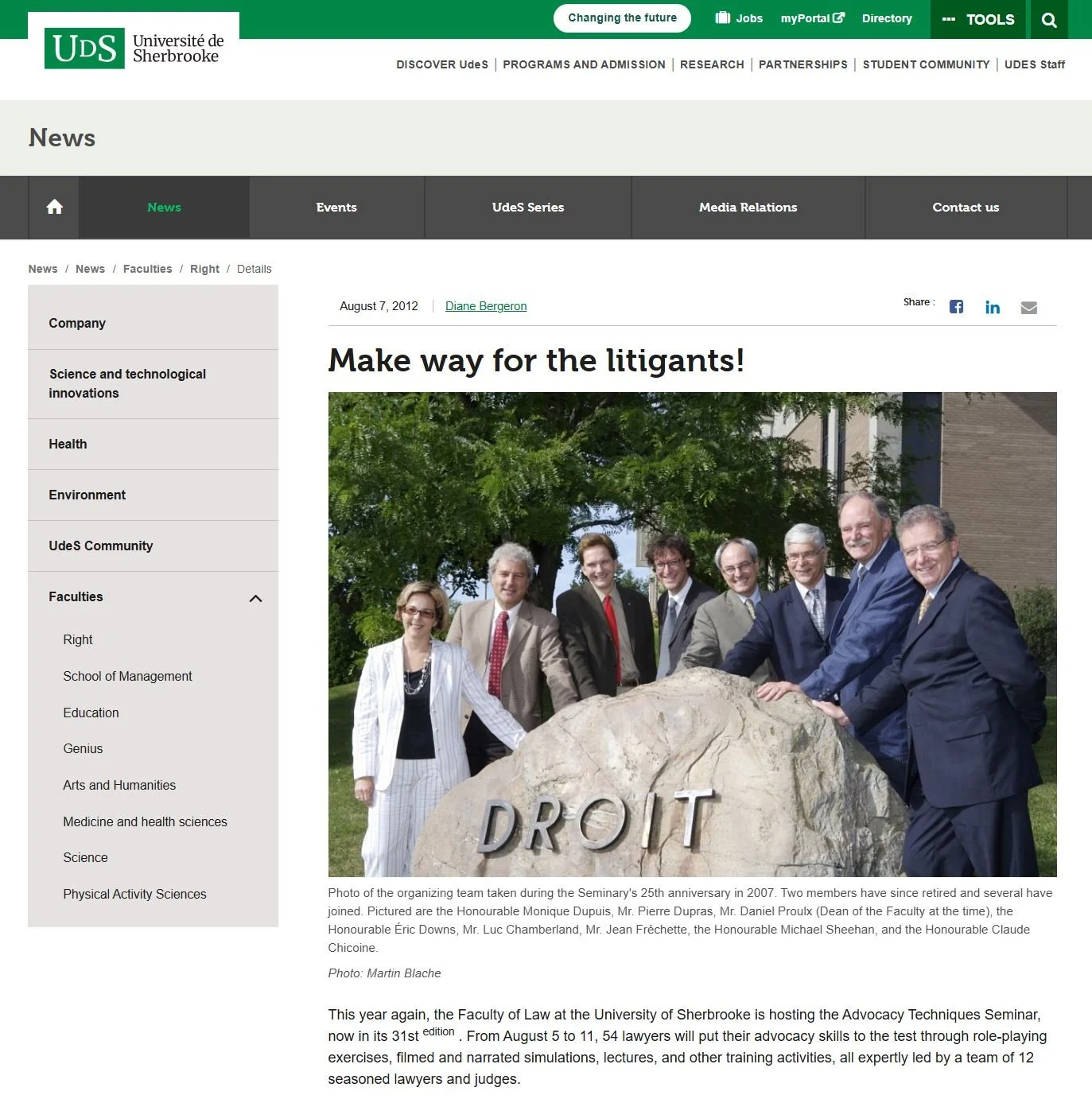
Source : Faculty of Law, University of Sherbrooke. Original in French. English version provided by Google Chrome Browser.
Furthermore, one of the greatest honours bestowed upon the Sheehan family came from the grand ambassador of the Faculty of Law of the University of Sherbrooke, Jean Charest, who awarded Michael Sheehan the title of Knight of the Order of Quebec.

Do we need to point out to Chief Justice Marie-Anne Paquette that a situation such as the one in which Judge Martin F. Sheehan placed himself, will not convince anyone that this judge was completely independent and totally impartial in this case?
This judge was disqualified by law from hearing this case. He was ethically required to recuse himself, but he failed to do so.
No member of the public would want to be judged by a judge who has ties to the opposing party.
No lawyer would want to plead their client's case before such a biased judge (unless the lawyer in question is colluding with the opposing party).
In these circumstances, the appearance of justice was, for all practical purposes, compromised, giving instead the impression of a mockery of justice, a charade, a decision taken in advance. Judge Martin F. Sheehan was not going to render a decision that risked, sooner or later, in one way or another, jeopardising his daughter's future within the opposing party, the University of Sherbrooke, not to mention his wife’s interests and the dynastic ties between his father and the opposing party.
In such circumstances, would the fundamental values of the Quebec judicial system, such as "the need to preserve its integrity" or "the need to maintain public confidence in the administration of justice," receive the same importance in this case as they had in other cases of disqualification against the Cain Lamarre law firm ?
Let us see how Judge Martin F. Sheehan ruled on this Application for a Declaration of Disqualification.
What did Judge Martin F. Sheehan decide?
The whole thing subsequently turned out to be, in fact, the travesty of justice that one might have expected.
Judge Martin F. Sheehan had all the necessary elements to grant the Application for a Declaration of Disqualification and declare the law firm Cain Lamarre and its lawyers disqualified : the law (section 193 of the Code of Civil Procedure, "namely" sections 13, 20, and 71 of the Code of Professional Conduct of Lawyers), the case law (Locas v. Boileau, 2000 CanLII 18232 (QCCQ), para. 38; Scripta.Net.Inc. v. BCE Emergis Inc., 2002 CanLII 13680 (QC CS), para. 65; Pellemans v. Lacroix, 2006 QCCS 2256, paras. 32 and 33; Centre commercial Rimouski inc . v. Ville de Rimouski, 2017 QCCS 6259, paras. 5 and 8; Trustee of 2542-5349 Québec inc., 2019 QCCS 1295, para. 49; Lessard and Coopérative de solidarité du Centre de la petite enfance Le Bilboquet, 2019 QCTAT 3255, para. 44; Gattuso Bouchard Mazzone v. Chartier, 2023 QCCS 3178, paras. 14, 15, 34; Commission des normes, de l'équité, de la santé et de la sécurité du travail (CNESST) v. 2319-1380 Québec inc., 2024 QCCQ 6000; etc.), the facts and the evidence on the record should have led judge Sheehan to prohibit the law firm from representing the University of Sherbrooke and to order the University of Sherbrooke to find a new law firm.
That is what an objective, independent, and impartial judge would have done.
However, Judge Martin F. Sheehan did the exact opposite. He rejected the Application for a Declaration of Disqualification and ruled in favour of the party with which he had ties, the University of Sherbrooke and its law firm Cain Lamarre, on every aspect.
On February 27, 2024, he arrived at the hearing with his mind already made up.
The judge already knew what the outcome would be, just as was the case with Judge Céline Legendre of the Superior Court of Quebec (see article 1. I will return to Judge Legendre in article 5 of this series).
Judge Martin F. Sheehan's decision, which was 9 pages long (filled with footnotes to give the impression of being very substantial - several of them irrelevant, but many nonetheless), had been written in advance.
Judge Sheehan simply waited for the end of the day, then read out his decision at the end of the hearing on February 27.
To quote judges Yves-Marie Morissette and Patrick Healy of the Court of Appeal of Quebec (two other protagonists in this series whom we will see a little later), regarding the bias of the trial judge in similar circumstances :
“Given the very short period of time that elapsed […] between the end of the hearing and the delivery or filing of very substantial judgments, there is certainly cause for serious concern [of judicial bias] on the part of the party whose claims are being dismissed.
What is the point of having the right to be heard in Court […] if the die has already been cast?”
- Yves-Marie Morissette and Patrick Healy,
in Attorney General of Quebec v. Pryde, 2025 QCCA 736, para. 97
That's what I was thinking too…
Worse still, in order to give the false impression that dismissing the arguments raised would be justified, Judge Sheehan resorted to a reprehensible conduct which included, among other things :
obscuring several of the main arguments put forward in support of the Application for a Declaration of Disqualification;
passing over several legal rules that were raised, without mentioning them in his decision and without analysing them;
distorting other arguments, presenting them without nuance, in a simplified or caricatured version;
responding to arguments in a superficial and sometimes illogical manner, or in a manner contrary to the legal rule.
In short, the decision dismissing the Application for a Declaration of Disqualification was so flawed that Judge Sheehan chose not to publish it on legal search engines.
How did Judge Sheehan proceed to dismiss an application that he clearly should have granted?
The judge distorted the arguments
Judges distort the arguments presented to them when they seek to make them easier to attack or refute. This also allows them to make the arguments appear unreasonable and to discredit the person who is putting them forward. Once the arguments have been distorted, the judge can then provide a response tailored to their distorted form, and subsequently reject them.
It is essentially an illusionist's technique that plays on perceptions, making the judge's decision appear reasonable and harder to challenge even if it is "off" comparing to what was actually argued, even if it is a flawed decision, based on inaccuracies, falsehoods or fallacious reasoning.
By acting in this way, the judge gives the impression to the public reading his decision that he has resolved the litigated issue, without actually doing so.
This is what is known as the "straw man fallacy," and Judge Martin F. Sheehan used it extensively in his decision.
Some judges (including Yves-Marie Morissette and Frédéric Bachand of the Court of Appeal of Quebec) attempt to justify this “approach” by claiming they are "objectifying" the parties' arguments, but in reality, what they are doing is subjectivizing them by altering the meaning of the arguments as they see fit and tailoring them to the perspective through which these judges then manipulate public perception. Despite their efforts to justify themselves, this is nonetheless a dishonest practice, a way of deceiving the public, in a manner that is difficult to detect, since, beyond the fact that they falsely claim that a party raised an argument it did not raise, these judges evade their obligation to carry out a genuine, rational, logical, correct, and reasonable legal analysis — an analysis they fail to perform in these circumstances — whilst giving the false impression that such an analysis has been carried out.
This is a fourfold deception : (1) the judge is not doing the job he is paid to do (between $300,000 to $500,000 per year, depending on the court), (2) the judge conceals this first deception with a second one - that of giving the impression of having done his job, (3) the judge misleads the public regarding the true arguments that had been raised, and (4) the judge causes the loss of rights of a party by deceptive means, thus generating injustice.
Some judges take the liberty of using this technique, relying on the fact that the public generally trusts them (although this level of trust has been in freefall for several years) and that the public does not necessarily have access to the parties' procedures, evidence and pleadings to verify the degree of honesty, accuracy and truthfulness of the judges' remarks in their written decisions.
Furthermore, since judges are the ones who control the narrative of their decisions, some of them believe they can write whatever they want in their rulings, knowing they are subject to very little accountability or, more often than not, no accountability at all. They can cause you to lose a perfectly solid case by fabricating “prose” out of thin air if they so choose. They know you have no other option but to appeal and that there is a high probability you will “end up” in front of one of their friends at the Court of Appeal. It is no coincidence that trial judges engage in “networking and partying” with the judges from the Court of Appeal who are supposed to judge them. And so, “too bad” for you. You will then appeal to the Supreme Court of Canada, which refuses to hear more than 90% of cases, without providing reasons or explanations, and your case will come to an end despite the falsehoods stated by the trial judge in his decision.
You are stuck with an unjust and deceitful decision that infringes upon your rights, causes you irreparable harm, and that no court will rectify. And you get all of this after you have wasted tens of thousands, even hundreds of thousands of dollars, on legal proceedings that turn out to be futile.
In such circumstances, judges become agents of injustice. A source of impoverishment. A public danger.
Let us examine Judge Martin F. Sheehan's judgment.
In the case of the Application for a Declaration of Disqualification, Judge Martin F. Sheehan falsely claimed that the main arguments presented to him were as follows :
[18] In support of his application, Mr. Popa invokes four arguments :
18.1. Some of the lawyers from the Cain Lamarre law firm act as lecturers at the University’s Faculty of Law (the “Faculty”);
18.2. Some professionals from the law firm maintain privileged personal ties with the Faculty’s managers;
18.3. The Cain Lamarre law firm has committed to donating $50,000 over five years to the Faculty;
18.4. Some of Cain Lamarre's lawyers may be compelled to testify in the case.
However, the first argument was not that “some of the lawyers from the Cain Lamarre law firm acted as lecturers at the Faculty of Law of the University of Sherbrooke,” but rather that several lawyers and notaries at the Cain Lamarre law firm had a personal interest in the case of their client, the University of Sherbrooke, being, in particular, beneficiaries of the fraudulent schemes in the granting of teaching contracts that the case ultimately revealed, schemes from which these lawyers and notaries had benefited thanks to the very same managers that the Cain Lamarre law firm was defending in this case. The Cain Lamarre lawyers had a personal interest in this case because the legality of their own hiring was called into question. This personal interest of the lawyers and the Cain Lamarre law firm in their client's case violated their duty of impartiality (“désintéressement” in French - which translates to disinterestedness) (section 20 of the Code of Professional Conduct of Lawyers), thus rendering the law firm disqualified to represent its client in this case.
The second argument was not that “some professionals from the law firm maintain privileged personal ties with the Faculty’s managers,” but rather that, in addition to the personal interest of the law firm Cain Lamarre and its lawyers had in their client's case, several of these lawyers had relationships of dependency with the Faculty of Law at the University of Sherbrooke, relationships of subordination as lecturers, and long-standing personal relationships with the managers of the Faculty of Law at the University of Sherbrooke who were involved in the litigation and whom the law firm Cain Lamarre was representing. However, the role of a lawyer as a representative imposes a duty of detachment, objectivity, and independence (section 13 of the Code of Professional Conduct of Lawyers) with regard to the client and their case, ethical obligations that the Cain Lamarre law firm and its lawyers failed to uphold in this matter.
The third argument was not that “the Cain Lamarre law firm has committed to donating $50,000 over five years to the Faculty,” but rather that the tens of thousands of dollars in “donations” that the Cain Lamarre law firm was giving to its client, the University of Sherbrooke, occurred within a specific and problematic context for this case. This money that Cain Lamarre was putting into its client's pocket was followed by Cain Lamarre lawyers securing teaching contracts, contracts that were granted to them by their client in breach of the collective agreement rules. Once its client caught out for violations in the teaching contract granting process, the law firm that had benefited from said violations subsequently claimed in court that there had been no violations, while the evidence on record demonstrated the contrary. The appearance of detachment, objectivity, professional independence and disinterestedness required for the performance of the role of lawyer (sections 13 and 20 of the Code of Professional Conduct of Lawyers) was simply absent, which rendered the law firm disqualified to act in these circumstances.
The fourth argument was not that “some of Cain Lamarre's lawyers may be compelled to testify in the case,” but rather that several of the lawyers and notaries from the Cain Lamarre law firm had personal knowledge of the key elements at the heart of the dispute and that they were going to be questioned about how they had obtained their teaching contracts. These lawyers and notaries from Cain Lamarre constituted “living proof” demonstrating that their client’s position and the law firm’s own position were false and that they were knowingly misleading the courts, one of their lawyers having already publicly contradicted their own position. Now, when a lawyer “or a member of their firm is called [or risks being called] to testify on a relevant and important fact, that is, at the heart of the controversy,” this is sufficient to disqualify them from representing their client (Centre commercial Rimouski inc. v. Ville de Rimouski, 2017 QCCS 6259, para. 90).
Judge Martin F. Sheehan grossly distorted the arguments presented to him, and it was this distorted version that the judge addressed in his decision. He then dismissed them one by one, concluding that the Application should be dismissed.
QED : distort in order to more easily dismiss.
The judge concealed rules of law that had been raised in order not to apply them, and concealed grounds for disqualification that he could not dismiss
Let us take two examples : 1) the ground for disqualification based on the law firm's personal interest in its client's case (section 20 of the Code of Professional Conduct of Lawyers), and 2) the ground for disqualification based on the lack of objectivity, detachment and independence (section 13 of the Code of Professional Conduct of Lawyers).
What did Judge Martin F. Sheehan do with these grounds for disqualification?
Nothing. They do not appear in his decision.
Judge Sheehan never mentioned section 20 of the Code of Professional Conduct of Lawyers, nor did he mention the grounds for disqualification based on the lack of disinterestedness of the Cain Lamarre law firm and its lawyers, nor did he analyse the state of the law regarding the obligation of disinterestedness incumbent on lawyers. The judge stayed silent on these points.
The judge also did not mention in his decision the grounds for disqualification based on the lack or the risk of a lack of objectivity, detachment, and independence on the part of the Cain Lamarre law firm and its lawyers. The terms “objectivity” or “detachment” do not appear in the nine pages of the pre-written decision signed by Judge Sheehan. As for the word “independence,” the judge mentions it only to reiterate what was already known, namely that a lawyer must preserve their integrity and safeguard their professional independence, without analysing whether or not this obligation was met or not by Cain Lamarre and its lawyers.
The rule of law is quite simple :
"The full execution of the role of judicial officer requires a certain detachment from the lawyer's function in relation to his client and the case he defends. It presupposes respect for a value of independence in his relationship with his client and the court."
- Gattuso Bouchard Mazzone c. Chartier, 2023 QCCS 3178, para. 12 (translated from French)
- Lessard et Coopérative de solidarité du Centre de la petite enfance Le Bilboquet, 2019 QCTAT 3255, para. 24
- Centre commercial Rimouski inc. c. Ville de Rimouski, 2017 QCCS 6259, para. 89
Therefore, there must exist, between the lawyer and his client :
"a distance that allows him not to confuse his own interests with those of the person he represents"
- Locas c. Boileau , 2000 CanLII 18232 (QCCQ), para. 38 (translated from French)
because :
"the lawyer’s independence and disinterestedness contribute to the impartiality of the judicial system."
- Trustee of 2542-5349 Québec inc., 2019 QCCS 1295, para. 49 (translated from French)
Consequently, in the absence of detachment, objectivity, or professional independence, the court declares the lawyer and his law firm disqualified :
"It is important to exclude members of the firm […] from acting as counsel in the case because their personal interests are at stake in various ways and they will consequently be unable to possess the necessary detachment and independence to participate adequately in the judicial process."
- Gattuso Bouchard Mazzone c. Chartier, 2023 QCCS 3178, para. 34 (translated from French)
These legal principles, that are theoretically laudable (had Judge Martin F. Sheehan applied them), made it so that the judge had no choice but to disqualify the Cain Lamarre law firm. But Judge Sheehan chose instead not to mention them.
This is what some judges sometimes do, particularly when they seek to favour one of the parties in a litigation or when they try to render a decision contrary to the one they ought to render. It is, in fact, easier for a judge to dismiss an argument or not apply a rule of law if they simply do not mention them.
Judge Martin F. Sheehan's decision was appealed within the 30-day period provided by law.
The Quebec Court of Appeal refuses to hear the appeal
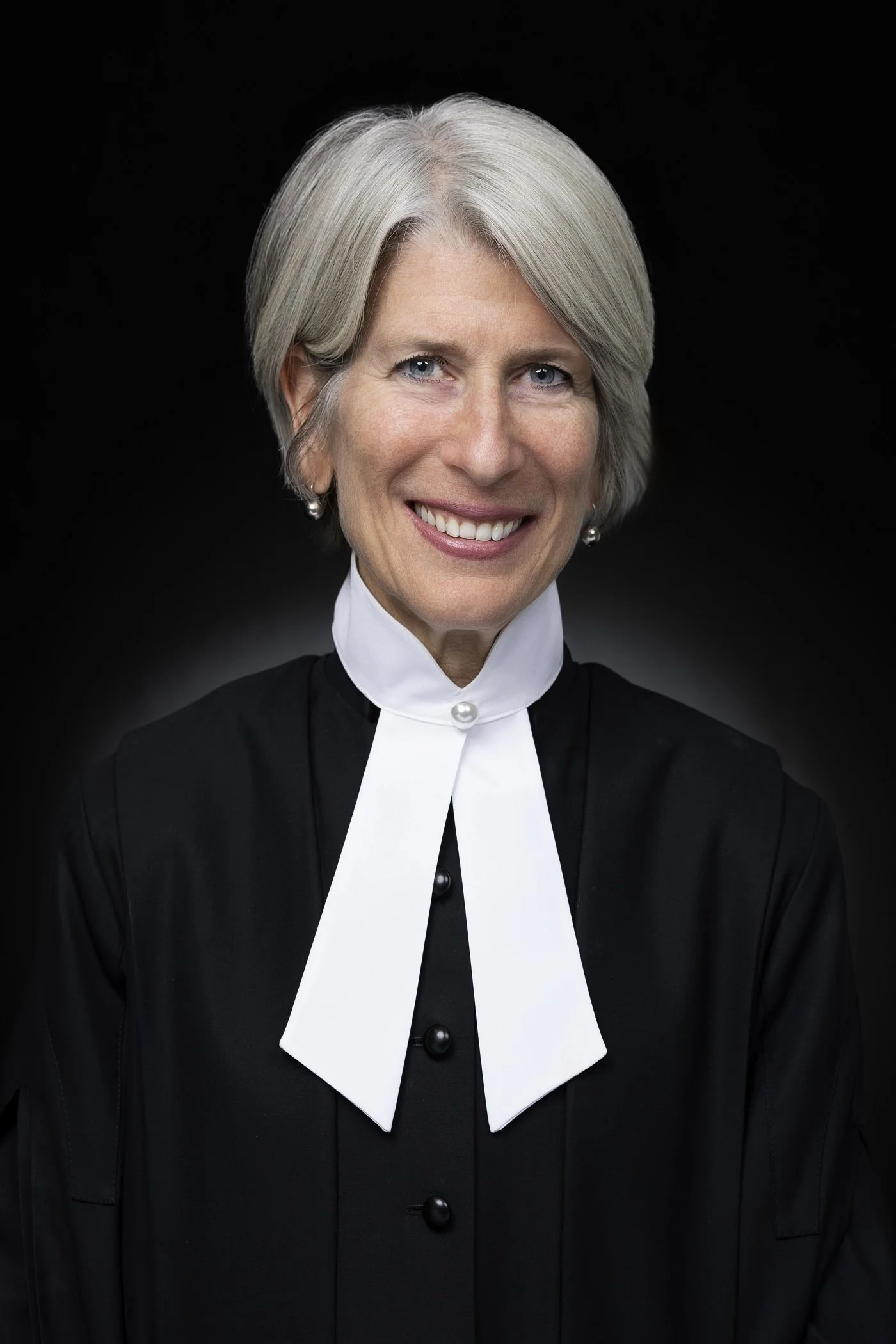
“Our [Canadian] justice system provides an appeals process that a party who feels aggrieved by a decision may follow, thereby avoiding the need for civil disobedience.” […] “Our judicial system thus includes all the necessary safeguards to ensure its integrity. That is why, I say this with conviction : the citizens of Quebec can have confidence in their judiciary, whose quality and integrity are the envy of many around the world.”
- Manon Savard, Chief Justice of the Quebec Court of Appeal
Address, Opening of the Judicial Year, September 4, 2025 (translated from French)
Speaking of “integrity” which is “the envy of many around the world”, to whom do you think Chief Justice Manon Savard of the Court of Appeal of Quebec assigned this appeal case concerning the disqualification of the law firm that defended the schemes involving Dean Louis Marquis?
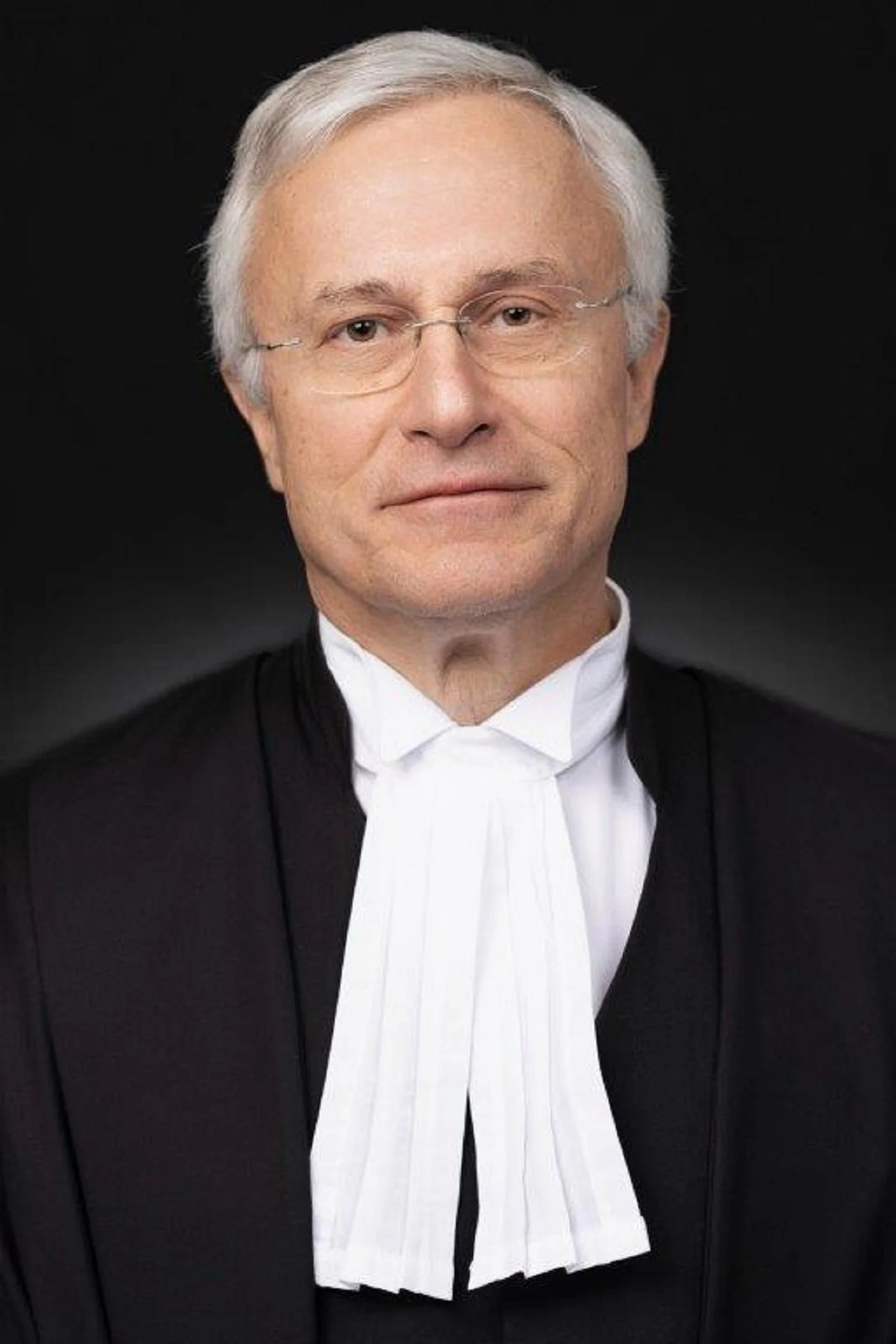
Chief Justice Manon Savard assigned the case involving Louis Marquis to the judge who recommended Louis Marquis for appointment as a judge. He was appointed as a judge in the district where the legal proceedings involving him were being heard [23].
Unsurprisingly, this judge refused to hear the appeal concerning Louis Marquis.
We are talking about Judge Mark Schrager who, incidentally, was known in the legal circles as one of the protectionist judges of the university establishment (of the “rich and powerful”, to quote Quebec Chief Justice Manon Savard), who ruled in favour of the universities and to the detriment of the rights of professors, lecturers, researchers, students who had taken legal action against the universities.
The judge's statistics speak for themselves.
The percentage of appeals dismissed by the Court of Appeal of Quebec is a little over 60%.
The percentage of appeals dismissed by Mark Schrager in favour of the universities is 100% .
Indeed, 12 out of 12 judgments available on the CanLII legal search engine, rendered by Judge Mark Schrager in appeals cases brought against universities, were in favour of the universities, including :
4 out of 4 judgments rendered in favour of the University of Montreal (Hrabovskyy v. University of Montreal, 2021 QCCA 1607; Hrabovskyy v. University of Montreal, 2020 QCCA 1571; Nenciovici v. University of Montreal, 2017 QCCA 855; Antoun v. University of Montreal, 2015 QCCA 1011). Judge Mark Schrager is a graduate of the University of Montreal who participated in the University of Montreal's "networking and partying" activities;
3 out of 3 judgments rendered in favour of McGill University (Fleming v. McGill University, 2018 QCCA 1689; Fleming v. McGill University, 2015 QCCA 2161; Poplawski v. McGill University, 2015 QCCA 303). Judge Mark Schrager was employed by McGill University as a lecturer;
2 out of 2 judgments rendered in favour of the University of Sherbrooke (Scherzer v. University of Sherbrooke, 2023 QCCA 419; Malakijoo v. University of Sherbrooke, 2022 QCCA 61);
2 out of 2 judgments rendered in favour of the University of Quebec at Montreal (University of Quebec at Montreal v. Syndicat des professeurs de l'Université du Québec à Montréal - SPUQ, 2020 QCCA 1245; Florea v. University of Quebec at Montreal, 2015 QCCA 1843);
1 out of 1 judgments rendered in favour of the University of Quebec in Outaouais (Boukendour v. Syndicat des professeures et professeurs de l'Université du Québec en Outaouais, 2017 QCCA 1074).
It is understandable why Chief Justice Manon Savard entrusted this case to Mark Schrager.
The Court of Appeal of Quebec, another court of the judicial system, another charade
Five grounds of appeal were raised before the Court of Appeal of Quebec :
“A. LACK OF DISINTEREST, DISTANCE, OBJECTIVITY AND PROFESSIONAL INDEPENDENCE. Judge Sheehan erred in law by refusing to declare the law firm Cain Lamarre and its lawyers disqualified despite the lack of disinterest, distancing, objectivity and professional independence on the part of Cain Lamarre’s lawyers regarding the Faculty of Law of the University of Sherbrooke and the case in dispute which affects them personally and which renders them disqualified to act;
B. ALIGNMENT OF PERSONAL INTERESTS. Judge Sheehan erred in law in concluding that the personal interests of Cain Lamarre's lawyers in their client's case do not constitute grounds for disqualification as long as they are aligned with their client’s interests, whereas case law recognises that the alignment of a lawyer’s personal interests with those of his client leads to disqualification in several circumstances;
C. APPEARENCE OF CONFLICTS OF INTERESTS. Judge Sheehan erred in law by not concluding that the multiplicity of personal interests of Cain Lamarre's lawyers regarding their client's case creates an appearance of conflicts of interests which justifies the disqualification of the law firm;
D. APPEARANCE OF COMPROMISED CREDIBILITY. Judge Sheehan committed a manifest and fundamental error in not concluding that the credibility of the University of Sherbrooke lawyers was compromised at the very least in appearance, whereas the evidence on the Court's record demonstrated the contrary, which justified their disqualification;
E. TESTIMONY OF THE LAWYERS : Judge Sheehan erred in law in concluding that the testimony of Cain Lamarre's lawyers is not permitted in judicial review proceedings and therefore unnecessary, whereas such testimony is authorised by case law and is necessary given that the issue at hand concerns a matter of "improper purpose or fraud" in the two-tiered hiring practices of the managers of the Faculty of Law of the University of Sherbrooke.” (translated from French)
Let's talk about Judge Mark Schrager's decision.
A judge has a legal and ethical obligation to provide solid reasons for their decision, an essential component of the right to a fair and equitable trial, and one of the judge's primary duties :
"Reasons for judgment are the primary mechanism by which judges account to the parties and to the public for the decisions they render. The courts frequently say that justice must not only be done but must be seen to be done, but critics respond that it is difficult to see how justice can be seen to be done if judges fail to articulate the reasons for their actions."
-R. c. Sheppard, 2002 SCC 26, para. 15
However, Judge Mark Schrager made no mention of section 13 or section 20 of the Code of Professional Conduct of Lawyers, no mention of the personal interest of the firm Cain Lamarre and its lawyers in the case of their client University of Sherbrooke, no mention of their lack of objectivity, detachment and independence.
Judge Mark Schrager essentially used the same techniques as Judge Martin F. Sheehan : obscuring important arguments raised in support of the grounds of appeal, obscuring rules of law that had been raised without mentioning them in his decision and without analysing them, distorting other arguments by presenting them without nuance, in a simplified or caricatured version, and using reasoning contrary to the rule of law.
In a brief judgment riddled with empty, general assertions lacking any solid legal basis, Judge Mark Schrager obscured elements that could have been damaging to Cain Lamarre and the Faculty of Law at the University of Sherbrooke : no reference to fraudulent schemes, no reference to the rigged contract granting mechanism, no reference to the fact that the Cain Lamarre law firm and its lawyers had been the beneficiaries of this rigged mechanism, no reference to the mechanism of mutual benefits between the law firm and its client, no reference to anything else that might have affected the Cain Lamarre law firm, its lawyers, the University of Sherbrooke, or the managers of the Faculty of Law of the University of Sherbrooke. Classic judicial protectionism.
Without providing an analysis, Judge Schrager simply stated, in a superficial manner, that, in his opinion, it was “far from obvious that there are valid grounds for disqualifying Cain Lamarre’s lawyers based on the fact that they are lecturers at or even donors to the Faculty of Law.” However, the synergy established between the client and the law firm was not the one described by Judge Mark Schrager, and constituted grounds of disqualification, since the Cain Lamarre law firm (1) donated significant sums of money to the Faculty of Law of the University of Sherbrooke, which (2) subsequently granted teaching contracts to its lawyers and notaries in violation of the contract granting rules set out in the Collective Agreement, and (3) when problems arose related to these violations, the same firm that had benefited from them would then defend the managers of the Faculty of Law of the University of Sherbrooke, claiming that these violations were not violations at all. All this occurred while these lawyers were fully aware that these were indeed falsehoods, as they themselves were living proof of these violations. The Cain Lamarre law firm aided and abetted conduct it knew to be illegal or fraudulent on the part of its client, which in itself constituted grounds for disqualification (a serious breach of the obligation set out in section 14 of the Code of Professional Conduct of Lawyers). This simultaneously demonstrated the lack of objectivity, disinterestedness, and independence of the law firm and its lawyers in their client's case.
Judge Mark Schrager then concluded, contrary to the rule of law and without providing any reasons, that the personal interests of the Cain Lamarre law firm and its lawyers in their client's case constituted an "alignment of interests" that would not affect the image of justice, claiming that the "facts" that had been raised "do not constitute a conflict of interest; it may be an alignment of interests with their client, the University of Sherbrooke". However, the rule of law was clear, and Judge Schrager could not have been unaware of it : aligned or not, the personal interests of a lawyer or the firm’s in the client's case were incompatible with the ethical obligations set out in section 20 of the Code of Professional Conduct of Lawyers, since having aligned interests implies having a conflict of interest that contravenes the obligation of disinterestedness.
Judge Mark Schrager knew he was on very thin ice since once a law firm has a personal interest in its client's case, a fact essentially accepted by both Judge Martin F. Sheehan and Judge Schrager, the situation often becomes untenable for the law firm because : (1) if its personal interest is "aligned" with that of the client, then the law firm is in breach of the duty of disinterestedness (which is a ground for disqualification, section 20 of the Code of Professional Conduct of Lawyers), and (2) if its personal interest is not aligned with that of the client, if it is different or if there is a possibility that this interest may become misaligned during the proceedings, then not only does the law firm continue to be in breach of the duty of disinterestedness but the law firm is also in a conflict of interests (which is also a ground for disqualification, section 193 of the Code of Civil Procedure of Quebec and section 71 of the Code of Professional Conduct of Lawyers). In both cases, the law firm should have been declared disqualified, so Judge Mark Schrager simply chose to ignore this aspect.
I also pointed out to the judge the fact that it was "in the best interest of justice for judges to fulfill their duty to safeguard the image of the justice system," which was being undermined by Cain Lamarre's presence in the case, that
"the preservation of the integrity of the justice system underpins the idea that courts must remain vigilant with regard to compliance with the rules of professional conduct and ethical principles" for lawyers
- The Court of Appeal of Quebec, in R. v. Harrison, 2017 QCCA 263, para. 47 (translated from French)
since
"it is incumbent upon the courts, guardians of fundamental values and guarantors of procedural fairness, to intervene so as not to condone a breach of this duty [...] To tolerate a conflict of interest that is apparent in some respects and concrete in others [...] would amount to undermining procedural fairness and casting doubt on the reliability of the decisions rendered by the courts."
- The Court of Appeal of Quebec, in R. v. Harrison, 2017 QCCA 263, paras. 47, 48 and 74
Judge Mark Schrager briefly questioned Cain Lamarre's lawyer, Denis Cloutier, on this point :
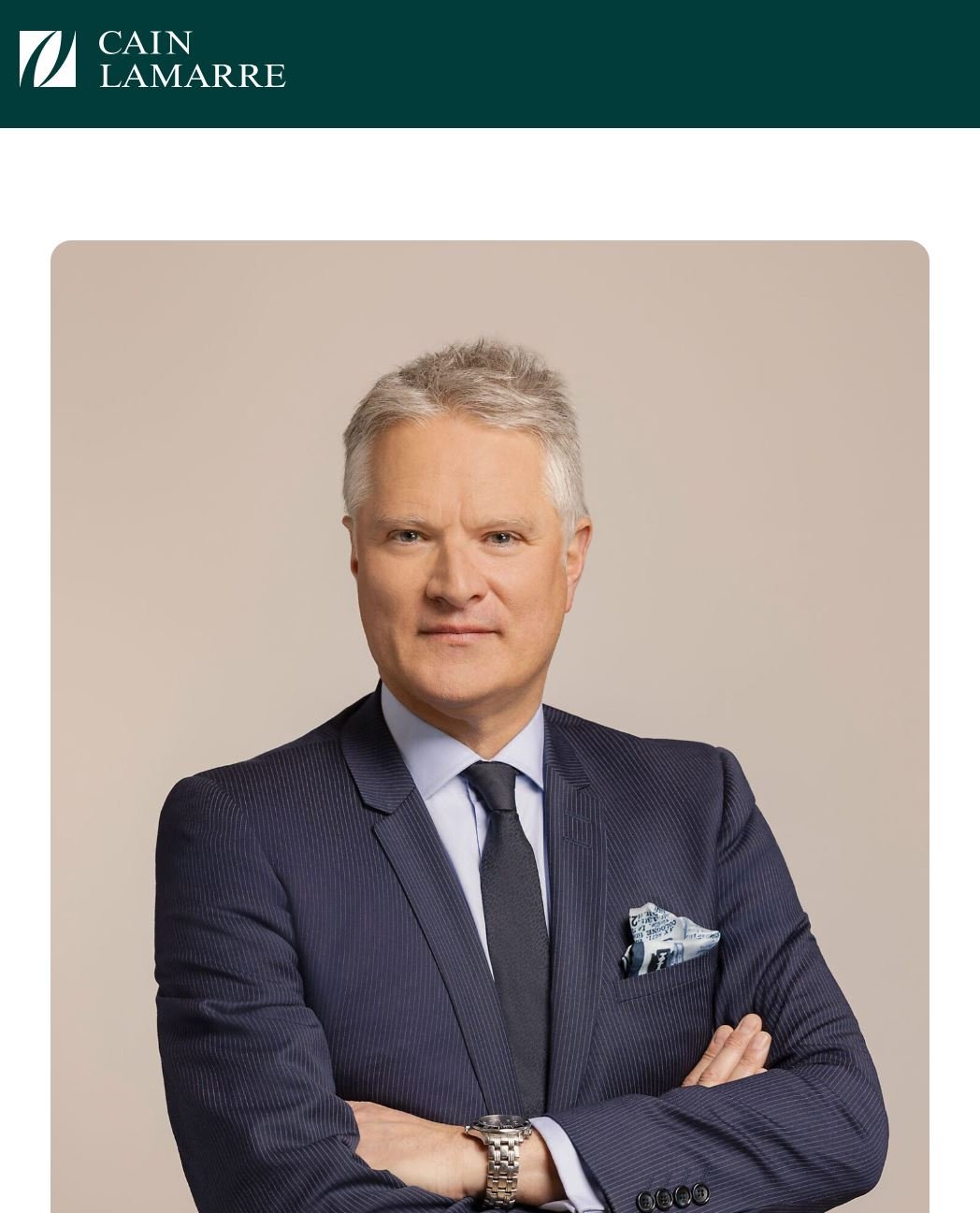
Judge Mark Schrager:
"Mr. [Cloutier]... what do you have to say regarding Mr. Popa's comments about the image of the judicial system?”
Attorney Denis Cloutier:
“The same thing Judge Sheehan said. That is to say, if… you and I can’t be here. We can no longer have any meetings between the judiciary and court officers, the system based on trust is non-existent, and this will become a pretext for derailing justice every time, whereas, I, as a court officer and you, as a judge, we know what duties are incumbent upon us, and we are capable of putting things into perspective. And that… what we aim to sanction in terms of conflicts or apparent conflicts, I have given lectures on this, these are real or perceived situations, but they are far from what we are dealing with here.”
Did Denis Cloutier convince you why they should not be declared disqualified?
Did you understand why, in his response, he referred to meetings between lawyers and the judiciary? Yet, the Application for a Declaration of Disqualification concerned Cain Lamarre's relationship with its client, not Cain Lamarre's relationships (and meetings) with the judges. A “Freudian slip”, perhaps?
Judge Mark Schrager concluded his judgment in grand style, declaring that “the interests of justice argue in favour of dismissing the application for leave to appeal”.
What kind of “justice” are we talking about?
If we are talking about "justice" reserved for those close to the system, for the "rich and powerful," then yes, it was not in "their interest" to argue during an appeal what had transpired before the Superior Court of Quebec. It was not in "their interest" for a court to hear a case that revealed the fraudulent schemes of the managers of a law school. It was not in "their interest" for the lawyers from the Cain Lamarre law firm to be questioned and risk demonstrating a potential deceit and their involvement in any way in their client's fraud. It was also not in “their interest” to allow evidence to be presented showing how managers of the University of Sherbrooke's Lecturers' Union might have participated, through aid or encouragement, in the same fraudulent schemes perpetrated by managers of the University of Sherbrooke's Faculty of Law, or how the court might have been misled regarding evidence that would have disqualified Cain Lamarre or allowed a trial on the merits of the grievance (I shall return to this aspect eventually). In this case, the interests of “their justice” were better served if the Court of Appeal of Quebec did not hear this appeal, or any other appeal, which revealed what should not be revealed.
Finally, Judge Mark Schrager's icing on the cake : "There is nothing that undermines the image of the administration of justice."

The Supreme Court of Canada refuses to hear the appeal
The judges of the Supreme Court of Canada did nothing either, but they bought themselves some new robes.
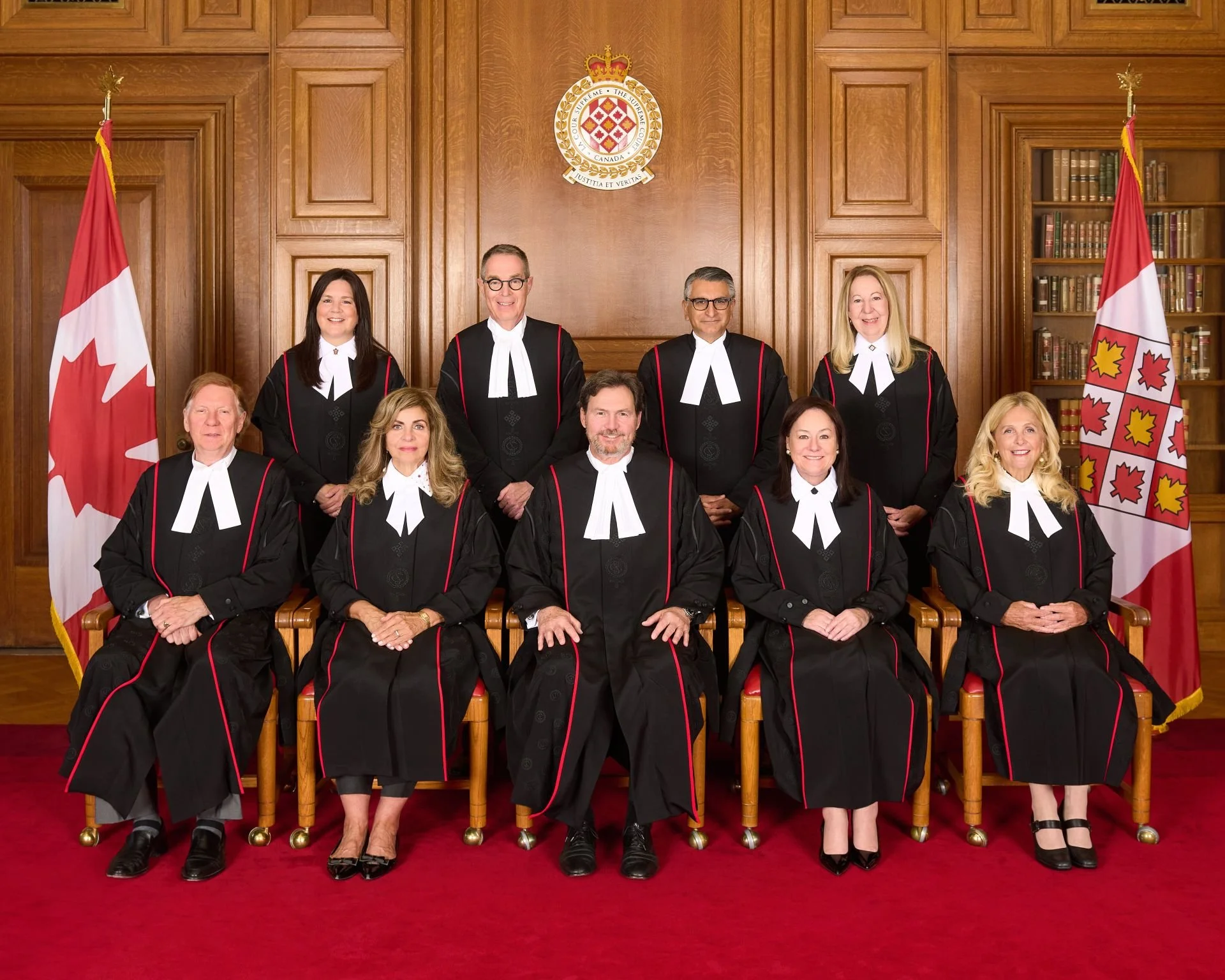
From left to right : (seated) Malcolm Rowe, Andromache Karakatsanis, Richard Wagner, Suzanne Côté, Sheilah Martin; (standing) Michelle O'Bonsawin, Nicholas Kasirer, Mahmud Jamal, Mary T. Moreau
Even though the Application for a Declaration of Disqualification was dismissed, behind the scenes, things have been moving
Behind the scenes, things got hectic, particularly because the Application for a Declaration of Disqualification brought to light the sensitive issue of “networking and cronyism between judges, lawyers, politicians, executives, and business people” and a circular mechanism of financing and mutual benefits between the law firm Cain Lamarre, its client the Faculty of Law of the University of Sherbrooke, and the Association of Law Graduates of the University of Sherbrooke.
The revelations arising from the Application for a Declaration of Disqualification were followed by some changes, particularly within the board of directors of the ADDUS.
Following the filing of the Application in September 2023, the lawyer Charles Guay of the law firm Cain Lamarre stepped down as Vice-President of the ADDUS in November 2023, after having held this position for nearly 10 years [24]. He also resigned from his position as a director on the ADDUS Board of Directors.
The president of ADDUS, the lawyer Alexandre McCormack, also left his position at the same time as Charles Guay.
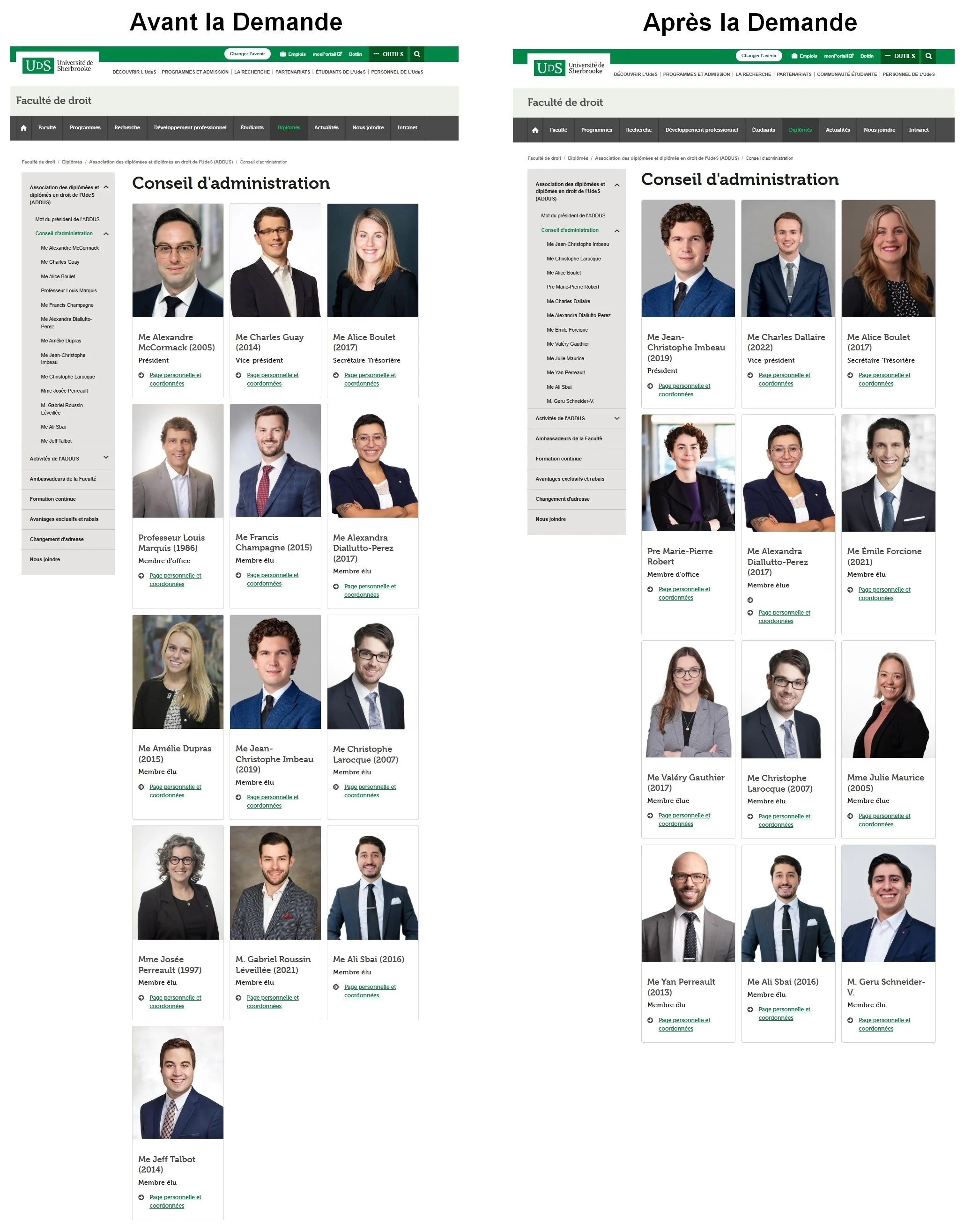
Source : Faculty of Law, University of Sherbrooke
The lawyer Audrey Campbell of the firm Cain Lamarre (the lawyer working alongside Charles Gaulin involved in the case that exposed the fraudulent schemes of the Faculty of Law's managers) has stepped down from the Board of Directors of the Sherbrooke Seminary, where she had worked closely with Dean Sébastien Lebel-Grenier for five years. The disqualification proceedings highlighted this lawyer's ties to the dean involved in the case in which she was involved.
Dean Sébastien Lebel-Grenier has also left the Board of Directors of the Sherbrooke Seminary.
In November 2023, the notary Catherine Beaumier-Dupont (who had received teaching contracts from the Faculty of Law of the University of Sherbrooke) left the law firm Cain Lamarre, after having been hired there in May 2022.
The Lawyer Rosemarie Bouchard (who had received teaching contracts from the Faculty of Law of the University of Sherbrooke) has left the law firm Cain Lamarre, after a career spanning nearly 14 years with them.
Rosemarie Bouchard's father, the lawyer François Bouchard (who had received teaching contracts from the Faculty of Law of the University of Sherbrooke), left the law firm Cain Lamarre after a career of nearly 44 years with them.
The Lawyer Valéry Gauthier of Cain Lamarre, who had joined the Board of Directors of the ADDUS following the departure of her colleague Charles Guay, has also left the Cain Lamarre firm.
After a career of nearly 36 years at Cain Lamarre, Gina Doucet, the firm's managing director who boasted about the firm's network of "contacts" (including their relations with the judiciary) and its use to pull strings and settle clients' cases, is no longer employed with the law firm.
Following the publication of this article, Charles Gaulin and Audrey Campbell, the two lead lawyers at Cain Lamarre who acted in the cases involving the University of Sherbrooke, the Faculty of Law of the University of Sherbrooke and its managers, are no longer employed with the law firm Cain Lamarre.
Furthermore, while several lawyers from the Cain Lamarre law firm risked, following the ethical infractions revealed by the disqualification case, being subject to investigations and disciplinary sanctions by the Quebec Bar, can you guess who was “elected”, at the beginning of 2025, as the big boss of the Quebec Bar? A lawyer from Cain Lamarre : Marcel-Olivier Nadeau [25].

Source : Cain Lamarre, https://cainlamarre.ca/employe/marcel-olivier-nadeau/
Furthermore, no sooner had Cain Lamarre’s Bar president taken up his position as president of the Quebec Bar that his law firm, Cain Lamarre, entered into a partnership with the Quebec Bar Foundation, whose board chair is another of Cain Lamarre's lawyers and whose governor is Jean Charest's right-hand man, Raymond Bachand [26]. Regarding this partnership, the Quebec Bar Foundation stated:
"The Foundation is pleased to announce a new partnership with the firm Cain Lamarre, whose commitment to sustainable, innovative and socially responsible legal practices aligns with our values" [27].
"The Foundation is pleased to partner with the firm Cain Lamarre, whose commitment to sustainable, innovative and socially responsible law fully alligns with our values" [28].
Part 3 of this series was particularly enlightening regarding the "legal practices" and "values" promoted by the Cain Lamarre law firm. If these are the same "values" shared by the new leadership of the Quebec Bar, then this speaks volumes about the Quebec Bar and the future of the legal profession within it.
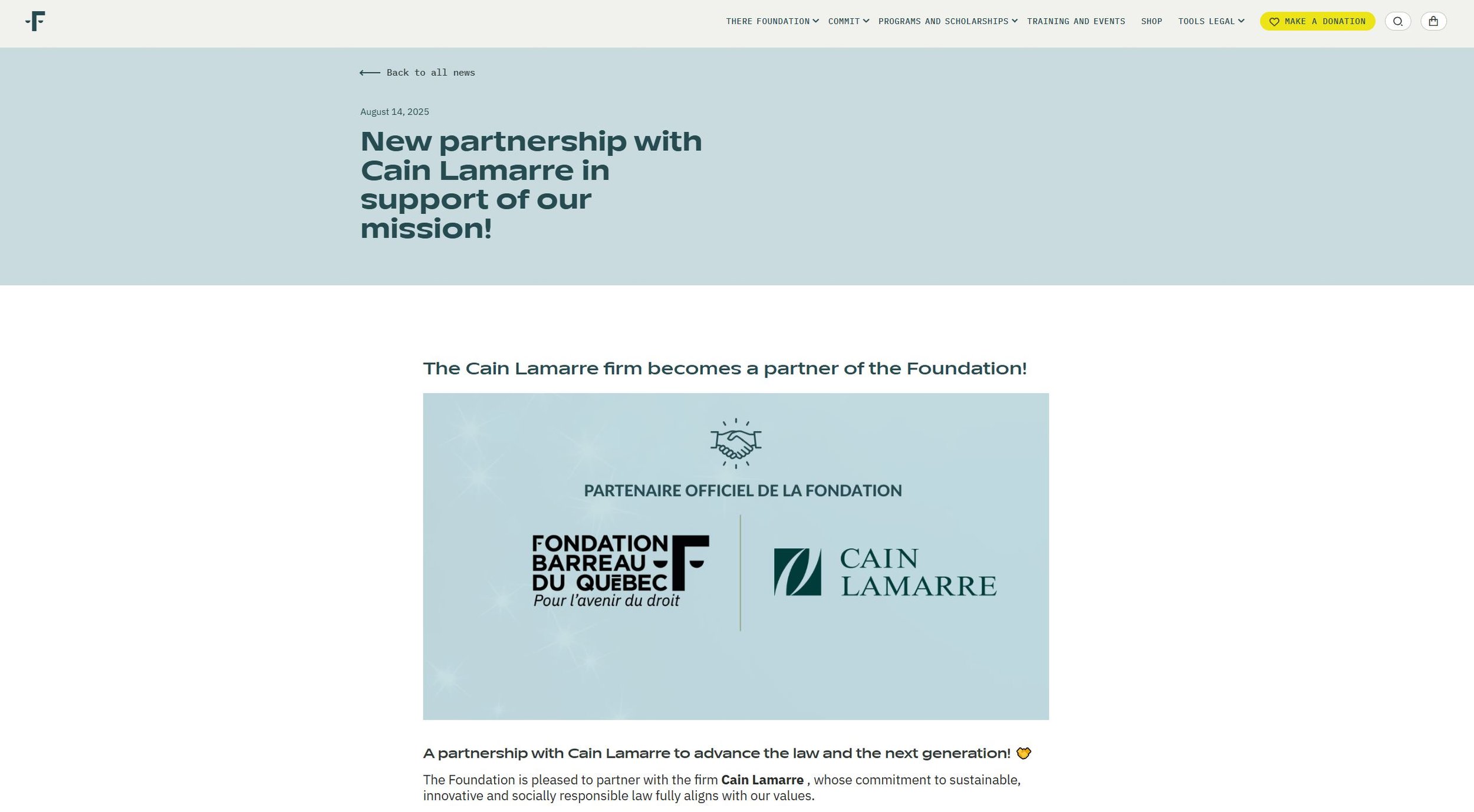
Source : Quebec Bar Foundation, https://fondationdubarreau.qc.ca/nouvelles/nouveau-partenariat-avec-cain-lamarre. Original in French. English version provided by Google Chrome Browser.


Source : Quebec Bar Foundation, Marie-Pierre Robert - Midday Web Conference, https://web.facebook.com/photo.php?fbid=1257325826422022&set
ALL ARTICLES IN THIS SERIES :
-
-
-
-
-
-
Coming soon
-
Coming soon
-
-
-
English version coming soon.
French version available here : https://www.claudiu-popa.com/publications-juridiques/decoder-la-fraude
*****
[1] Raphaël PIRRO and Charles MATHIEU, “Here are four donors to the Liberal Party appointed judges in Quebec by the Trudeau government”, Journaldequebec.com, January 30, 2025, online: ‹https://www.journaldequebec.com/2025/01/30/voici-quatre-donateurs-au-plc-nommes-juges-au-quebec-par-le-gouvernement-trudeau›; Antoine ROBITAILLE, “A majority of judges lean towards the Trudeaus”, Journaldequebec.com, March 30, 2024, online: ‹https://www.journaldequebec.com/2024/04/13/le-trudeauisme-des-juges-decortique›; Raphaël PIRRO, “Judicial Appointments: Conservatives Denounce ‘Preferential Treatment’”, Journademontreal.com, September 10, 2021, online: ‹https://www.journaldemontreal.com/2021/09/10/nomination-des-juges--les-conservateurs-denoncent-un-traitement-de-faveur-1›; QMI AGENCY, “Liberals Appoint Judges Who Are Donors to Their Party”, Journaldemontreal.com, August 9, 2023, online: ‹https://www.journaldemontreal.com/2023/08/09/les-liberaux-ont-nomme-des-juges-donateurs-de-leur-parti›; Olivier BOSSÉ, Isabelle MATHIEU and Marc ALLARD, “Minister Jolin-Barrette chose one of his friends as a judge”, Lesoleil.com, May 12, 2023, online: ‹https://www.lesoleil.com/actualites/politique/2023/05/12/le-ministre-jolin-barrette-a-choisi-un-de-ses-amis-comme-juge-TEOCOA3WBRA33J3RCK4P2B7ITU/›; Daniel LEBLANC, “A donor to the Minister of Justice’s coffers appointed to the judiciary”, Ici.radio-canada.ca, November 19, 2020, online: ‹https://ici.radio-canada.ca/nouvelle/1750496/nomination-juge-donateur-ministre-justice-lametti›; Robert JONES, “Trudeau defends judicial appointments with personal connections to Dominic LeBlanc,” Cbc.ca, July 4, 2019, online: <https://www.cbc.ca/news/canada/new-brunswick/dominic-leblanc-judicial-appointment-justin-trudeau-1.5200176>; Lee BERTHIAUME, “Judges close to LeBlanc: Trudeau defends a ‘merit-based’ system,” Lactualité.com, July 4, 2019, online: <https://lactualite.com/actualites/des-juges-proches-de-leblanc-trudeau-defend-un-systeme-base-sur-le-merite/> RADIO-CANADA, “Five close associates of Dominic LeBlanc among the six most recent judicial appointments”, Ici.radio-canada.ca, July 2, 2019, online: ‹https://ici.radio-canada.ca/nouvelle/1206442/cinq-proches-dominic-leblanc-nominations-magistrature-nouveau-brunswick›.
[2] NORTON ROSE FULBRIGHT, “Raymond Bachand”, Nortonrosefulbright.com, 2025, online : ‹https://www.nortonrosefulbright.com/en/people/130006›; John BOYKO, “Richard Wagner”, Thecanadianencyclopedia.ca, July 13th, 2023, online : ‹https://thecanadianencyclopedia.ca/fr/article/richard-wagner›.

[3] SUPREME COURT OF CANADA, “News Releases“, Decisions.scc-csc.ca, October 11, 2022, online : ‹https://decisions.scc-csc.ca/scc-csc/news/en/item/7520/index.do›; SUPREME COURT OF CANADA, “News Releases“, Decisions.scc-csc.ca, May 26, 2025, online : ‹https://decisions.scc-csc.ca/scc-csc/news/fr/item/8248/index.do›.

[4] NATIONAL SECURITY AND INTELLIGENCE REVIEW AGENCY, Review of Global Affairs Canada’s Global Security Reporting Program, NSIRA Review no 2020-01, Ottawa, December 2020, online : ‹https://publications.gc.ca/collections/collection_2024/ossnr-nsira/PS108-9-2020-eng.pdf›;
Dylan ROBERTSON, “Les diplomates qui colligent du renseignement risquent de heurter des alliés”, Lactualite.com, December 20, 2023, online : ‹https://lactualite.com/actualites/les-diplomates-qui-colligent-du-renseignement-risquent-de-heurter-des-allies/› :
OTTAWA — Canada's intelligence watchdog says a Global Affairs Canada program that allows diplomats to gather sensitive information abroad risks provoking backlash in capital cities. […] Under this program, Global Affairs Canada deploys about 30 diplomats abroad to meet with "contacts" such as activists, journalists, religious leaders, government opponents, and even armed groups. The information gathered in this way is often shared with Canada's intelligence agency, the Canadian Security Intelligence Service (CSIS) .
Leyland CECCO, “Canada intelligence operation put diplomats in legal ‘grey zone’ – report”, Theguardian.com, December 21, 2023, online : ‹https://www.theguardian.com/world/2023/dec/21/canada-intelligence-program-danger-report-china-detention› :
« A controversial intelligence-gathering program run by Canada’s foreign affairs ministry operates in a “distinctly grey zone”, puts its officers at risk and breaches global diplomatic conventions, says a damning watchdog report ».
[5] DENTONS, “Jean-Claude BACHAND”, Dentons.com , 2025, online: ‹https://www.dentons.com/fr-ca/jc-bachand›.
[6] QUEBEC COURT OF APPEAL, “Frédéric Bachand”, Courdappelduquebec.ca, 2025, online: <https://courdappelduquebec.ca/a-propos/juges-de-la-cour-dappel/frederic-bachand>; MCGILL UNIVERSITY, “Frédéric Bachand appointed to the Superior Court of Quebec”, Mcgill.ca, May 4, 2017, online: <https://www.mcgill.ca/law/fr/channels/news/frederic-bachand-nomme-la-cour-superieure-du-quebec-268006>; NORTON ROSE FULBRIGHT, “Our history”, Nortonrosefulbright.com, 2025, online: <https://www.nortonrosefulbright.com/fr-ca/declarations-mondiale/history>.
[7] QUEBEC COURT OF APPEAL, “Manon Savard”, Courdappelduquebec.ca, 2025, online: ‹https://courdappelduquebec.ca/a-propos/juges-de-la-cour-dappel/manon-savard›.
[8] Rodger BRULOTTE, “Un petit gars de Rosemont nommé recteur de l’Université de Montréal”, Journaldemontreal.com, February 20, 2022, online : ‹https://www.journaldemontreal.com/2022/02/20/un-petit-gars-de-rosemont-nomme-recteur-de-luniversite-de-montreal›.
[9] CANADIAN JUDICIAL COUNCIL, “Judicial Conduct”, Cjc-ccm.ca, 2025, online : ‹https://cjc-ccm.ca/fr/nouvelles?f%5B0%5D=news_category%3A411›; See also “Previous Complaints” of the CANADIAN JUDUCIAL COUNCIL, “Previous Complaints”, Cjc-ccm.ca, 2025, online : ‹https://cjc-ccm.ca/fr/centre-de-ressources/publications?f%5B0%5D=publication_category%3A4›; JUDICIAL COUNCIL OF QUEBEC, « Inquiry Reports », Conseildelamagistrature.qc.ca, 2025, online : ‹https://conseildelamagistrature.qc.ca/en/decisions/inquiry-reports›.
[9.1] WIKIPÉDIA, “Claude Villeneuve (juge)”, Wikipedia.org, April 6, 2026, online : <https://fr.wikipedia.org/wiki/Claude_Villeneuve_(juge)>.
[10] Apolline CARON-OTTAVI, “Le fils du juge Wagner chez Fasken!”, Droit-inc.com, December 10, 2018, online : ‹https://www.droit-inc.com/conseils-carriere/nominations/le-fils-du-juge-wagner-chez-fasken›.

[11] CAIJ, “Conseils d’administration antérieurs”, online : ‹https://www.caij.qc.ca/conseil-dadministration-du-caij/›.


[12] Robert HALL, “Sébastien Lebel-Grenier named Principal and Vice-Chancellor of Bishop’s University”, Ubishops.ca, March 23, 2023, online : ‹https://www.ubishops.ca/sebastien-lebel-grenier-named-principal-and-vice-chancellor-of-bishops-university/› :
“Professor Lebel-Grenier’s spouse Nadia Martel, who is a lawyer, graduated from Bishop’s in 1990 with a degree in Business Administration. She served with distinction on the Bishop’s Board of Governors for nine years and is currently a member of the Board of the Bishop’s University Foundation”.
FASKEN, “Me Martin F. Sheehan Ad. E.”, LinkedIn.com, 2019, online : ‹https://www.linkedin.com/posts/fasken_fasken-activity-6514142873963810816-BFIW?›.

(“lucky”, indeed…)
[13] GOVERNMENT OF CANADA, “Government of Canada announces judicial appointments in the province of Québec“, Canada.ca, March 8, 2019, online : ‹https://www.canada.ca/en/department-justice/news/2019/03/government-of-canada-announces-judicial-appointments-in-the-province-of-quebec.html›.

[14] UNIVERSITÉS CANADA, “Pierre Cossette”, Archives.univcan.ca, online : ‹https://archives.univcan.ca/fr/a-propos/conseil-dadministration/pierre-cossette-notice-biographique/›.

[15] UNIVERSITÉ DE SHERBROOKE, “Bottin - Pierre Cossette”, Usherbrooke.ca, 2025, online : ‹https://www.usherbrooke.ca/bottin/recherche/resultat/uid/730498›.
[16] UNIVERSITÉ DE SHERBROOKE, “Jean-Pierre Perreault est élu recteur de l’Université de Sherbrooke“, Usherbrooke.ca, March 20, 2025, online : ‹https://www.usherbrooke.ca/actualites/nouvelles/details/55242›.
[17] AUTORITÉ DES MARCHÉS FINANCIERS, “Kim Lachapelle”, Lautorite.qc.ca, 2025, online : ‹https://lautorite.qc.ca/grand-public/a-propos-de-lamf/haute-direction-et-audit-interne/kim-lachapelle#:~:text=De%202008%20jusqu'%C3%A0%20sa,coordination%20de%20l'ensemble%20des›.
[18] AUTORITÉ DES MARCHÉS FINANCIERS, “L’AMF et l’Université de Sherbrooke s’allient pour le développement de la finance quantique”, Lautorite.qc.ca, May 16, 2025, online : ‹https://lautorite.qc.ca/grand-public/salle-de-presse/actualites/fiche-dactualite/lamf-et-luniversite-de-sherbrooke-sallient-pour-le-developpement-de-la-finance-quantique›; UNIVERSITÉ DE SHERBROOKE, “Quand la finance côtoie la quantique”, Usherbrooke.ca, August 30, 2023, online online : ‹https://www.usherbrooke.ca/actualites/nouvelles/details/50852›; AUTORITÉ DES MARCHÉS FINANCIERS, “Programme d'excellence - L'Autorité dévoile les noms de ses nouveaux boursiers universitaires”, Lautorité.qc.ca, January 20, 2014, online : ‹https://lautorite.qc.ca/grand-public/salle-de-presse/actualites/fiche-dactualite/programme-dexcellence-lautorite-devoile-les-noms-de-ses-nouveaux-boursiers-universitaires-1›; Emeline MAGNIER, “Un nouveau programme à l'UdeS”, Droit-inc., July 7, 2014, online : ‹https://www.droit-inc.com/conseils-carriere/campus/un-nouveau-programme-a-ludes›.
[19] AUTORITÉ DES MARCHÉS FINANCIERS, “L’AMF et l’Université de Sherbrooke s’allient pour le développement de la finance quantique”, Lautorite.qc.ca, May 16, 2025, online: ‹https://lautorite.qc.ca/grand-public/salle-de-presse/actualites/fiche-dactualite/lamf-et-luniversite-de-sherbrooke-sallient-pour-le-developpement-de-la-finance-quantique›; UNIVERSITY OF SHERBROOKE, “When finance meets quantum”, Usherbrooke.ca, August 30, 2023, online: ‹https://www.usherbrooke.ca/actualites/nouvelles/details/50852›.
[20] CAIJ, “Annual Report 2016-2017”, Caij.qc.ca, online: ‹https://cdn.caij.qc.ca/assets/docs/rapports-annuels/rapport_annuel_2016-2017_web.pdf›.
[21] CAIJ, “Annual Report 2015-2016”, Caij.qc.ca, online: ‹https://cdn.caij.qc.ca/assets/docs/rapports-annuels/rapport_annuel_2015-2016_web.pdf›; CAIJ, “Annual Report 2014-2015”, Caij.qc.ca, online: ‹https://cdn.caij.qc.ca/assets/docs/rapports-annuels/rapport_annuel_2014-2015_web.pdf›.
[22] FACULTY OF LAW OF THE UNIVERSITY OF SHERBROOKE, “Juste Titre Editions”, Usherbrooke.ca , online: ‹https://www.usherbrooke.ca/droit/recherche/publications/editions-juste-titre#acc-5620-1348›.

[23]Judge Mark Schrager was the chair of the Federal Judicial Advisory Committee on for the province of Quebec, appointed to that position by Chief Justice of the Court of Appeal of Quebec Manon Savard herself. In May 2024, Judge Schrager dismissed the appeal involving the person he had recommended for appointment as a judge, who was appointed a judge on the basis of that recommendation a month later, in June 2024.
Another member of this committee chaired by Judge Mark Schrager is the lawyer Steeves Bujold, a partner at McCarthy Tétrault, a former colleague of Dean Marie-Pierre Robert's husband (Sébastien Pierre-Roy, also a former lawyer at McCarthy Tétrault), of Judge Céline Legendre (a former lawyer at McCarthy Tétrault), of Chief Justice Marie-Anne Paquette (a former lawyer at McCarthy Tétrault), of Judge Marie-Josée Hogue (a former lawyer at McCarthy Tétrault, an ambassador for the Faculty of Law of the University of Sherbrooke, and a longtime friend of Louis Marquis), of Jean Charest (a former lawyer at McCarthy Tétrault, a prominent ambassador for the University of Sherbrooke, and a longtime friend of Louis Marquis), and of Gérald R. Tremblay (a former lawyer at McCarthy Tétrault, a friend of Judge Martin F. Sheehan and his father, Judge Michael Sheehan), but also of Judge Catherine Mandeville (wife of Judge Richard Wagner and former lawyer at McCarthy Tétrault).
[24] CHARLES GUAY, “LinkedIn Profile”, Linkedin.com , 2025, online: ‹https://ca.linkedin.com/in/charles-guay-69144256›.
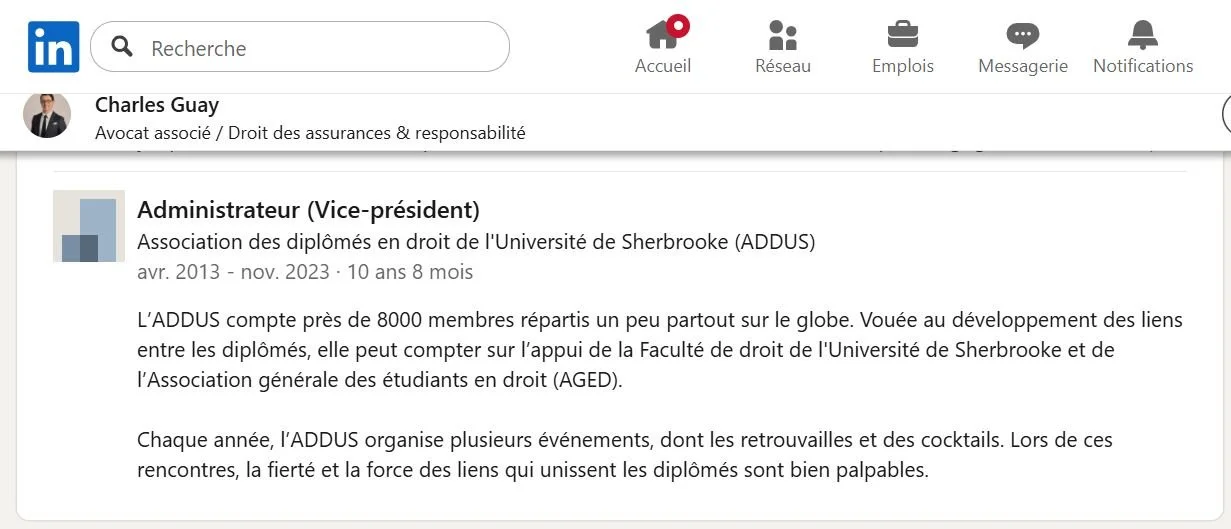
[25] QUEBEC BAR, “Meeting with the new president of the Quebec Bar”, Barreau.qc.ca, June 2, 2025, online: ‹https://www.barreau.qc.ca/fr/nouvelle/article/rencontre-nouveau-batonnier-quebec/›.
[26] THE QUEBEC BAR FOUNDATION, “Governors”, Fondationdubarreau.qc.ca, 2025, online: ‹https://fondationdubarreau.qc.ca/gouverneurs?recherche=&lettre%5B0%5D=b&page=1›.
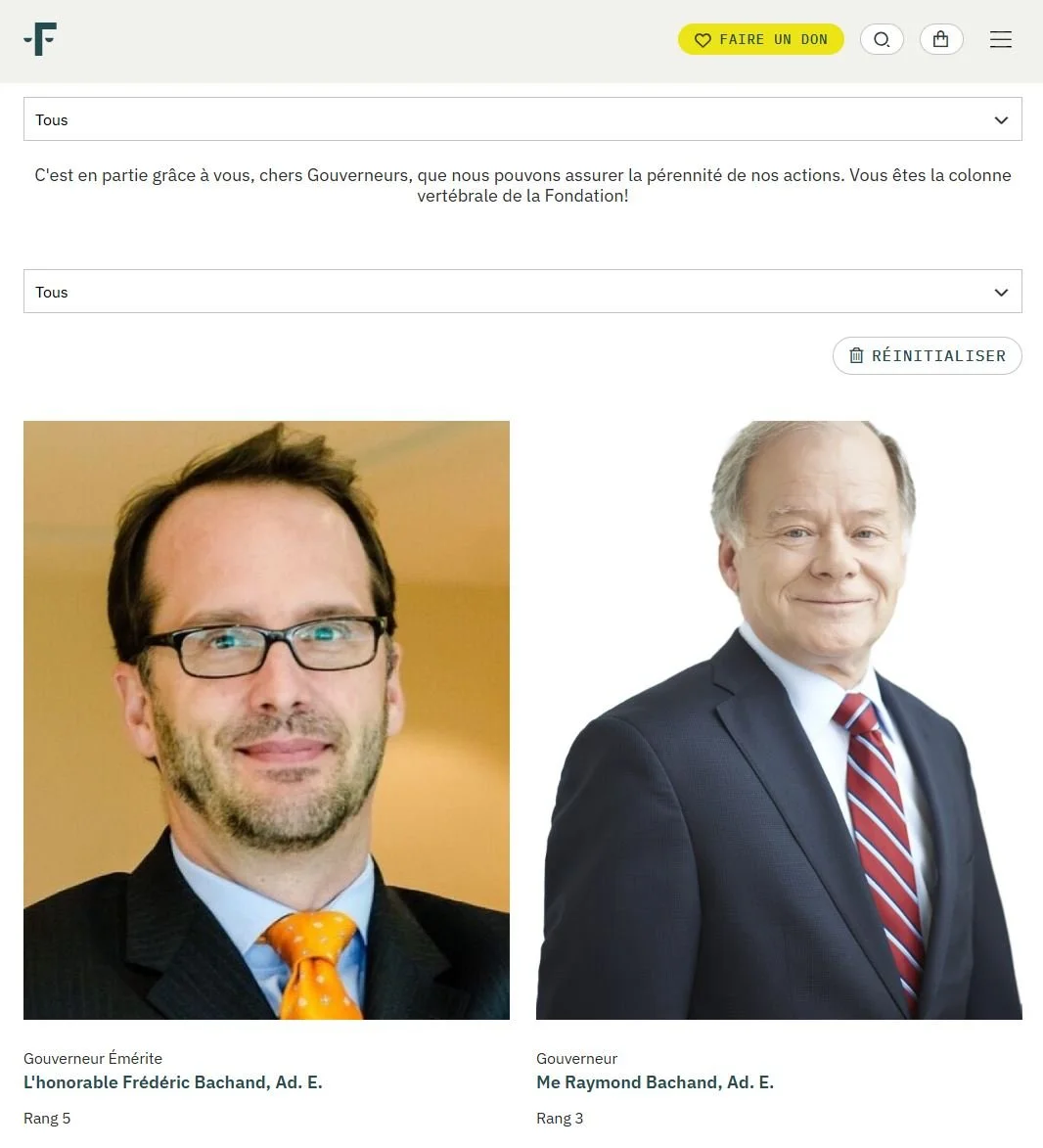
QUEBEC BAR FOUNDATION, “Composition of the Board of Directors”, Fondationdubarreau.qc.ca, 2025, online: ‹https://fondationdubarreau.qc.ca/equipe-et-conseil-dadministration›.

[27] QUEBEC BAR FOUNDATION, “A partnership with Cain Lamarre to advance the law and the next generation!”, Linkedin.com, August 2025, online: ‹https://fr.linkedin.com/posts/fondation-du-barreau-du-quebec_un-partenariat-avec-cain-lamarre-pour-faire-activity-7361750818099732481-qk0U›.
[28] QUEBEC BAR FOUNDATION, “New partnership with Cain Lamarre in support of our mission!”, Fondationdubarreau.qc.ca, August 14, 2025, online: ‹https://fondationdubarreau.qc.ca/nouvelles/nouveau-partenariat-avec-cain-lamarre›.